Newsletter Marketing Strategy: Email & Customer Retention

AI summary
- Rising advertising costs on Meta and Google force companies to use retention marketing through email and WhatsApp to turn first-time buyers into loyal repeat customers.
- Every year 2-3% of all email addresses become inactive, making list cleaning essential; Gmail classifies senders as spam when only 10% of 100,000 weekly emails are opened.
- Optimal subject line length is 38-45 characters for mobile devices; increasing popup opt-in from 1% to 4% and email conversion from 10% to 30% achieves five-figure monthly differences.
- Newsletter marketing strategy requires five essential automated flows: welcome, abandoned cart, post-purchase, win-back, and browse abandonment flows that deliver continuous results without manual effort.
Generated with AI, the details are in the article.
Table of contents
Introduction
A well-thought-out newsletter marketing strategy is today one of the strongest levers in e-commerce – and at the same time one of the most underestimated. Rising advertising costs on Meta and Google are forcing companies to finally make strategic use of their existing customer data. Email marketing and WhatsApp marketing – collectively referred to as retention marketing – make it possible to turn first-time buyers into loyal repeat customers.
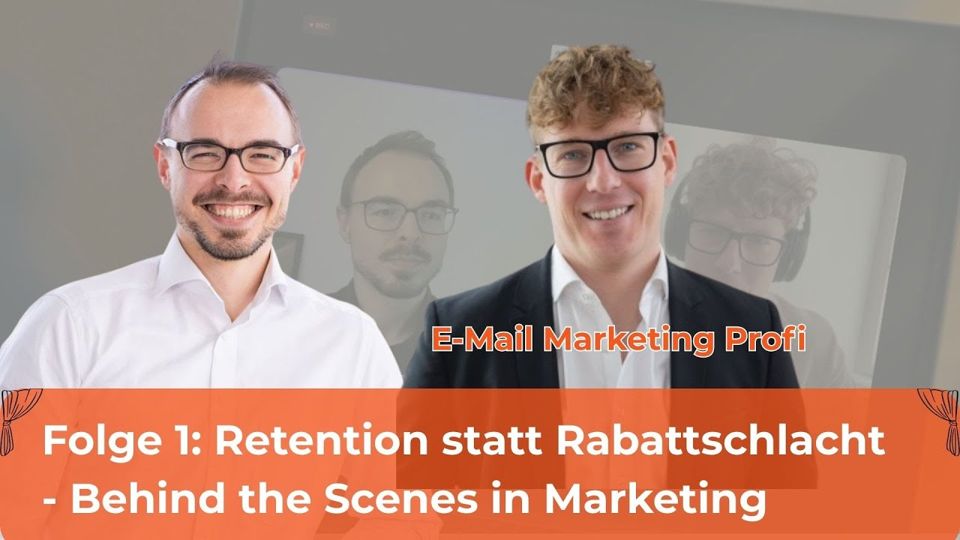
In the first episode of the podcast Behind the Scenes in Marketing, host Antonio Blago speaks with Robert Kraxner, who has been 100% specialized in retention marketing in e-commerce for years. The conversation delivers concrete strategies, typical mistakes, and tangible benchmarks – not gut feelings, but numbers, data, and facts.
To the podcast episode:
What is retention marketing – and why is it so often underestimated?
Retention marketing describes all measures aimed at retaining existing customers and encouraging repeat purchases. In practice, these are primarily email marketing and WhatsApp marketing. That sounds unspectacular – and that's exactly the problem.
„Email marketing? Nobody's interested in that. I don't even read newsletters myself." – According to Robert Kraxner, this statement comes up at almost every industry event.
Yet the numbers regularly disprove this misconception. Those who use emails strategically accompany customers precisely during the phases of the customer journey when they are most receptive to relevant content. Kraxner himself describes how, as a private customer, he ordered dietary supplements and actually read the follow-up emails – because they were relevant and helpful.
Another underestimated aspect: even unopened emails have value. They appear in the inbox and serve as a reminder of the brand – much like a billboard on the side of the road.
Visibly AI: your SEO copilot
Projects, rankings, Search Console data and a copilot that runs the analysis for you. Start for free.
The most common mistakes in newsletter marketing strategy
Mistake 1: Dirty data and neglected lists
The foundation of any successful newsletter marketing strategy is a clean data base. Many companies have been collecting email addresses for years without ever cleaning up their lists.
The result: email providers such as Gmail, Outlook, or GMX classify the sender as a spam candidate when only a fraction of recipients open the emails.
„When Gmail sees that 100,000 emails arrive per week but only 10% are opened, you'll eventually end up in the spam folder."
Important to know: Every year, 2–3% of all email addresses become inactive – because people change jobs, inboxes fill up, or addresses are simply forgotten.
Mistake 2: Lack of segmentation
Treating all contacts the same way means wasting enormous potential. Kraxner uses the example of a sporting goods retailer with 50,000 contacts: it makes a huge difference whether someone plays tennis, golf, or volleyball – and emails should be segmented accordingly.
Good segmentation criteria in e-commerce:
– Purchase status: First-time buyers vs. existing customers
– Product interests: Which categories were viewed or purchased?
– Purchase frequency: How often were orders placed?
– Engagement: Who opens emails regularly, and who never does?
Mistake 3: Flows that nobody checks
Many automated email sequences are set up once by the intern at the time and never touched again. The result: outdated content, broken links, and flows that no longer align with the current brand strategy.
„I had a marketing manager who told me: I don't even dare to open our own emails myself."
Mistake 4: No tracking, no learning
Without documented campaign data, every plan is guesswork. Anyone who starts from scratch every year at Black Friday because nobody evaluated the previous year's results is wasting valuable time and money.
The right setup: building a newsletter marketing strategy from scratch
For companies that are just starting out, Kraxner recommends a pragmatic approach without overengineering. A solid newsletter marketing strategy begins with the right basic flows.
The essential basic flows
- Welcome flow – for new leads who haven't made a purchase yet
- Abandoned cart flow – for visitors who abandoned the purchase process
- Post-purchase flow – for recent buyers immediately after their order
- Win-back flow – for customers who haven't been active for a long time
- Browse abandonment flow – for visitors who viewed products but didn't buy
These flows are set up properly once, then run automatically and deliver results continuously – without any manual effort.
„Set up the basic flows, let everything run, and observe. Only then move on to optimization."
When does deep optimization pay off?
Beyond a certain size – for example, 100,000 page views per month – even small improvements can have a massive impact. Kraxner calculates: anyone who increases the opt-in rate of their popup from 1% to 4% while simultaneously improving email conversion from 10% to 30% achieves a difference in the five-figure euro range – monthly.
Email marketing customer retention: subject lines as an underestimated lever
Many teams put hours of work into the design and copy of an email – and then hastily type the subject line at the last minute. This is a costly mistake, because the subject line determines whether the email gets opened at all. For sustainable email marketing customer retention, it is the first and most important element.
Kraxner's four most important rules for strong subject lines:
-
Recognizability: Recipients must immediately recognize which brand the email is from. A subject line like "Hey, glad you're here" without a sender name is worthless.
-
Character count: The optimal length is 38–45 characters. On mobile devices – where the majority of emails are opened – anything beyond that gets cut off.
-
Caution with emojis: Modern emojis are displayed as unreadable squares in older email clients like Outlook and can appear spammy. Better: use standard emojis sparingly or avoid them altogether.
-
Balance between informative and curiosity-driven: A good mix of informative and curiosity-provoking subject lines keeps readers interested in the long term. Persistent clickbait-style subject lines destroy trust.
Plain text vs. HTML: when each makes sense
This debate is omnipresent in email marketing. Kraxner's pragmatic answer: it depends on the use case.
HTML emails make sense when:
– Dynamic content is being pulled in (e.g., the most recently purchased product)
– Personalized product recommendations are to be displayed
– Graphics and brand-compliant designs are absolutely required
Plain text emails are better when:
– A personal, direct form of communication is desired
– Compatibility issues need to be avoided
– HTML rendering causes problems in certain email clients
A well-known issue: in many corporate email clients, images and HTML elements are blocked by default – rendering elaborately designed HTML emails unreadable.
List hygiene and deliverability: the technical foundation of newsletter marketing strategy
The best campaign is useless if emails end up in the spam folder. Technical cleanliness is an indispensable part of any newsletter marketing strategy. Kraxner distinguishes between two important concepts:
Shared IP: Multiple senders share the same IP address when sending emails. If another user abuses the IP (e.g., by sending to purchased lists), the deliverability of all senders suffers.
Dedicated IP: The IP address belongs exclusively to the sender. Full control, but also full responsibility – and only worthwhile above a certain sending volume.
As recommended tools, Kraxner mentions:
– Maileon (for the German-speaking market, GDPR-compliant, with its own deliverability infrastructure)
– Klaviyo (widely used internationally, extensive segmentation and automation features)
Target audience psychology: the neuromarketing perspective
For truly targeted communication, Kraxner recommends the model of neuromarketing researcher Georg Häusel, who describes various psychological buyer types:
| Type | Characteristics | Example brand | Implication for email |
|---|---|---|---|
| Performer | Benefit- and status-oriented, minimal text | Audi | Elegant design, strong headlines |
| Analyst | Data-driven, detail-oriented | Volvo | Plenty of facts, studies, specifications |
| Hedonist | Variety-seeking, impulsive | Varies | Difficult for retention – low brand loyalty |
„The analytical type buys Miele once and keeps buying Miele. The hedonist buys from you today and from a competitor tomorrow – simply because they could."
This insight has a direct impact on strategy: not every target group is equally well suited for email marketing customer retention. This must be taken into account when positioning.
Content as fuel for email marketing customer retention
Email marketing and content marketing are not separate worlds – they complement each other perfectly. A clever newsletter marketing strategy uses content in a targeted way to deliver real added value and strengthen customer loyalty.
SEO articles as an entry point
Anyone who arrives at a blog article via a Google search result has a clearly identifiable need. This need can be directly addressed in the welcome flow – with matching content and offers.
Example: An article about "10 tips for a better tennis serve" is combined with a thematically fitting opt-in form. The welcome flow picks up on exactly this interest.
Enriching the post-purchase flow with content
After a purchase, customers want to know how to get the most out of the product. Rather than leaving them to figure it out on their own, well-structured post-purchase flows deliver the answers proactively:
- Instructions and
Brand Radar: where does your brand stand?
Brand and generic traffic, competitors and potential at a glance, free of charge.

About the Author: Antonio Blago
SEO Freelancer & AI Visibility Expert
I optimize SEO data-driven with Python, behavioral psychology, and my Neuro-SEO System®. On YouTube, LinkedIn, and Instagram I share hands-on tutorials, insights, and SEO strategies.