Vacation Rental SEO: How Jacek Builds 100,000 Clicks with SEO

AI summary
- Jacek built Fewolino to help vacation rental landlords generate 100,000 annual clicks through Google, YouTube, and direct bookings instead of relying on Airbnb.
- After initially operating as a generalist agency with 20,000 EUR monthly revenue, Jacek specialized exclusively in vacation rental SEO following partner Agnes's feedback.
- Jacek's organic growth required 150 blog articles and YouTube videos, taking 12 to 16 months before the first organic leads arrived in 2023.
- Jacek transitioned from cold calling 200 prospects to building sustainable SEO and YouTube assets that generate passive leads without paid advertising investment.
Generated with AI, the details are in the article.
Table of contents
Vacation Rental SEO: How Jacek Builds 100,000 Clicks with SEO
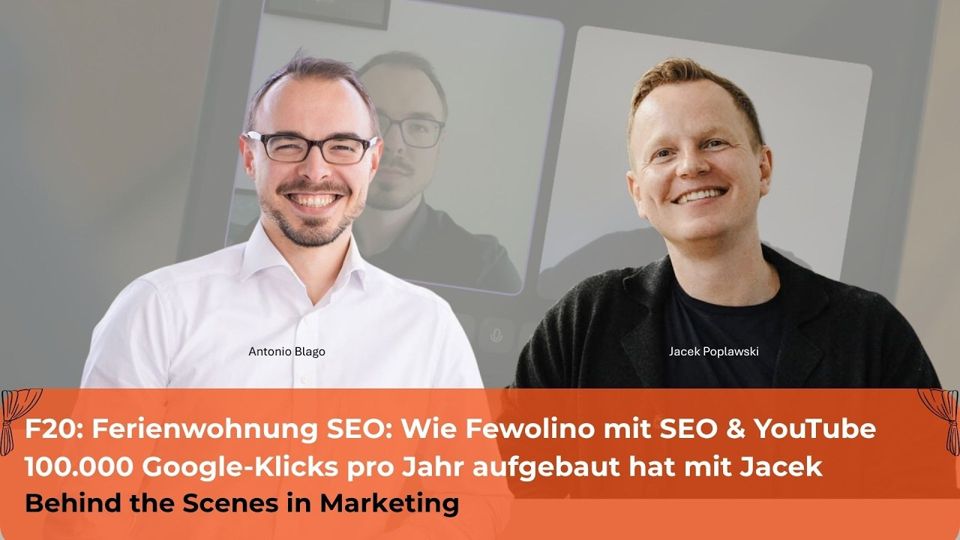
Jacek and I have known each other for a while through LinkedIn. We've spoken on the phone a few times over the years – sometimes about SEO, sometimes about vacation rental SEO. At some point it became clear: I had to invite him on the podcast. What drew me to his story isn't just the result – the 100,000 clicks per year in a relatively small niche. What I was most interested in was how he got there. Because the journey was anything but straightforward.
The video:
Who Is Jacek and What Does Fewolino Do?
Jacek is co-founder of Fewolino and works together with his partner Agnes. The two of them help landlords of vacation apartments, holiday homes, and serviced apartments generate more direct bookings through Google, YouTube, and their own website – rather than remaining permanently dependent on platforms like Airbnb.
The name Fewolino comes from two directions: "Fewo" stands for Ferienwohnung (vacation apartment), as it's abbreviated in northern Germany, and the "ino" at the end is inspired by Italian culture. Bambino, Piccolino – that sort of thing. Honestly, I think the name is pretty great, from an SEO perspective too. A distinctive brand that sticks in your memory.
Jacek was born in Poland, grew up in the Oldenburger Münsterland region, and has been self-employed since 2019. He and Agnes founded the company six months before Corona. I don't think I need to elaborate on what that meant.
The Career Before Fewolino: Intel, Startup, Booking.com
Before we talked about SEO, Jacek and I took the time to understand his path to get there. And it's a genuinely interesting one.
He started at Intel as a working student, then worked his way up to Senior Finance Analyst. A permanent contract at a global corporation. And then he quit, because a friend had won him over with a Berlin startup. The startup was called Karubi, tried to build something like a Booking.com for auto repair shops, and no longer exists today.
As Jacek himself puts it:
"In those 12 months at the startup, more happened than in almost four years at Intel."
I believe that immediately. I know the feeling of switching from a corporate structure to a startup. The learning curve is brutal, but also really rewarding.
After the startup, Jacek landed at Booking.com as an Account Manager. There he didn't just learn how the extranet works and what products Booking offers. He also figured out how to achieve over 90 percent occupancy at his parents' holiday home. That was the seed for everything that came later.
His contract with Booking was not renewed after an internal restructuring. At the time, he was very disappointed. Looking back, he says it was the best thing that could have happened to him.
Visibly AI: your SEO copilot
Projects, rankings, Search Console data and a copilot that runs the analysis for you. Start for free.
The Airbnb Arbitrage Model: Opportunities and Limitations
Anyone who seriously thinks about vacation rental SEO quickly encounters a central question: how sustainable is this business model really?
The Airbnb arbitrage model works like this: you rent an apartment on a long-term lease and sublet it short-term through Airbnb – with the goal of keeping the difference between rent and income as profit. Sounds simple, but it isn't. Anyone who wants to stay profitable long-term needs more than just a good location. They need occupancy, processes, and – increasingly important – visibility beyond the platform.
That's exactly the point where Jacek's story becomes relevant. He recognized that platform dependency in vacation rental SEO is a structural risk. Platforms change their algorithms, increase their fees, and favor certain listings. Anyone who is only visible there is building on someone else's land.
Direct Booking Inquiries: Moving Away from Platform Dependency
One concept that keeps coming up in Jacek's work: direct booking inquiries. Not as a platform channel, but as a goal. Landlords who generate direct booking inquiries through their own website pay no commission, build their own brand, and have direct control over prices and availability.
That's the strategic core of Fewolino: making landlords more independent. Anyone running a vacation rental SEO model can benefit long-term by simultaneously building their own digital presence that enables bookings without a platform intermediary.
The Jack-of-All-Trades Phase and the Insight That Changed Everything
Jacek and Agnes initially launched Fewolino as a classic generalist agency. Websites, social media marketing, clients from all sorts of industries. A dentist from Poland, a tiler from Germany, a performance agency. A bit of everything, as long as it generated revenue.
In 2021 they had a month with nearly 20,000 EUR in revenue. Sounds good, right? But it really wasn't. Because every client was different, every project ran differently, and fulfillment was complete chaos.
Then came the sentence from Agnes that Jacek mentioned twice during our conversation:
"Fewolino is not fun anymore."
That hit home. They went looking for a coaching program and worked with Marcel and Alexander from Agentur Consulting. The recommendation was clear: specialize. Either social media marketing as a service, or the vacation rental niche where you have a real story and real expertise.
They chose the vacation rental niche. And they went all in.
Cold Calling as a Starting Point: What Actually Worked
After repositioning, Jacek and Agnes didn't get a single organic lead at first. That's normal. SEO takes time. Their coach also told them clearly: don't start with SEO, start with sales. You need to make money.
So Jacek did cold calling. Pick up the phone, call cold, face rejection, keep going. He talks about 200 calls, many failures, and the decisive moment when the eleventh script finally worked.
What made the difference? A single sentence:
"We're former Booking.com and Zalando employees and we help landlords achieve XY."
As soon as potential clients heard "ex-Booking," they sat up and paid attention. That was the button, as Jacek calls it. And once you've found a button, you keep pressing it until nothing comes out anymore.
He incorporated this directly into all his marketing. Every video, every blog article, every mention. I think that's smart, because it doesn't feel forced. It's simply a genuine part of his story.
Two things Jacek learned from cold calling:
- Avoid small fish: Calling Google Maps leads barely worked. It wasn't until he switched to GmbHs using North Data that better results came in.
- The script is everything: Not the first attempt, but the eleventh one worked. Cold calling is a craft you learn.
What he sees as a mistake in hindsight: he should have handed off the working script to a working student sooner and scaled it. That's a point I know very well from my own experience. When something works, systematize it instead of continuing to do it yourself.
Organic Growth: How 150 Blog Articles and YouTube Build 100,000 Clicks
This was the most exciting part of our conversation for me. Jacek showed me the Sistrix screenshot and you can see pretty clearly when the dam broke.
At the end of 2022 the first blog articles went online. January 2023 the first YouTube video. And then it took time. Not weeks, but months. About 12 to 16 months before the first organic leads came in.
The way Jacek describes it really resonated with me:
"You're creating something that pays you dividends permanently. You get that drip, drip, drip the whole time."
That's exactly how I see it too. SEO isn't a campaign you switch on and off. It's an asset you build. Just as a successful vacation rental SEO business stands on a solid foundation, organic marketing takes time, patience, and consistency.
Today clients come through Google, through YouTube, and recently also through ChatGPT. Jacek asks every new lead: "How did you find us?" He enters it into the CRM. That sounds simple, but it's one of the most underrated marketing levers there is.
What he's observed:
- Older domains have a real advantage over newer ones
- YouTube and Google SEO together are stronger than either channel on its own
- Some clients come back two years after the first contact, because they weren't ready at the time
His tip for everyone just starting out: buy the domain now, even if you won't launch for another six months. Put it online, even just in maintenance mode. Domain age counts.
The Airbnb Arbitrage Model and the Role of YouTube SEO
This is where things got really interesting for me. Jacek described how a simple iPhone video about Booking.com extranet optimization reached 10,000 organic views without a single EUR in ad spend. And that changed everything.
Anyone who wants to run the Airbnb arbitrage model long-term can't avoid building their own brand. YouTube is an underestimated channel for this – especially in the vacation rental niche, where not everyone is playing this combination yet.
What many people don't realize: YouTube videos show up in Google search results. So if you have a blog article on a topic and a matching YouTube video to go with it, you can theoretically appear twice in the search results. That's a genuine advantage.
Jacek sees it this way:
"If you have good SEO, you also have GEO. Good SEO and good content make you visible for AI searches too."
That aligns with what I'm observing myself. Anyone optimizing for Google today will also be visible for ChatGPT and other AI tools tomorrow. The foundation is the same: trustworthy, helpful content.
What Specialization Really Means
I asked Jacek whether he ever regretted committing so narrowly to the vacation rental niche. His answer was unequivocal: no. But he also admitted it was hard.
He still receives inquiries from clients in other industries today. And every time he has to say no, even though the leads are there and the money is tempting. That's perhaps the hardest discipline in entrepreneurship.
What struck me: he had a clear time horizon from the start. He told Agnes: "We're going to count this out for five years." Not "let's see how it goes." A concrete commitment.
That's a real difference. Anyone who gives up on SEO and content marketing after three months because no leads have come in yet hasn't understood the game. The moat Jacek has built is not replicable. You can copy his texts, imitate his design, but you can't copy his story, his domain authority, his YouTube subscribers.
My Key Takeaways from the Conversation
If I make a list from our conversation, it's this one:
These are the five points I noted down immediately:
- Specialization requires a time commitment. Not "I'll give this a try," but "I'm doing this for five years."
- Cold calling works, but the script has to be right. Iteration is everything. Don't give up after the first or second attempt.
- Your personal background is your marketing asset. "Ex-Booking employee" isn't a coincidence – it's deliberately deployed positioning.
- SEO and YouTube together build a moat. That's significantly more valuable long-term than paid ads – and more stable than any vacation rental SEO model without its own brand.
- Track where your clients come from. Not as a statistic, but actually ask, listen, write it in the CRM.
Conclusion
What I like about Jacek's story is the honesty. He doesn't just talk about the 100,000 clicks. He talks about the crises before that, about the cold calling he hated, about the moments when nothing was working. And that's exactly what makes the story valuable.
Vacation rental SEO can be a solid entry point into the holiday property business. But anyone who wants to stay independent and profitable long-term needs more: their own brand, organic visibility, and direct booking inquiries without platform fees. Jacek has demonstrated this impressively.
Organic marketing isn't a trick. It's work, patience, and the willingness to commit to a niche – even when it feels uncomfortable at first.
Here's the direct link to the podcast episode: Vacation Rental SEO with Jacek from Fewolino on YouTube
And here's where you can find Fewolino: fewolino.com
FAQ: Frequently Asked Questions about Vacation Rental SEO
What is vacation rental SEO and how does the model work?
In the vacation rental SEO model, you rent an apartment on a long-term lease and sublet it short-term through Airbnb. The difference between the rent and your income is your profit. The Airbnb arbitrage model is particularly attractive because you don't need to own any real estate – but it requires consistent management, high occupancy, and increasingly a brand strategy of your own beyond the platform.
How long does it take before SEO actually generates leads?
Jacek and I talked about this in detail. At Fewolino it took about 12 to 16 months before the first organic lead came in through Google. That's not unusual. Anyone who takes SEO seriously plans for at least a year before the curve clearly starts moving upward. Taking a quick look and then giving up is the most common mistake.
How can vacation rental SEO help me become more independent from platforms?
The crucial step is to build your own website alongside your platform presence, one that generates direct booking inquiries. That way you're not exclusively dependent on Airbnb and you save on commission costs. SEO and YouTube are the most sustainable channels for this – as Jacek's example shows.
Does the Airbnb arbitrage model work long-term?
The Airbnb arbitrage model is profitable in the short term, but structurally risky if you rely exclusively on the platform. Algorithm changes, rising fees, and increased competition can quickly squeeze your margins. Anyone who wants to succeed long-term combines vacation rental SEO with their own brand strategy and organic visibility.
What's the difference between direct booking inquiries and Airbnb bookings?
With direct booking inquiries, guests book directly through the landlord's website, without platform commission. For landlords this means higher margins and direct customer communication. For vacation rental SEO operators, this is the next strategic step: moving away from pure platform dependency toward their own booking infrastructure.
How do YouTube and Google SEO complement each other in vacation rental marketing?
YouTube videos appear in Google search results. Anyone who has a blog article on a topic and a matching YouTube video can potentially appear twice in the search results. Jacek uses this deliberately: the blog for depth, YouTube for personality and reach. Together they build an authority that would be very expensive to replicate with paid advertising – and that secures any vacation rental SEO business for the long term.
How visible is your brand in ChatGPT and friends?
The AI Check shows you within minutes whether and how AI assistants mention your brand.

About the Author: Antonio Blago
SEO Freelancer & AI Visibility Expert
I optimize SEO data-driven with Python, behavioral psychology, and my Neuro-SEO System®. On YouTube, LinkedIn, and Instagram I share hands-on tutorials, insights, and SEO strategies.