Should You Switch SEO Agencies? 7 Diagnostic Questions Before You Quit

AI summary
- Business owners investing tens of thousands of euros in German SEO agencies report no rankings, no additional traffic, and no new inquiries after six months.
- 90% of agency-switching decisions are made too late, with sufficient warning signals appearing by month three that should trigger action.
- Paying an agency 1,000 euros per month provides roughly one working day of effort monthly, which is insufficient to meaningfully improve rankings.
- A good SEO consultant differs through direct communication without project management layers, strategy prioritized before execution, and integrated classic SEO plus AI visibility planning.
Generated with AI, the details are in the article.
Table of contents
Three agencies. Six months. No results. That's the most honest summary I've read about German SEO agencies on Gutefrage and Reddit over the past few months. Business owners who have invested tens of thousands of euros see no rankings, no additional traffic, no new inquiries – and in the end, the agency blames Google, the market, or the product.[1]
If you're currently thinking about canceling your SEO agency: don't act hastily. Before you send that cancellation letter, work through the following seven diagnostic questions. They'll show you whether your agency is really the problem – or whether you have the wrong expectations, the wrong setup, or simply need a different kind of support.
Key takeaway: 90 % of all agency-switching decisions are made too late. Those who are struggling after six months without results usually had enough signals by month three to pull the plug – or not. The seven questions below are your early warning system.
Why so many SEO agencies fail
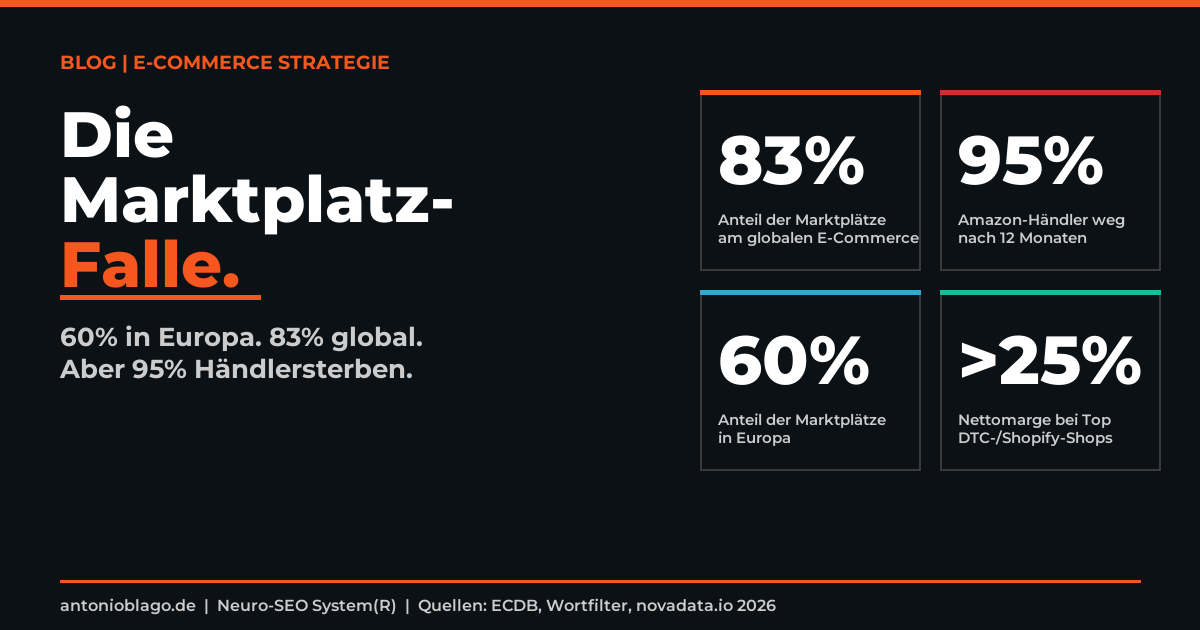
Anyone searching German forums for SEO agency experiences will find four patterns that repeat themselves almost word for word:[2]
- Activity instead of results. Reports full of completed tickets, but no measurable rankings. The agency delivers output, not outcomes.
- Strategic vacuum. Backlinks are purchased before the low-hanging fruit has even been identified. Customer journey, search intent, content structure – nowhere to be found.[1]
- Content at school essay level. Texts that don't even meet basic editorial standards. Bought from content marketplaces, reviewed by no one.[1]
- Pseudo-agencies. Individuals who present themselves more professionally with a "we" than their setup actually warrants – and who blame overseas support when problems arise.[1]
Alongside this, there's a structural problem: anyone paying an agency 1,000 euros per month and expecting miracles is almost inevitably going to be disappointed. That amounts to roughly one working day of effort per month – not enough to meaningfully move rankings.[3] So the problem isn't always the agency. Sometimes it's also the price-to-performance setup.
The 7 diagnostic questions before you switch
1. Have you agreed on clear, written KPIs?
Not "more visibility," not "better rankings" – concrete numbers: organic traffic after 6 months, top-3 placements for X focus keywords, growth in qualified leads. If the KPIs are vague, any dispute later becomes a matter of interpretation. And the agency almost always wins that dispute.
2. Is there a written monthly delivery plan?
Good service providers send a list at the start of each month: "Here's what we'll do in May." At the end of the month, there's a comparison: "Here's what we delivered." Anyone who has only seen internal "setup phases" after six months but no concrete deliverables doesn't have an agency problem – they have a transparency problem.[4]
3. Are the focus keywords commercially relevant?
A classic mistake: the agency gets you to position 1 for terms that nobody searches for – or that have search volume but no purchase intent. Try the reverse test: which keywords would your ideal customers actually type in right before they buy? Does your site rank for those terms? If not: it doesn't matter what numbers the agency reports – you're chasing the wrong goal.
4. Do you have access to Google Search Console and GA4?
If you can't see the raw data yourself, you're only seeing the story the agency wants to tell you. Demand read access. If that's not possible "for technical reasons," that's a red flag.
5. Does your contact person understand your business – or are they just processing tickets?
Ask at your next meeting: "What do you think makes our customers buy from us?" If a precise answer doesn't come within 30 seconds, you're working with a ticket processor, not a strategist. Without an understanding of your business, no SEO strategy can work.
6. Is there a cohesive thread running through the work, or just individual measures?
Backlinks, meta tags, technical audits – these are tools, not a strategy. Good support starts with a keyword topic architecture, a prioritization based on search intent, and a content plan built on top of that. If instead you're getting new isolated measures every month with no recognizable plan, that's not strategy. That's busywork.
7. Is AI/GEO visibility part of the strategy?
By 2026, no SEO project ends at Google anymore. ChatGPT, Perplexity, Google AI Overviews, and Gemini are increasingly answering search queries without anyone clicking through to your site. If your agency has no plan for how your brand appears in these AI responses – think GEO, AEO, Neuro-SEO – you're working with a provider that got stuck in 2020.
Quick test: If you can't answer a clear "yes" to 3 or more of these 7 questions, you have an agency problem. If you get stuck on 5+, that client conversation should happen this week – not next quarter.
Stay, switch, or bring in a freelancer?
The diagnosis is done. Now for the decision. Three scenarios cover 90 % of cases:
Scenario A: Expectation problem – stay, but recalibrate
You have a tight budget (< 1,500 euros per month), clear KPIs don't yet exist, but the agency is fundamentally credible and communicates openly. Solution: a new briefing with hard KPIs, monthly deliverables in writing, quarterly review. Not every disappointed client needs a new agency – some just need a better contract.
Scenario B: Structural problem – switch
The agency has delivered no measurable results for 6+ months, has no recognizable strategic thread, and communication is non-transparent. Your action plan: request a data audit of the work done so far (GSC history, indexed pages, backlink profile), cancel at the earliest possible date, and put out a new brief – this time using the 7 questions above as a filter.
Scenario C: Strategic deficit – freelancer or specialist instead of agency
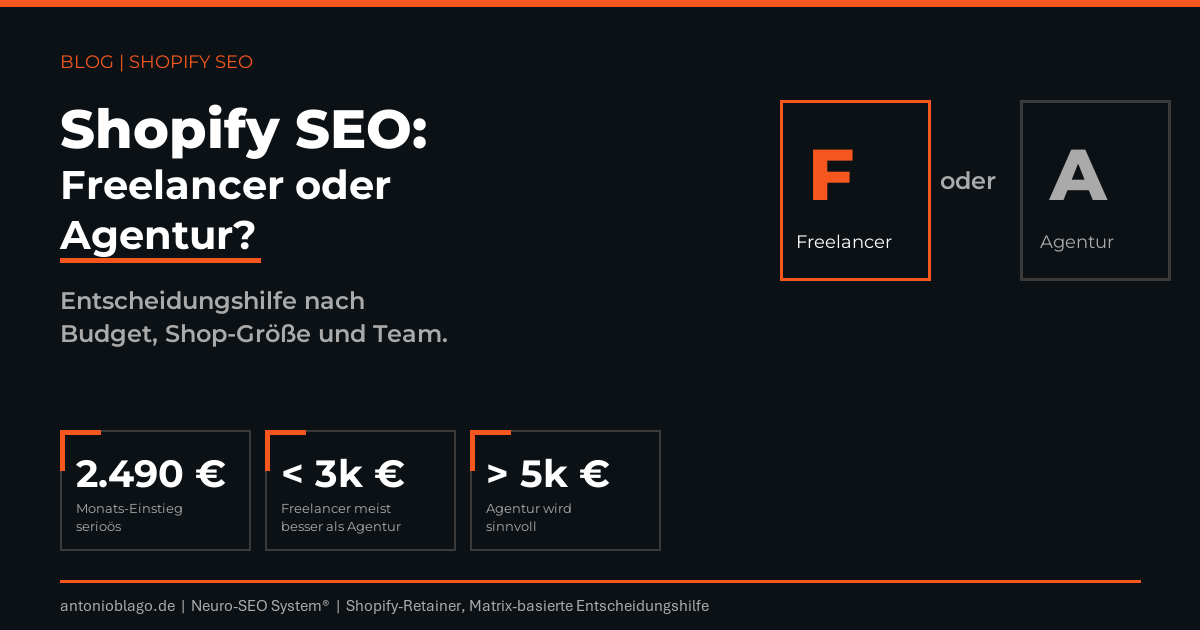
You need less execution and more thinking. You want a dedicated contact who understands your business, not a project manager forwarding tickets from production. In that case, a freelance SEO consultant on a retainer model is a better fit: the same monthly investment, more strategy, direct communication, no intermediate layer.
What a good SEO consultant does differently
From my work with e-commerce shops and B2B service providers, I see three levers that distinguish a retainer SEO consultant from a traditional agency – especially if you've already been let down once:
- One contact person, no project management layer. You communicate directly with the person doing the work. No handoffs, no loss of information in translation.
- Strategy first, execution second. Before a single backlink is built or a blog article is written, there's a keyword topic architecture in place that's oriented around the customer journey and search intent – not search volume alone.
- Classic SEO + AI visibility as a system. Google rankings remain important, but ChatGPT, Perplexity, and Google AI Overviews are becoming a second front. A modern SEO retainer covers both – not as an add-on, but as an integrated strategy.
This is the core of the Neuro-SEO Systems® framework I work with: classic on-page– and off-page work, combined with content optimization for AI answer systems and psychological principles of search intent. Not for every shop, not for every budget – but for business owners who value transparency, strategy, and a direct point of contact more than the agency logo on their invoice.
Key takeaway: Before you cancel your SEO agency, work through the 7 diagnostic questions. The decision between staying, switching, and going freelance then becomes rational rather than emotional – and you avoid the most costly mistake: running into the same problems all over again with the next agency.
Here's how your visibility compares
Before you speak with a new provider, it's worth taking a look at your domain's baseline data: where do you actually stand, which keywords are driving your traffic, and how do competitors in your market segment look?
Want to know whether your current SEO provider is really doing their job – or whether you'd be better off with a retainer model? Book a free initial consultation and we'll go through the 7 questions together using your actual data.
Sources
- Rauschsinnig – SEO agency experiences – bad experiences with dubious agencies in Germany. rauschsinnig.de
- Gutefrage.net – Thread collection "What experiences have you had with SEO agencies?" and "Has anyone had good experiences with an SEO agency??". gutefrage.net
- SEOagentur.de Magazin – Top 10 complaints about SEO agencies and solutions for businesses. seoagentur.de
- Search Engine Land – How to work with your SEO agency to drive better results, faster. searchengineland.com
- Peec AI Forum Analysis – Own evaluation of Reddit and Gutefrage threads on "SEO agency no results" and "switching SEO agency", April 2026.
Free SEO tools
Keyword ranking, SSR text check, sitemap audit and more, right in the browser and without signup.

About the Author: Antonio Blago
SEO Freelancer & AI Visibility Expert
I optimize SEO data-driven with Python, behavioral psychology, and my Neuro-SEO System®. On YouTube, LinkedIn, and Instagram I share hands-on tutorials, insights, and SEO strategies.