AI in Sales: A One-Day Workshop with Microsoft Copilot

AI summary
- A one-day workshop in Rotkreuz trained FOAMGLAS Switzerland's sales team to each build their own Microsoft Copilot agent for real everyday tasks.
- Three transferable agent patterns emerged: multilingual email drafting, visit reports from dictation, and research prioritization for B2B sales teams.
- Five success factors determine adoption: own use cases, building agents personally, iterating three to five times, clarifying data protection beforehand, and scheduling recurring team reviews.
- AI in sales succeeds when positioned behind salespeople handling groundwork tasks like drafting emails and reports, not between salespeople and customers in conversations.
Generated with AI, the details are in the article.
Table of contents
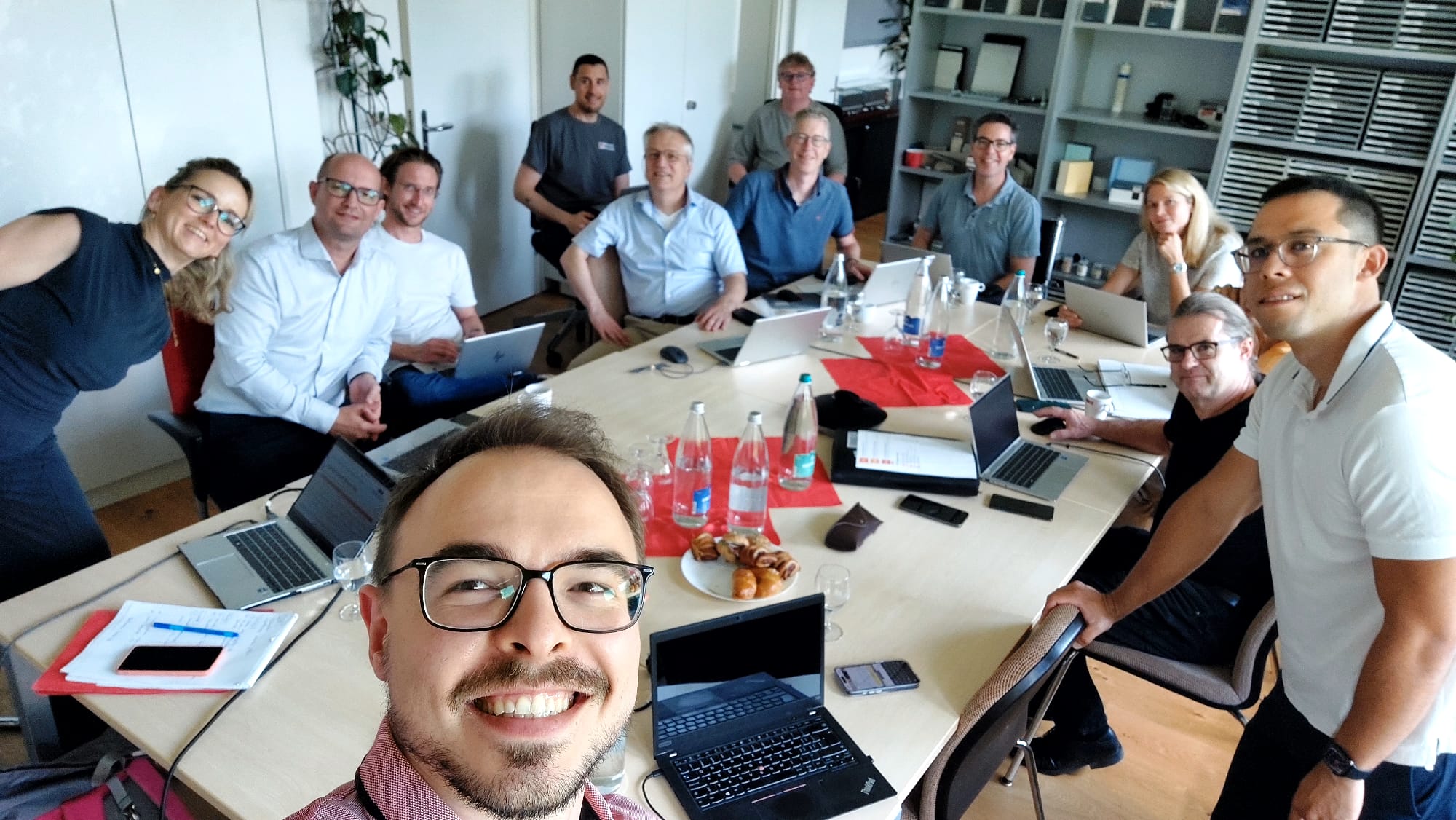
Friday morning, shortly after eight, a conference room in Rotkreuz in the canton of Zug: in front of me sits the sales team of FOAMGLAS Switzerland, laptops open, Copilot licenses active. The brief for the day is simple: tonight, every single person leaves this room with their own AI agent that takes over a real task from their everyday sales work. No slide marathon, no tool tourism – we build.
This article is the field report from that workshop day: why AI in sales belongs behind the salesperson and not between salesperson and customer, which three agent patterns work in almost every B2B team – and five success factors you can adopt if you are planning the same with your team.
AI in sales: behind the salesperson, not in between
B2B sales in the building materials world is a relationship business. Decisions are made in conversations, on construction sites, on the phone – not in a chat window. Anyone who wants to use AI there has to answer one fundamental question cleanly: where does it belong?
My answer, confirmed once again in this workshop: AI belongs behind the salesperson, not between salesperson and customer. It writes the first draft of the difficult email, it structures the visit report, it sorts the research – but the conversation, the relationship and the responsibility stay with the human. The business stays human, the groundwork gets faster.
This attitude also changes the mood in the room. The question of the day was not “Will AI replace us?” but: “How does it take away the work that keeps me from my customers?” As soon as a team frames the question like that, scepticism turns into tool thinking.
The format: one day, everyone builds their own agent
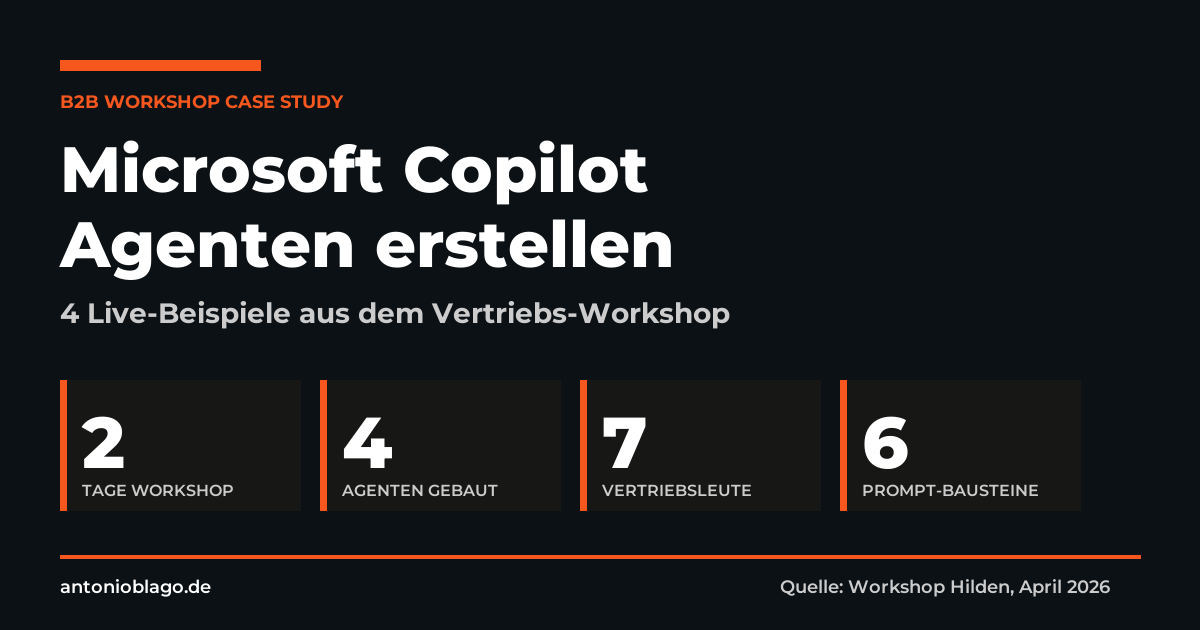
After the two-day Copilot workshop at Paroc, I condensed the format for Switzerland into one compact day: a short theory block in the morning – how language models work, why they hallucinate, what makes a good prompt – and after that, almost exclusively hands-on practice.
The entry point was once again the master prompt concept: an agent whose only job is to build other agents. You describe the task and the goal, and it returns a structured prompt with role, context, procedure, negative instructions and placeholders. Nobody needs to know prompt engineering by heart – and the quality of the agents stays consistent across the team.
The difference to classic AI trainings: nobody just watched. Every person in the room picked their own use case, built their own agent, tested it with real tasks and sharpened it. At the end of the day there was not one demo agent from the trainer, but a dozen personal assistants – one per head.
Visibly AI: your SEO copilot
Projects, rankings, Search Console data and a copilot that runs the analysis for you. Start for free.
Three agent patterns that work in almost every B2B sales team
The participants’ concrete agents stay internal. But the patterns behind them are transferable – I see them in almost every B2B team:
Pattern 1: emails in the customer’s language and tone
The classic – with a Swiss twist: enquiries come in German, French or Italian. A well-built email agent replies automatically in the language of the incoming mail, in a selectable tone (polite, firm, diplomatic, factual) and in Swiss spelling. The salesperson reads, adjusts, takes responsibility – but the first draft is ready in seconds instead of twenty minutes.
Pattern 2: visit reports from dictation or transcript
Visit reports are the least popular document in field sales – and at the same time the most valuable one for the team. The pattern: after the appointment, dictate into the phone or hand over the conversation transcript, and the agent structures the report according to a fixed template. The decisive part is the negative instruction: only what was said, invent nothing. This is exactly where a cleanly built agent separates itself from a naive “summarise this” prompt.
Pattern 3: research and prioritisation in daily business
The third pattern bundles the small time-eaters: gathering information on projects and contacts, pre-sorting a full inbox by urgency, pulling the relevant points out of long documents. Each of these tasks looks trivial on its own – together they decide whether the morning belongs to the customer or to the inbox.
5 success factors for AI in sales
From the day in Rotkreuz – and from the workshops before it – five factors have crystallised that decide whether AI sticks in sales or disappears again after two weeks:
- Own use cases instead of tool demos. The workshop does not start with the tool but with the question of which everyday task eats the most time. First the pain, then the agent.
- Build it yourself, don’t watch. An agent you built yourself gets used. An agent the trainer demonstrated gets forgotten. Therefore: one agent per head, on your own laptop, with real tasks.
- Start small and iterate. No agent is finished on the first attempt. Three to five iterations are normal – if you plan for that from the start, you don’t give up frustrated, you sharpen.
- Clarify the data framework beforehand. Company and customer data belong exclusively in the protected enterprise environment – with Microsoft Copilot in the workspace with commercial data protection, not in freely accessible tools. This guardrail has to stand before the first prompt, not after.
- Follow up with fixed review slots. Agents are not one-off projects. A recurring slot in the team meeting – what works, what doesn’t, what do we extend – turns a workshop success into a way of working.
What remains: openness beats scepticism
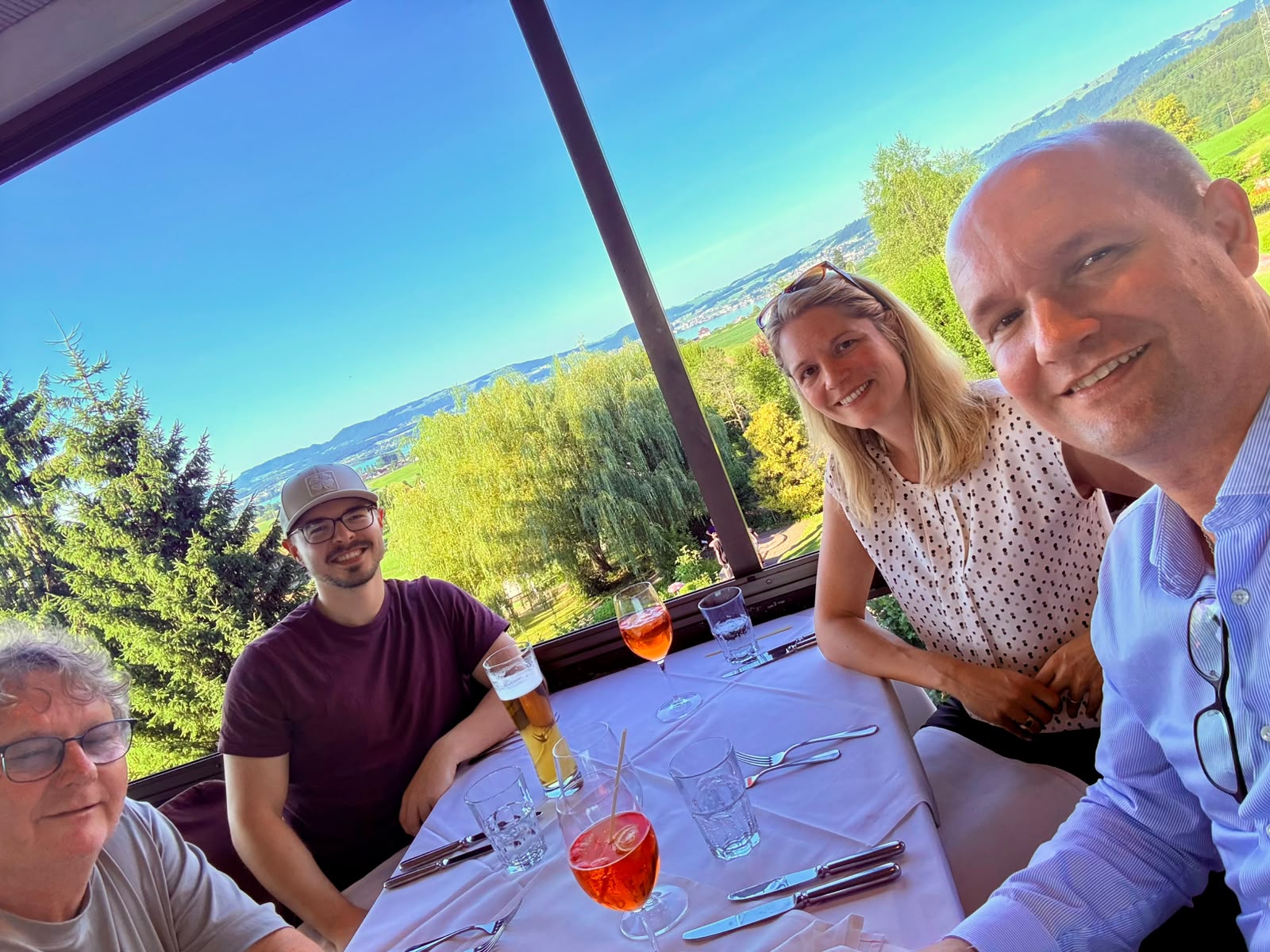
What impressed me most about this day was not a Copilot feature but the openness in the room. A sales team that has sold successfully through personal relationships for years would have every reason to read AI as a threat. Instead, they built, tested, laughed and sharpened – with the clear expectation that the tools serve the sales team and not the other way around.
A workshop is not the goal but the ignition: once you have understood how a master prompt is built, you build the next agents on your own. The method comes from me, the use cases come from the team – and it is exactly in this order that AI works in sales.
Want the same for your team?
I support sales and marketing teams in two formats: as a compact one-day on-site workshop like in Rotkreuz, or as a two-day format with an upstream needs analysis. Both start with a free initial consultation in which we take an honest look at where your team stands – no tool show, no obligation.
Sources
- My own workshop notes – AI workshop with the sales team of FOAMGLAS Switzerland, Rotkreuz, July 2026.
- Microsoft Copilot documentation – agent creation and commercial data protection. learn.microsoft.com
Free initial consultation
30 minutes, your website, concrete next steps. No sales pressure.

About the Author: Antonio Blago
SEO Freelancer & AI Visibility Expert
I optimize SEO data-driven with Python, behavioral psychology, and my Neuro-SEO System®. On YouTube, LinkedIn, and Instagram I share hands-on tutorials, insights, and SEO strategies.