Bootstrapping by the numbers: what 878 companies show

AI summary
- In 2024, 75 percent of German founders financed their startups with their own money only, the highest share ever recorded.
- Among 191 bootstrapped companies, 45 gained first revenue from their network and 25 from existing clients, totaling almost half of all first sales.
- 58 percent of self-funded companies were founded by a single person, compared to 28 percent among investor-backed startups.
- The median time from founding to acquisition was 7 years for 33 bootstrapped companies with known exit dates, and the median time to failure was 6 years for 122 failed companies.
Generated with AI, the details are in the article.
Table of contents
Three out of four founders in Germany finance their start with their own money only. KfW measured a share of 75 percent for 2024, the highest value ever[1]. Yet the startup debate is almost entirely about funding rounds. I wanted to know what bootstrapping looks like in practice: where does the first revenue come from, who starts alone, how long does it take to exit, and why do companies give up?
To find out, I analyzed 701 companies from public founder interviews and checked every one of them against sources on the web. On top of that come 177 failed startups from Germany, Austria and Switzerland, collected from startup press and insolvency notices. Everything is available as a searchable database in Founder Intelligence.
Open the Founder Intelligence database
The data and its limits
The database covers 878 companies. For 714 of them there is a source on the open web, such as the company website, a commercial register service or a press article. I know the founding year for 651 companies. I only marked a company as insolvent, acquired or closed when a source states it explicitly. Where that was not possible, the status is "unclear".
| Status | Companies |
|---|---|
| Active | 450 |
| Acquired (exit) | 43 |
| Insolvent | 163 |
| Closed | 22 |
| Unclear | 200 |
One limit belongs at the start: founders who talk about their company in an interview usually have something to show. The 701 interview companies are therefore a selection of the successful ones. That is exactly why I researched the 177 failed startups separately. How skewed the picture still is, I show further below.
First revenue comes from the network
For 191 companies we know through which channel the very first revenue came in. The result is clear: 45 companies first sold to people from their network, 25 to an existing client or their former employer, 21 through a marketplace or app store. Together that is almost half.
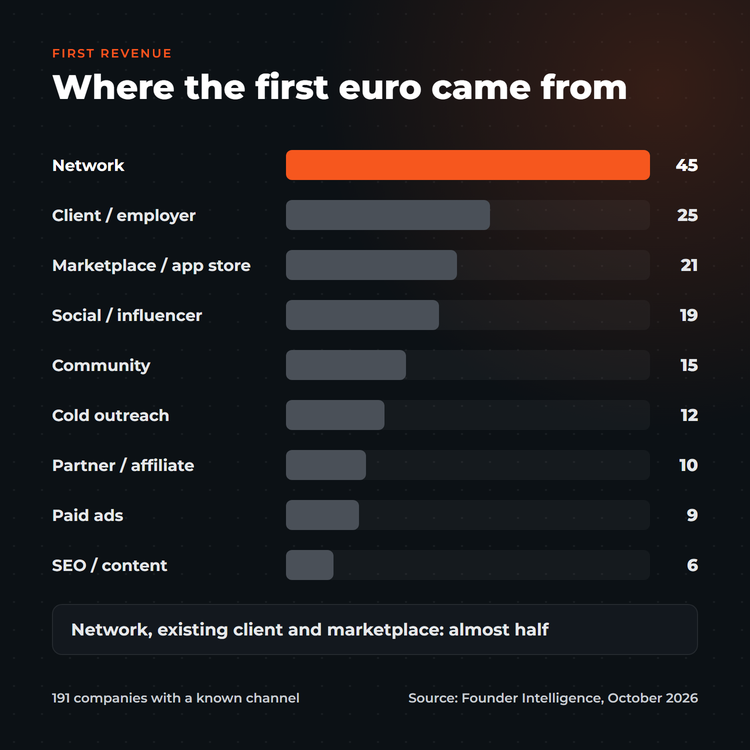
Paid advertising brought the first revenue for only 9 companies, SEO and content for 6. These channels often carry growth later. For the start, what counts is who you already know and who trusts you.
How fast the first euro arrives
54 companies say how long it took until the first revenue. 24 of them earned money within the first month, 13 even in the first week. 15 needed more than a year. This fits the capital founders in Germany start with: for 56 percent of new businesses in 2024, up to 5,000 euros of starting capital was enough[2]. With that little money, revenue has to come in early.
Bootstrappers start alone more often and grow through content
58 percent of the self-funded companies in the database were founded by a single person (133 of 231). Among companies with investors it is 28 percent (45 of 162). For comparison: in the German Startup Monitor 2025, solo founders make up 20.7 percent, and on average 2.5 people found a startup together[3]. Among bootstrappers, the solopreneur is the normal case.
The way to customers differs as well. 36 percent of the bootstrapped companies grow mainly through content: website, blog, social media, newsletter. Among investor-backed startups, sales dominates with 37 percent, and only 6 of 162 grow through content. Content mainly costs time, a sales team costs salaries. If you start without outside money, you have more time than money.
Bootstrapping is also gaining ground among startups. In the German Startup Monitor, 22.3 percent rely on it, up from 19.2 percent the year before. 38.5 percent already have external investors on board[3]. How founding activity and venture capital develop overall, I analyzed in Startups in Germany 2026.
It takes seven years to exit
43 companies in the database were acquired. For 33 I know both the founding and the exit year: the median gap was seven years. Two examples of exits without investors: mydealz was founded in 2007 and became part of the Pepper group in 2014[7]. Feedback Panda, a tool for online teachers, started in 2016 without investors and was sold to SureSwift Capital in 2019[8].
Seven years is a realistic time frame. If you build a company with your own money, plan in years rather than in funding rounds.
Why startups fail: 177 cases from Germany, Austria and Switzerland
The 177 failed companies come from Germany (161), Austria (14) and Switzerland (2) and failed between 2015 and 2026. For 106 of them the source names a cause. Several causes per company are possible.
| Cause according to source | Companies |
|---|---|
| Funding fell through or capital ran out | 46 |
| Costs higher than revenue | 31 |
| Demand or customers did not come | 19 |
| External crisis (Covid, energy, war, weak consumption) | 16 |
| Dependence on a partner or platform | 5 |
From founding to the end, the median was six years. Only 23 of the 122 companies with both years gave up within three years. Most companies gave up only after years, and the most frequently named cause was funding.
This matches an analysis by CB Insights from March 2026. Of 431 VC-backed startups that shut down, 70 percent named a lack of capital. CB Insights classifies this as the final cause. Below it are a missing product-market fit (43 percent), bad timing (29 percent) and unit economics that did not work (19 percent)[4].
How many companies fail overall?
There is no reliable rate for all startups. I could not find the often quoted 90 percent in any primary source. The German Federal Statistical Office measures how many new businesses are still active after five years. In food service it was just over a third (36.0 percent), in the creative industries 27.3 percent, in veterinary services 60.2 percent[5]. In skilled crafts, a good two thirds are still active after five years[6]. The industry matters.
The blind spot: failed bootstrappers
Of the 177 failed companies, 103 had investors. Exactly two were verifiably self-funded. I specifically searched for failures without investors, in local newspapers, founder blogs and insolvency notices. I found hardly anything.
The two documented cases show what it looks like when things go wrong. Vinokilo ran vintage flea markets, reached revenue in the millions and more than 100 employees, deliberately without investors and without bank loans. When the pandemic stopped the pop-up markets, there was no buffer, and insolvency followed in 2023. The founder writes that the company went bankrupt because he did not want investors[9]. The fashion company bleed from Upper Franconia worked for 15 years without investors and with thin margins. Supply chains, rising prices and a drop in consumption hit almost no reserves[10].
Both cases share the same pattern: the company worked for a long time, but it had no reserves for an external shock.
What I take away
- Look for the first revenue in your network. Almost half of the companies first sold to acquaintances, former employers or existing clients. A list of 20 people who know the problem is a better start than an ad budget.
- Choose a channel that costs time instead of money. Content, community and marketplaces are the bootstrappers' channels. They work slowly and grow with you.
- Plan reserves. The failed bootstrappers had revenue but no buffer. Without investors, your own reserves are the only safety net.
- Think in years. The median time to exit is seven years, the median time to failure six.
- Read comparisons with care. Success stories are overrepresented, in my database too. If you only study winners, you underestimate the risk.
In Founder Intelligence you can filter all 878 companies by status, funding, industry, channel and founding year. For direct-to-consumer brands, the Brand Radar shows how search interest in the brand develops. And if you want to know which founders are closest to your own business, compare yourself with all 878 companies in Founder Intelligence by Visibly AI.
Conclusion
In Germany, bootstrapping is the normal case. The companies in my database start small, often alone, get their first revenue from their own circle and grow through content. It takes years to exit. The risk lies in missing reserves, and this risk stays invisible in public perception because hardly anyone writes about failed bootstrappers.
The data comes from public founder interviews, company websites, commercial register services and press reports, analyzed in October 2026. Figures for individual companies are founders' own statements or public information, not audited business figures.
Sources
- KfW Research: Gründerinnen und Gründer in Deutschland so jung wie nie, press release of 3 June 2025. kfw.de, retrieved 19 October 2026.
- Munich Startup: KfW-Gründungsmonitor 2025. munich-startup.de, retrieved 19 October 2026.
- Startup-Verband: Deutscher Startup Monitor 2025, 1,846 participants. startupverband.de, retrieved 19 October 2026.
- CB Insights: The top 9 reasons startups fail, 5 March 2026. cbinsights.com, retrieved 19 October 2026.
- German Federal Statistical Office (Destatis): 36 % der neu gegründeten Gastronomie-Unternehmen waren nach fünf Jahren noch aktiv, number of the week 2025. destatis.de, retrieved 19 October 2026.
- German Federal Statistical Office (Destatis): Gründungen und Schließungen im Handwerk, WISTA 02/2026. destatis.de, retrieved 19 October 2026.
- deutsche-startups.de: 5 Fakten zur 9-jährigen Erfolgsstory von mydealz, 28 April 2016. deutsche-startups.de, retrieved 19 October 2026.
- Indie Hackers: FeedbackPanda sold. indiehackers.com, retrieved 19 October 2026.
- Business Insider (Gründerszene): Vinokilo, Mein Startup ging pleite, weil ich keine Investoren wollte. businessinsider.de, retrieved 19 October 2026.
- Bayreuther Tagblatt: Oberfränkisches Modeunternehmen insolvent, "Unser Herz blutet". bayreuther-tagblatt.de, retrieved 19 October 2026.
Visibly AI: your SEO copilot
Projects, rankings, Search Console data and a copilot that runs the analysis for you. Start for free.

About the Author: Antonio Blago
SEO Freelancer & AI Visibility Expert
I optimize SEO data-driven with Python, behavioral psychology, and my Neuro-SEO System®. On YouTube, LinkedIn, and Instagram I share hands-on tutorials, insights, and SEO strategies.