Local AI Models for SEO: Qwen vs. Claude, Codex, DeepSeek


AI summary
- I tested 10 local Qwen models against Claude, Codex, and DeepSeek on 29 SEO tasks with automatic checks, achieving 0.77 accuracy for best local model versus 0.98 for Claude Haiku.
- Local models failed at mathematics without intermediate steps, scoring 0.20 average on a CTR potential calculation where all 8 cloud models got 704 clicks correct.
- Qwen3:4b-instruct performed well on keyword classification, alt texts, and FAQ extraction with 0.9 plus accuracy, suitable for bulk tasks where data cannot leave the company.
- Local models are no replacement for cloud models on analysis work, but deciding per task instead of per model allows sensitive data to run locally with script validation.
Generated with AI, the details are in the article.
Table of contents
"Can't we just do this with a local model?" I hear that question in client calls more and more often. Usually it is about data protection: in June 2026 a marketing lead mentioned a local model as the privacy-friendly option, "but some specialist has to certify it". In October an industrial client told me their company policy blocks third-party tools by default.[6] Local AI models run on your own computer or server, so no text leaves the building. The only question is: are they good enough for real SEO work?
I no longer wanted to answer that from gut feeling. For a training on AI with your own data, Ollama was already running on a GPU server, so I wrote 29 typical SEO tasks with fixed expected answers and automatic checks. I gave them to ten local Qwen runs and, for comparison, to Claude, Codex and DeepSeek in the cloud.[1] Here are the results: accuracy, run time, and the places where I had to correct my own grading.
Best local model (qwen3:4b-instruct)
0.77
accuracy, 14 of 29 fully correct
Smallest Claude model (Haiku)
0.98
27 of 29 fully correct
Fastest model (DeepSeek v4.1 Flash)
0.6 s
median per task, all 29 in 18 s
The test setup: 29 SEO tasks, checked automatically
An LLM comparison is only as good as its tasks. So I used tasks I actually hand to a model in client projects: sorting keywords, writing snippets, finding technical errors, analysing Search Console data. Every task has a clear answer a script can check.
The tasks
All data is made up: an e-bike brand called Velora, heat pump guides, sample URLs. That way no model can know the answer from training, and no client data is in the test.[1] The prompts are in German, because that is the language I work in.
| Category | Tasks | Example |
|---|---|---|
| Keywords | 5 | Assign search intent, find brand keywords including typos, regex for the Search Console filter |
| Snippets | 4 | Title tag up to 60 characters, meta description with 140 to 160 characters, alt text |
| Texts | 6 | H2 outline, summary in 220 characters, spot keyword stuffing, extract FAQ and entities |
| Technical | 8 | Read robots.txt, check hreflang, redirect chain, sitemap, canonicals, JSON-LD |
| Analysis | 6 | Calculate CTR potential, quick wins, cannibalisation, duplicate titles, internal links, content gap |
The models and the hardware
The local models ran via Ollama on a cloud server with an Nvidia Tesla T4 (16 GB of video memory). That is an older data centre card, roughly on par with a good gaming GPU. I tested Alibaba's Qwen family because it handles German well and comes in many sizes: qwen2.5 with 0.5, 1.5, 3, 7 and 14 billion parameters, and qwen3 with 4 and 8 billion, each with and without thinking mode. On top came qwen3:30b-a3b, a mixture-of-experts model with 30 billion parameters, of which only about 3 billion compute per token. At 19 GB it is too large for the card, so Ollama automatically offloads the rest to system memory.[4]
On the cloud side I ran Claude Haiku, Sonnet and Opus plus three Codex models (gpt-6-luna, gpt-6.1-terra, gpt-6.2-sol), all through the subscriptions and their command line, with no tools and no custom system prompt. DeepSeek v4.1 Flash and v4 Pro ran through an OpenAI-compatible API. Each task ran once per model at temperature 0.[1][5]
How grading works
Every task has its own check in code that returns a score from 0 to 1. Lists are compared with an F1 score, so half right earns half the points. For snippets the script counts characters, for JSON-LD it checks the structure, for calculations it reads the last number in the answer. I checked the expected answers against Google's documentation; the CTR values come from my Keyword Study 2026.[2][3][7] "Accuracy" is the mean across all 29 tasks, "fully correct" counts the tasks with a score of 1.
Everything is public on GitHub: every question, every reference answer, every check as code, all 522 answers and a guide to repeat the test on your own hardware. Go to the seo-llm-bench repository
Results: local AI models vs. the cloud
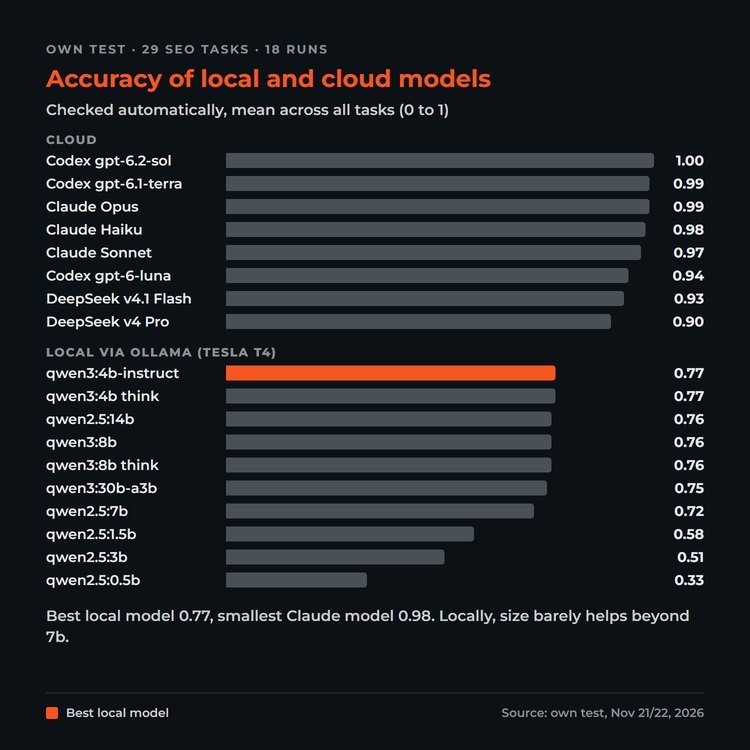
The result is clear. The cloud models score between 0.90 and 1.00, the local models 0.77 at most.[1]
| Model | Accuracy | Fully correct | Median per task |
|---|---|---|---|
| Codex gpt-6.2-sol | 1.00 | 29 | 5.3 s |
| Codex gpt-6.1-terra | 0.99 | 28 | 4.7 s |
| Claude Opus | 0.99 | 28 | 4.1 s |
| Claude Haiku | 0.98 | 27 | 3.3 s |
| Claude Sonnet | 0.97 | 26 | 3.5 s |
| Codex gpt-6-luna | 0.94 | 26 | 5.2 s |
| DeepSeek v4.1 Flash | 0.93 | 24 | 0.6 s |
| DeepSeek v4 Pro | 0.90 | 23 | 0.7 s |
| qwen3:4b-instruct (local) | 0.77 | 14 | 2.7 s |
| qwen3:4b with thinking (local) | 0.77 | 19 | 41.9 s |
| qwen2.5:14b (local) | 0.76 | 17 | 3.9 s |
| qwen3:8b (local) | 0.76 | 15 | 3.3 s |
| qwen3:8b with thinking (local) | 0.76 | 20 | 14.8 s |
| qwen3:30b-a3b (local) | 0.75 | 15 | 3.7 s |
| qwen2.5:7b (local) | 0.72 | 15 | 2.8 s |
| qwen2.5:1.5b (local) | 0.58 | 9 | 2.5 s |
| qwen2.5:3b (local) | 0.51 | 8 | 2.6 s |
| qwen2.5:0.5b (local) | 0.33 | 3 | 2.3 s |
Three things stand out to me. First, there are 13 points between the best local and the weakest cloud model, and 21 points to the smallest Claude model. Second, size barely helps locally beyond 7 billion parameters: the 14b model is twice as large as the 7b model, only 0.04 better, and runs at 23 instead of 44 tokens per second. The newer qwen3 with 4 billion beats both. Even the largest local model in the test, qwen3:30b-a3b, only reaches 0.75. It is the best local model for keywords at 0.96, but weaker than qwen3:4b-instruct on snippets and technical SEO. Despite the offloading it ran at a brisk 41 tokens per second, because only a tenth of its parameters compute per token.[1] Third, the gap inside the cloud is small. Haiku at 0.98 is almost level with Opus. For tasks like these you don't need the largest model.
In terms of speed, the local models without thinking mode are not slower than the cloud. At 2.3 to 3.9 seconds per task they are in the same range as Claude. The outlier is DeepSeek Flash at 0.6 seconds. Codex is the slowest because its command line, as an agent, sends around 11,500 tokens of instructions with every call; for Claude it is about 1,000.[1]
Brand Radar: where does your brand stand?
Brand and generic traffic, competitors and potential at a glance, free of charge.
Happy clients and case studies: All case studies
Where local AI models fail
The average hides the fact that the errors are not spread randomly. On alt texts and FAQ extraction every local model scored full points. In other places almost all of them failed.[1]
Maths without intermediate steps
The hardest task for local models was a simple potential calculation: a page ranks in position 8 with 40,000 impressions, CTR is 0.61 percent in position 8 and 2.37 percent in position 3. How many extra clicks does moving to position 3 bring? The answer is 40,000 times 1.76 percent, so 704 clicks.[7] qwen3:4b-instruct answered 190, qwen2.5:7b 152. No local model without thinking mode got to 704; all eight cloud models did. On average the local runs scored 0.20 here.[1]
In practice: never let a local model do the maths itself. Give it the calculation as code, or have it output a formula that a script runs.
Length limits and content gaps
Character limits are hard for small models because they think in tokens, not letters. Asked for three title variants of at most 60 characters, qwen3:4b-instruct delivered two at 62, the 14b model one at 63. For the meta description with 140 to 160 characters, qwen2.5:7b came in at 70.[1] Small deviations, but those are exactly the characters that get cut off in the snippet.
The content gap was even clearer: compare your own H2s with a competitor's H2s on a heat pump page and name the missing topics. The answer is noise level, electricity tariff and maintenance. The local models named topics that were already on the own page instead, such as installation costs. Locally the average was 0.21, in the cloud 0.92.[1] That is the part you actually need a model for in a content gap analysis.
Technical SEO with pitfalls
On the question which hreflang values are invalid, and on the redirect chain with a 302 in the middle, the local models scored around 0.4. The hreflang task was also the second hardest for the cloud: only two cloud models knew in full that Google ignores en-UK and does not support es-419.[1][2] On robots.txt, sitemaps and JSON-LD the local models were mostly right.
Thinking mode: more accurate, but up to 15 times slower
qwen3 can "think" before it answers, writing intermediate steps that Ollama controls with the think parameter.[5] With it, qwen3:8b solves the click calculation correctly with 704 and gets 20 tasks fully right instead of 15. Its accuracy still stays at 0.76, because the model gets worse elsewhere, for example at clustering keywords.[1]
The price is time. qwen3:8b needed a median of 14.8 instead of 3.3 seconds per task. qwen3:4b needed 41.9 seconds and 1,300 seconds for all 29 tasks, 15 times the version without thinking. In eight tasks the small model went round in circles until it hit the limit of 4,096 tokens.[1]
qwen3:4b is now the thinking-only variant (version 2507). Turning thinking off does not help there; the model thinks anyway. Without thinking you need qwen3:4b-instruct.[4][1] It took me half an hour to find that out, because the first run consisted of nothing but aborted answers.What I had to correct in my own grading
Before trusting the numbers, I looked at every wrong answer individually. Several times the error was in my check:
- hreflang: my first expected answer treated
es-419as valid. Google states explicitly that such codes are not supported.[2] The two Codex models that flagged it were right. - 404 or 410: for a permanently removed product page, 410 is the usual recommendation. Google itself treats all 4xx codes except 429 the same.[3] A 404 answer therefore gets half points instead of zero.
- Format issues: "E-Bike-Leasing" with a hyphen, entities as objects instead of text, a regex with an explanation attached. Correct in substance, rejected by my first check anyway.
- Wrapped lists: qwen2.5:14b wrapped a requested list in an object 13 times. I now count that separately instead of discarding the whole answer.[1]
The lesson matches what I discussed in October 2026 at a kickoff with an industrial client: a language model never reaches 100 percent. What counts is a validator in the script that spots errors and sends them back to the model until the output is right.[6] The same applies to grading. If you read a model comparison only by its average, without looking at the errors per task, you end up measuring your own expected answers.
When local AI models pay off in SEO
Based on this test, local models are no replacement for Claude or Codex when it comes to analysis. They are not useless either. qwen3:4b-instruct and qwen2.5:7b were good enough for these tasks:
- Classifying search intent and brand keywords (0.85 to 0.90 in the keywords category)
- Alt texts, FAQ extraction and H2 outlines (above 0.9 in the texts category)
- Generating robots.txt rules, sitemap rules and JSON-LD, as long as a validator checks the output
Those are exactly the bulk tasks where data often must not leave the company: thousands of keywords from Search Console, internal product data, texts before publication.[1] Maths, content gaps and tricky technical questions belong in a large model or in plain code. If it has to be the cloud, I described how to use Claude in a privacy-compliant way in my article on Claude Code, privacy and GDPR. Whether your data calls for RAG, fine-tuning or a good prompt is covered in RAG, fine-tuning or prompt.
On costs, an honest look helps. A local model has no fee per request, but hardware, electricity and maintenance. The cloud models in my test ran on existing subscriptions with no extra cost per call; what those subscriptions cost in daily use is in my article on Claude Code pricing. For pure volume, DeepSeek Flash is interesting: 0.93 accuracy and all 29 tasks in 18 seconds.[1] For data that must not leave the company it is of course no option.
Conclusion
On SEO tasks, local AI models deliver about three quarters of what cloud models achieve. The best local model in the test, qwen3:4b-instruct, scored 0.77; the smallest Claude model 0.98. Locally it is enough for classifying, extracting and simple technical tasks, as long as a script checks the output. On maths, content gaps and pitfalls like hreflang the small models fail, and thinking mode only partly fixes that, at the cost of up to 15 times the run time.[1]
My advice after this test: decide per task, not per model. Anything that touches sensitive data and can be checked automatically can run locally. Anything that needs judgement belongs in a large model. And before you believe any model comparison, mine included, look at where the models failed.
Sources
- Own test: 29 SEO tasks with automatic checks, 18 model runs (Qwen via Ollama on an Nvidia Tesla T4, Claude and Codex via subscription command line, DeepSeek via API), 522 answers. Run on November 21 and 22, 2026. Tasks, script and every answer: github.com/AntonioBlago/seo-llm-bench.
- Google Search Central: Tell Google about localized versions of your page (hreflang, supported language and region codes). developers.google.com, accessed November 21, 2026.
- Google Crawling Infrastructure: How HTTP status codes affect Google's crawlers. developers.google.com, accessed November 21, 2026.
- Ollama Library: qwen3, available variants. ollama.com, accessed November 21, 2026.
- Ollama API documentation, parameters
thinkandoptions. github.com/ollama, accessed November 21, 2026. - Own conversations with clients and prospects, June to October 2026, transcripts stored locally, anonymised.
- Antonio Blago: Keyword Study 2026, CTR by position in organic search. antonioblago.com.
Free SEO tools
Keyword ranking, SSR text check, sitemap audit and more, right in the browser and without signup.
Happy clients and case studies: All case studies

About the Author: Antonio Blago
SEO Freelancer & AI Visibility Expert
I optimize SEO data-driven with Python, behavioral psychology, and my Neuro-SEO System®. On YouTube, LinkedIn, and Instagram I share hands-on tutorials, insights, and SEO strategies.