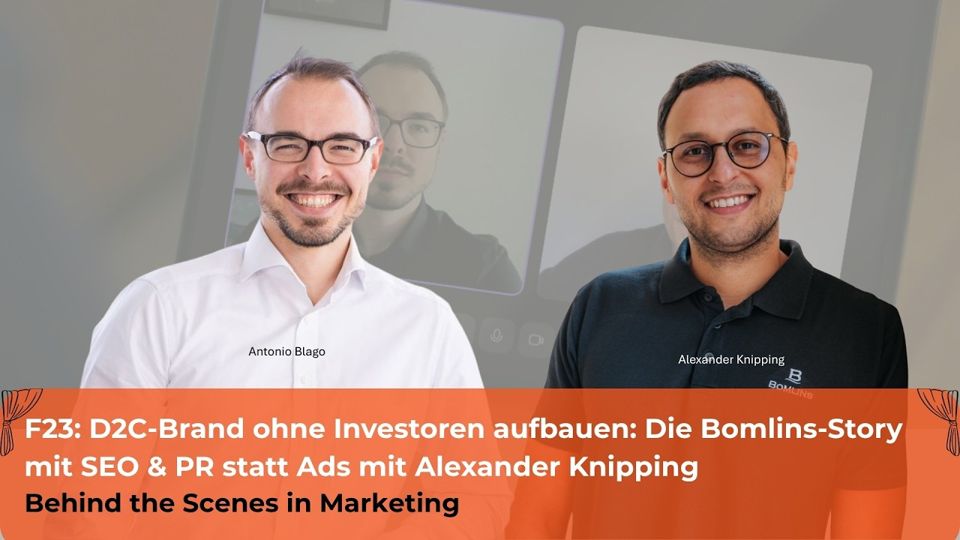
Build a D2C Brand Without Investors: The Bomlins Story

AI summary
- Alexander Knipping built Bomlins, a premium Egyptian Giza cotton towel brand, entirely organically without investors or performance budget by combining SEO and PR.
- An editorial article in BNN newspaper triggered the biggest sales lever, leading to SWR1 coverage and spa partnerships, while paid newspaper ads generated minimal results.
- Bomlins sources Giza cotton directly from Egypt through the embassy and produces in Portugal at a factory with its own yarn spinning mill and highest European standards.
- Alexander uses Shopify for the shop, Billbee for inventory management with automatic label printing, and employs manual quality control where his partner checks every single towel before shipping.
Generated with AI, the details are in the article.
Table of contents
Alexander Knipping had my curiosity before we even started recording. He comes from domain trading and affiliate SEO, then founded a physical premium towel brand. That is a rare path. What I really wanted to know: how do you build a business like this entirely organically, with no investors, no performance budget and none of the usual growth-hack noise? The conversation showed me there is far more behind it than a nice founder story.
Watch the video:
From Domain Trader to Founder: A Path Full of Trial and Error
With his very first domain, Alexander received an offer worth almost a full year's salary from his 400-euro job at the time. He negotiated too long, the offer fell through, but the hunger was awake. What followed sounds familiar to anyone who worked in early SEO: around 1,000 registered domains, affiliate projects, the Amazon partner program, loan comparison sites, quote sites.
As Alexander put it:
"Back then you could link from anywhere, every backlink was somehow valuable. And two days later you already saw whether it was good or bad."
I know that feeling. That era was wild and laid many foundations that still hold today. At some point it stops being enough, though. Alexander told me that missing something tangible eventually got on his nerves. When you explain to friends what you do and nobody understands it, that gets unsatisfying over time.
The change of mind came with the wish for something lasting, something you can pass on.
The Idea Behind Bomlins: A 25-Year-Old Towel from Cairo
Honestly, I find the origin of the product idea pretty strong. After a shower, Alexander held the old towel he had bought in Cairo about 25 years ago. Half of his family comes from Egypt, so the connection was there. At the same time, a YouTube documentary about opaque cotton supply chains was running.
The combination clicked: there was no high-quality, transparent towel made of Egyptian Giza cotton that you could buy directly.
What I did not know and Alexander explained to me: Giza cotton is more than just Egyptian cotton. The fibers have an even length, and that makes the decisive difference.
"Imagine spaghetti. If they are all the same length, you can spin an even yarn from them. If they differ in length, that simply does not work."
A nice image. It also shows why this product is not interchangeable.
Visibly AI: your SEO copilot
Projects, rankings, Search Console data and a copilot that runs the analysis for you. Start for free.
The Sourcing Disaster: Deposit Gone, Goods Never Arrived
This is where the story gets really interesting, because it was anything but easy.
Alexander and his business partner Christian visited factories, sent hundreds of emails, flew to Egypt and negotiated with Alexander's father as translator. Then came the moment I can hardly imagine:
Company founded. Warehouse rented. Insurance signed. Everything running. Three months delivery time agreed, 20 percent paid upfront. Two weeks before the delivery date the message arrives: no goods.
Many people simply quit at that point. What surprised me: Alexander got the money back anyway, because they kept negotiating. Then came a second flight to Egypt, more factories, more talks. And then the point where it became clear to him:
"When they asked us whether it would also be okay if it is not really Giza cotton but we still get the certificate, it was clear: no."
To me this shows an important character trait. Alexander wanted to sell exactly what the label says.
Portugal as the Last Chance
After about a year of unsuccessful sourcing in Egypt came the trip to Portugal. Alexander put it himself: if this does not work out, we close the company.
In Portugal they found a factory that sounds like this:
- Two football fields in size
- Its own yarn spinning mill
- Highest European standards
- No child labor, full traceability
The factory was far too big for the quantities Bomlins could take at first. But they agreed to the experiment because they found the approach interesting.
My thought during this part of the conversation: supplier relationships are real relationships. No tool replaces that. Alexander flew there, held conversations, went out for dinner. That makes the difference.
The Giza cotton still comes from Egypt, directly through the Egyptian embassy, which controls the sale. Production then takes place in Portugal.
Marketing Without a Budget: How SEO and PR Really Worked
Now we come to the part that was especially interesting for me as an SEO consultant.
Alexander has no investors, no ad budget and no big team. He started with SEO, then added PR. What he told me made me think hard, because I rarely hear this combination put so clearly.
The WordPress Mistake and Why Shopify Won
The first shop was WordPress. It took more than three months, an external developer built it, and it simply was not good. Alexander then switched to Shopify himself, taught himself the system and says today:
"That was one of the best decisions, because now I can change everything myself immediately."
I know this from many consulting calls. Flexibility and control often beat perfection, especially in the early phase.
The Newspaper Article That Changed Everything
What surprised me most: the biggest lever was an editorial article in the BNN (Badische Neueste Nachrichten). SEO, social and influencers played a smaller role.
Alexander told me the journalist simply wrote warmly about the story. No ad, no sponsored post. Just a real story, well told. The effect was clear:
- A real sales rush right after publication
- SWR1 took notice of Bomlins
- Magazines like "Bewusster Leben" got in touch
- Cooperations with thermal spas in the region became easier
Then Alexander tried to scale it. Placing ads in newspapers did not work.
"As soon as it says advertisement, hardly anyone is interested anymore."
I wrote that sentence down right away. Real editorial presence cannot be replicated with advertising. The trust effect is missing.
Thermal Spas as Cooperation Partners
Alexander built cooperations with thermal spas in the region: Caracalla Therme in Baden-Baden, Thermalbad Bad Wildbad, Bad Rotenfels. They serve less as a classic B2B channel and more as local brand awareness.
I find that a smart approach for a regional D2C brand. You bring the product exactly where the target group is.
Amazon: Tested and Paused
Amazon was briefly in play. The problem: Amazon cannot protect the term "Egyptian Giza cotton" on the platform. Anyone can write it in a product title, whether they hold a certificate or not.
Alexander eventually decided to invest the time in his own shop instead. Otto was also on board briefly and dropped out again.
D2C Without Middlemen: The Price Promise
One more thing I find important to mention: Bomlins deliberately decided against the luxury market, even though the product could land there. Giza cotton is used by five-star hotels and royal families.
Instead, Alexander says:
"We want to give as many people as possible access to a truly luxurious product, without the price going through the roof."
No middlemen, direct shipping, fair prices. That is the D2C promise in its purest form. It works because they do not need an eight-figure media budget.
The Inventory System: Billbee Makes the Difference
Since I am often asked for concrete tool recommendations: Alexander uses Billbee for inventory and order management. The system automatically prints the delivery note and shipping label as soon as an order comes in.
That sounds minor. It matters a lot if you did everything manually at the start. Alexander told me he first had to work out which box actually fits and what happens when an order arrives.
These are questions you rarely ask beforehand and never want to be without afterwards.
Alexander is very happy with Billbee, especially with the value for money. He would only like the option of paid support on top.
Quality Control as a USP
What impressed me personally: Alexander's partner checks every single towel that ships. Every seam, every thread, every label.
If anything is off, it leaves the range. It does not get sold.
That sounds like a process that scales poorly. For a brand built on trust and quality, exactly that makes the difference. 4.9 stars across more than 430 reviews and a 99 percent recommendation rate speak for themselves.
What Alexander Does Now: SEO Consulting for Shops
At the end we talked about his start as an SEO consultant. Alexander launched his own site at knipping.org, where he supports other shops and small businesses with SEO and e-commerce setup.
What I like about it: he brings real scars instead of theoretical agency experience. He made WordPress mistakes, lost deposits, switched suppliers, built inventory management himself. That is a very different starting point from someone who only knows frameworks.
By the way, we also worked together briefly ourselves, and I can say Alexander thinks in concrete levers instead of buzzwords.
My Personal Key Takeaways
These are the points I noted right after our conversation:
- Editorial PR beats ads. Real articles build trust you cannot buy.
- SEO and PR together form a system. Anyone who uses only one of the two channels leaves potential on the table.
- Supplier trips are investments. Relationships do not grow by email.
- Choose Shopify before WordPress. For day-to-day operations it saves nerves and time.
- Billbee for small D2C brands. Good value for money and automatic printing of delivery notes and labels.
- Quality has to be anchored in operations. At Bomlins, someone checks every single piece.
- PR does not scale like ads. What worked once as an editorial piece rarely works again as an advertisement.
Conclusion
Alexander and I talked about a path you do not learn in growth-hacking courses. No shortcuts, no investor money, no blind ad spend. Instead: persistence, switching factories, enforcing quality, growing organically.
What impressed me most in the end is the attitude behind it. Alexander does not build Bomlins to sell tomorrow. He builds it because his grandmother spent 30 years in the textile trade, because his father translated in Egypt, because there is a story in it that should outlive him.
You can feel that as a customer.
If you are building a D2C brand yourself, starting an online shop or want to understand how SEO and PR really work together, listen to the episode. There is more in it than meets the eye. If you want to talk about your own organic growth, you can book a call with me.
If you want to get to know Bomlins: bomlins.de
FAQ
How did Bomlins win customers without investors and without an ad budget? Alexander and his team relied on SEO and PR from the start. The biggest single lever was an editorial newspaper article in the BNN, which triggered a real sales rush. It led to further media cooperations, including an SWR1 feature. Paid newspaper ads brought hardly anything.
What makes Giza cotton so special? The fibers of Egyptian Giza cotton are unusually long and, above all, even in length. That allows an even yarn that is softer, more durable and higher in quality than conventional cotton. The cotton is also picked by hand, so only ripe bolls are harvested. In our conversation we used the spaghetti image: noodles of equal length are easier to process than noodles of different lengths.
Why did Bomlins pause Amazon? The main problem was the missing brand protection on the platform. Amazon cannot protect the term "Egyptian Giza cotton" exclusively, so competitors could simply write it in their product titles, whether a certificate exists or not. The effort of reporting every misuse was too high.
Which tools does Bomlins use for shipping and inventory? The shop system is Shopify, after a failed attempt with WordPress. For inventory and order management Bomlins uses Billbee. The system automatically prints delivery notes and shipping labels. Alexander told me this setup has run stably for years and the value for money is excellent.
Can PR really be used as a scalable channel? That is exactly the question we asked in the conversation. The honest answer: no, it does not scale the way paid advertising does. Alexander tried to repeat the success of the newspaper article with ads in other publications. It did not work. What worked: staying at it, nurturing contacts, telling stories. PR works as a system, not as a single switch.
Listen to the episode: D2C-Brand ohne Investoren aufbauen: Die Bomlins-Story mit SEO & PR statt Ads mit Alexander
How visible is your brand in ChatGPT and friends?
The AI Check shows you within minutes whether and how AI assistants mention your brand.

About the Author: Antonio Blago
SEO Freelancer & AI Visibility Expert
I optimize SEO data-driven with Python, behavioral psychology, and my Neuro-SEO System®. On YouTube, LinkedIn, and Instagram I share hands-on tutorials, insights, and SEO strategies.