Making Money with AI: Case Study of My Legal Tech Tool

AI summary
- I built an AI legal tech tool bootstrapped without a development team, growing gross volume from EUR 58 to EUR 951 half-year on half-year, a 1,540% increase.
- My tool generates approximately EUR 500 monthly revenue through a freemium model with paid reports, monitoring subscriptions, and lawyer referrals, developed with 504 commits in 7.5 months.
- Profitable AI business models solve expensive problems companies already pay for today, with own tools being most profitable long-term but requiring maintenance, support and sales efforts.
- I acquired customers primarily through organic search via landing pages and guide articles in multiple languages, losing 93% of impressions on one page when Google rankings dropped in summer 2026.
Generated with AI, the details are in the article.
Table of contents
Plenty of videos and guides promise to show you how to make money with AI. Most of them are about quick texts, images or affiliate links. Instead, I'll show you a real example with real numbers: my own AI business in legal tech. I built the tool myself alongside my SEO consulting, fully bootstrapped and without a development team. Half-year on half-year, the gross volume in my payment provider rose from EUR 58 to EUR 951, an increase of 1,540%. I currently estimate revenue at around EUR 500 per month.
This is not passive income and not a get-rich-quick story. It's a small, growing product, and that is exactly why it's a realistic example. I'm deliberately leaving out the tool's name; the numbers and decisions are real.
Gross volume, half-year
+1,540%
from EUR 58 to EUR 951
Revenue per month
~EUR 500
own estimate, September 2026
Development
504
commits in about 7.5 months
3 ways to make money using AI: services, products, tools
Artificial intelligence is first of all a tool. You can use it to make money in three fundamentally different ways. They differ in how quickly money comes in and how well the model scales:
| Path | Examples | Money comes in | Scales |
|---|---|---|---|
| AI as a service | Freelancing, consulting, content creation, workshops | immediately | barely, time for money |
| Digital products | Online courses, e-learning, templates, YouTube, affiliate marketing | once you have an audience | well |
| Your own AI tools | Software that solves a specific problem | slowly | very well |
I use all three: consulting and workshops pay the bills, online courses are digital products, and my own tools are the long-term bet. Most AI tools for beginners target the first or second path: text generation with ChatGPT for content, generative AI images for social media, prompt engineering as a service. That works if you find customers with a real problem. Generative AI does not replace selling.
Creating content with ChatGPT or AI automation: what works better?
AI-generated content has become so cheap that on its own it is barely worth any money. If you only sell texts or images, you compete with anyone who can open ChatGPT. The money is in automation that solves an expensive problem for businesses: saving time, reducing risk, preparing decisions. My tool falls into this category. It replaces research that founders would otherwise spend hours on or pay a lawyer for.
Which AI business models are profitable for companies and the self-employed
AI business models are profitable when they solve a problem people already spend money on today. From my experience, there are five models you can make money with:
- Freelancing with AI: deliver texts, translations, research or analyses faster. As a freelancer, you use AI to handle more projects in the same time and work more efficiently. First income can arrive within days.
- Content creation and audience: YouTube, newsletters or a blog supported by AI, monetised through ads or affiliate marketing. It takes months to years before meaningful money comes in.
- Digital products and e-learning: courses, templates or prompt collections. Create once, sell often, but only with an audience or good digital marketing.
- AI automation for businesses: agents and workflows that take over recurring tasks. Companies pay for time saved here, and prices are well above pure content.
- Your own AI tools: software with a subscription or one-off purchases. For programmers this is the most profitable direction, especially with data science and machine learning on your own or public data.
Passive income is only an illusion here. A tool also needs maintenance, support and sales. But it grows without you having to sell every hour again. For retirees, career changers and beginners without prior knowledge, the first three models are the easier way in. AI art for images or music is a market of its own, with a lot of competition and open copyright questions.
Brand Radar: where does your brand stand?
Brand and generic traffic, competitors and potential at a glance, free of charge.
The business case: why legal tech
The idea came from a question many founders have before launch: is what I'm planning legally sound? The answer is hidden in public registers that are hard for non-experts to read. An initial consultation with a lawyer quickly costs a three-digit amount. In between there was a gap: a quick, affordable assessment as a basis for decisions, before someone puts money into branding and launch.
Before writing a single line of code, I checked three things:
- Demand: keyword data showed that people search for the problem, with clear intent, because they are about to make a decision.
- Willingness to pay: a price between "free" and "lawyer appointment" is within what founders pay spontaneously once the risk becomes concrete.
- Build or buy: there was no ready-made tool that solved this task simply for founders in the German-speaking market.
This is exactly the check on day one of my vibe coding workshop (in German), before any building starts.
How I built the tool: vibe coding with Claude Code
Do you need programming skills to make money with AI? For your own tool they help, but the barrier to entry has dropped significantly. I built the tool with Claude Code, an AI agent that writes, tests and changes code in the terminal. My contribution was mainly product thinking: what gets built, in which order, and when something is good enough.
- Timeframe: first commit in February 2026, 504 commits since then in about seven and a half months.
- Size: around 115,000 lines of code and templates, in five languages.
- Tech: Python with Flask, MySQL, Stripe for payments, a language model to classify results, plus background jobs for PDF reports.
- Data: public registers in Germany and the EU, partly through official interfaces.
How high are the start-up costs? Surprisingly low. Hosting, the payment provider and the AI API cost little at first because they grow with usage. The real investment is time. I show how I use AI agents in my work in the case study on Claude Skills and the Peec AI MCP Challenge.
Business model and revenue: how much money is realistic
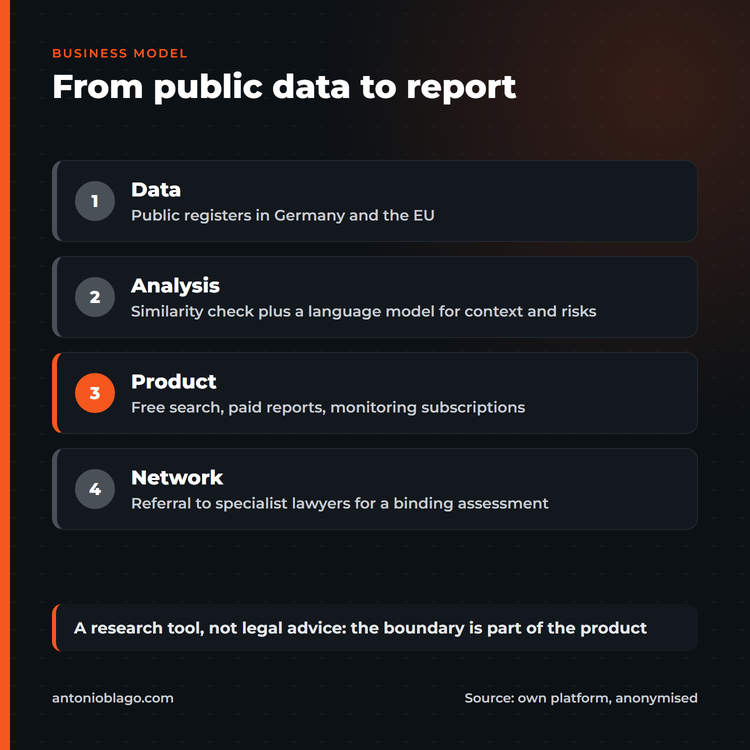
The model is freemium. Search is free, so users see the value immediately. The tool makes money with paid reports that go deeper, with monitoring subscriptions and with referrals to specialist lawyers for a binding assessment. That creates several revenue streams, and the law firms in the network are partners rather than competitors.
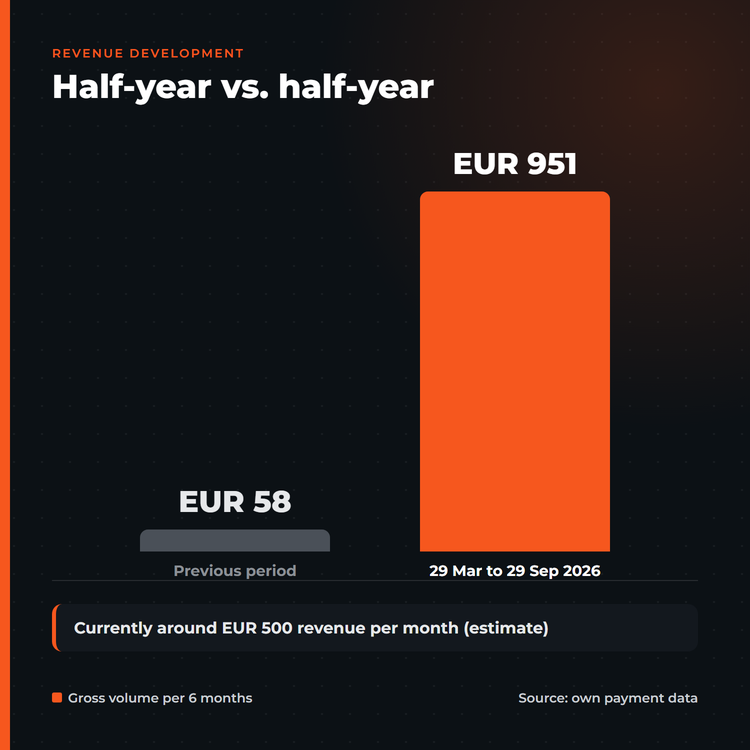
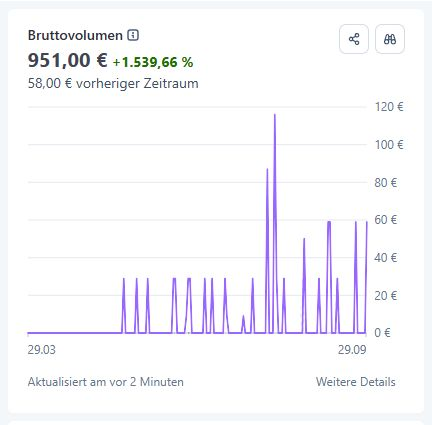
Methodology: this case study is based on my own data. The revenue figures come from my payment provider, the development figures from the commit history. How much money can you realistically make with AI? My honest status: EUR 951 gross volume from late March to late September 2026, after EUR 58 in the half-year before. Most payments are one-off purchases in the low double digits, recently more frequent and larger. My estimate for current monthly revenue is around EUR 500. That is not a full-time income. But it is a product that grows without an ad budget and runs alongside my consulting.
Sales: SEO instead of an ad budget
Customers mainly come through organic search. Alongside the main site, I built several landing pages in different languages, plus guide articles that answer typical pre-launch questions. On top of that come partnerships and targeted outreach to law firms for the network.
I experienced the downside in summer 2026: one of the landing pages lost around 93% of its Google impressions within a short time, and sales dropped noticeably afterwards. If you depend on a single channel, you carry that risk. That applies to Google as much as to ad accounts, as my article on the disabled Meta ad account shows. Why organic digital marketing is still the better start for small budgets is covered in going self-employed: paid vs. organic.
Fiverr, Upwork or your own website?
For AI services, platforms like Fiverr or Upwork bring first jobs quickly, but you compete on price and don't own the customer relationship. For your own tool, there is no way around your own website. It is product, sales page and SEO channel at the same time.
The legal boundary: a research tool, not legal advice
Is it legal and safe to make money with AI in the legal field? Only with a clear boundary. In Germany, the Legal Services Act (RDG) regulates who may provide a legal assessment of an individual case[1]. That's why the tool was built from the start as a research and orientation tool, not as legal advice. The boundary is part of the product itself:
- No predictions: the tool never says whether something will "definitely pass" or "be rejected", and gives no success probabilities.
- Clear notices: every results page and the terms state that it is an automated assessment, not legal advice.
- Transparency about the AI: the privacy policy explains the role of the language model and that it makes no independent decisions.
- A lawyer for the individual case: a specialist firm from the network provides the binding assessment.
This costs revenue, because some users want a clear yes or no. In the long run, though, it's the only sustainable position. Anyone working with AI in the legal field should have their texts, disclaimers and referral model reviewed by a lawyer.
Risks and lessons from seven months
- Data access is the foundation: the first route to the register data was error-prone. Around 16% of queries failed, and a search took over two minutes on average. The fix is an official interface, even if it costs money and an application.
- One channel is not a sales strategy: the Google drop of one landing page hit sales immediately. Several pages, partners and follow-up emails make the business more stable.
- Prices are experiments: a cheap entry option, a standard report and a detailed version show what people really pay for. Repeat buyers led me to bundles.
- AI makes mistakes: the language model classifies, but decides nothing. Every statement must be traceable to the register data. My article on AI hallucinations shows why this matters.
- Customers before capital: without an investor, every month forces you to find paying customers. That made the product better. More on this perspective in my analysis of startups in Germany 2026.
Build your own tool or offer AI as a service?
Is it more lucrative to build AI tools yourself or to offer AI as a service? In the short term, the service clearly wins: a single consulting day brings in more than the tool in a month. In the long term the ratio shifts, because a tool grows without extra hours. My recommendation for entrepreneurs, freelancers and career changers: start with a service that solves a real problem, and turn it into a tool once you've done the process by hand ten times.
The same principle applies to creative professionals: AI tools don't devalue your work if you use them for the grunt work and sell your judgement, style and client relationship. Students and beginners without experience are best off starting with small automations for real clients. The portfolio that comes out of it is worth more than any certificate.
FAQ: making money with AI
How can you use AI to make money online?
The fastest way is AI applications as a service: texts, research, data analysis or automations for clients. Digital products and your own tools are more stable in the long run, because they can be sold without extra hours. Generative AI and text generation are the tool; what you sell is the result.
What advantages does AI have over classic online business models?
The biggest advantage is speed: a prototype that used to take a development team weeks now takes days. The downside is that this applies to your competitors too. Classic models such as online shops, agencies or coaching remain relevant. AI lowers costs, but it does not replace positioning and sales.
Is AI-generated content worth it financially?
As mass-produced content, hardly, because the price tends towards zero. Content becomes valuable when it includes your own data, experience or case studies, which AI cannot provide. Prompt engineering makes the work faster, but the substance still has to come from you.
What technical expertise do you need to make money with AI?
For services and content, very little: if you can write good prompts and understand your client's problem, you can get started. For your own tools, coding agents like Claude Code lower the bar, but you still need to understand what the code does, how to test it and how to deploy it.
Which niches are most profitable when combining AI with business?
Niches where mistakes are expensive: legal, finance, health, compliance or B2B procurement. People pay for certainty there. The same niches come with stricter rules, so the legal and ethical considerations are part of the product, as in my legal tech tool.
How does competition affect earning potential with AI?
Strongly. Because everyone has access to the same models, generic offers get cheaper fast. Your earning potential comes from what others can't copy easily: your own data, a niche audience, trust and distribution.
Is using ChatGPT to make money different from Midjourney or other AI tools?
The tools matter less than the use case. ChatGPT helps with text, research and automation; image tools like Midjourney serve design and creative work. Both are available to everyone, so the value comes from the problem you solve for someone who pays.
Are AI side hustles more scalable than conventional online business models?
Only if the side hustle turns into a product. An AI service is still time for money. A tool or digital product scales, which is why I use services to fund the tools.
Can I generate passive income with AI?
Partly. Digital products and tools earn money at night too, but they need updates, support and new customers. Expect "less active" rather than "passive".
Which technical AI applications are most profitable for programmers?
Tools that connect data with a clear decision: risk checks, forecasts, classification or research on public data. Machine learning and data science pay off when the result saves time or money and can be sold through search or partners.
Conclusion
Making money with AI is possible, but it looks different from what many promises suggest. My legal tech tool shows the realistic path: a clear problem, validated demand, a product with a legally clean boundary, and organic sales. The result after just over seven months is an estimated EUR 500 in monthly revenue and a gross volume that grew more than fifteenfold half-year on half-year. It's a start, not an end point.
If you want to validate and build an idea yourself, my vibe coding workshop (in German) shows you how to challenge the business case and build the first version with Claude Code.
Sources
- German Federal Ministry of Justice: Legal Services Act (Rechtsdienstleistungsgesetz, RDG), Section 2, definition of legal services. Link (German), accessed 30 September 2026.
- Own data: gross volume according to the payment provider, period 29 March to 29 September 2026 and the previous period; commit history of the project. Anonymised.

About the Author: Antonio Blago
SEO Freelancer & AI Visibility Expert
I optimize SEO data-driven with Python, behavioral psychology, and my Neuro-SEO System®. On YouTube, LinkedIn, and Instagram I share hands-on tutorials, insights, and SEO strategies.