Agentic Engineering: 100+ SEO Projects Solo With AI

AI summary
- Fabian dismissed all ten developers in May 2025 after they rejected AI coding, then built over 100 projects solo within a year using Cursor.
- Agentic engineering differs from vibe coding by applying architectural standards where the developer understands and reviews every line of code the AI generates.
- Fabian manages 100+ projects simultaneously using three monitors, nine to fifteen sessions, and unique ports per project to prevent blocking.
- He developed a link building strategy for SEO Day that secured 15 links in Germany and over 200 links across multiple countries using event calendars.
Generated with AI, the details are in the article.
Table of contents
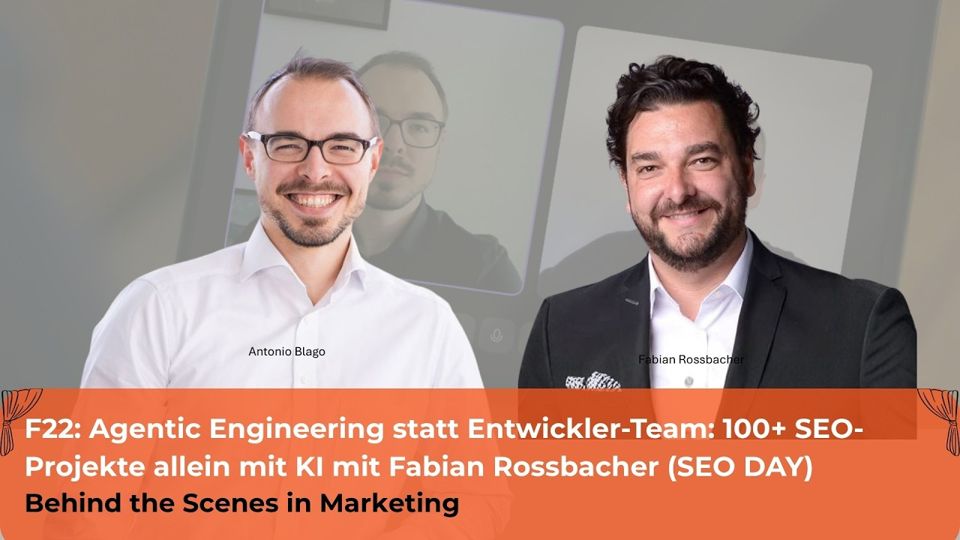
I had wanted to talk to Fabian for a long time. His work kept crossing my path, and I had the feeling that something is happening here that most of us do not yet have on the radar. When I heard that he let all ten of his developers go because they rejected AI coding, and has built everything himself since then, it was clear to me: I had to get him on the podcast. What came out of our conversation left me speechless in a few places.
Watch the video:
From Trouble With Developers to a One-Man Software Shop
Fabian is the founder of SEO Day, one of the best-known SEO conferences in the German-speaking world. He is also a trained software developer, although in recent years he has spent more time on his company than on code.
The trigger for his U-turn was quite concrete: he was annoyed by his developer team explaining yet again why something takes so long. Two developers, frontend and backend, for a small application. He sat down, built it himself, and found that it was not that hard after all.
He gave his team a choice. All ten said no. All ten did not believe that AI coding works. He ended the collaboration. That was in May 2025.
"Today they can no longer stop it." - Fabian
I found that courageous, because it was a real entrepreneurial step in the middle of running projects. And the result after a good year? Over 100 projects, alone.
The Moment That Changed Everything
I was curious when such a moment tips over, when you first truly think: okay, I do not need a team anymore.
For Fabian it was Cursor. He had tried ChatGPT before, but Cursor was the first tool that created real project files on his disk, a proper codebase instead of copied HTML snippets.
"Within three minutes I had an entire project. It was like firing a machine gun for the first time." - Fabian
He told me that for weeks afterwards he slept only three to four hours a night because he simply could not stop. He even pulled his girlfriend along, a WordPress web designer who now builds software for speech therapy practices herself. I know that feeling a little, even though I am far from 100 projects.
Free SEO tools
Keyword ranking, SSR text check, sitemap audit and more, right in the browser and without signup.
Vibe Coding vs. Agentic Engineering: An Important Difference
At this point it got really interesting for me, because we took apart a term that many people mix up.
Vibe coding means you prompt away, hope that something comes out, but do not really understand what the code does. Good for quick prototypes, interfaces and first ideas. Not sustainable once things get complex.
Agentic engineering is something else. Fabian knows his code. He defined it, he understands it, he can review it. For him, the AI is like a team of agents that works by his rules and does not just program on impulse.
"Not a single line of code gets past me that is not the way I want it." - Fabian
For myself I put it like this: the difference lies in the standard you apply. Vibe coding is freestyle. Agentic engineering is architecture. Anyone who only vibe-codes eventually loses control of their own codebase. Fabian experienced this himself in his first months and built a lot of rules out of those mistakes.
How He Manages 100+ Projects at the Same Time
I asked him directly, because it really interested me: how do you keep track of more than 100 projects?
His answer was surprisingly concrete. He works with three monitors. The left one is always frontend, the right one always backend, and the middle one handles middleware and domain logic. Several sessions run on each screen, between 9 and 15 in total at the same time.
He tracks projects in a very simple way, through ports. Every project gets its own port so that they do not block each other. That way he always knows what runs where. Right now he is at port 102 or 103.
Here is what he stressed and what I noted immediately:
- The real training program is memory. You have to learn to remember nine parallel construction sites.
- The new slowness is the human. Not the AI. Not the code. It is your own thinking, deciding and briefing.
- Mistakes now happen almost only in the domain logic, no longer in the code. He gave me an example: on his sailing club directory, images were inserted that showed churches and supermarket parking lots instead of lakes, because he had forgotten to tell the AI to check that water is actually visible in the picture.
I found that refreshingly honest. Technical errors hardly happen anymore. Domain errors happen all the time, because you are too fast yourself.
AI Wikis, Affiliate Sites and Parked Domains
Fabian's SEO strategy is not limited to one niche. He is working on very different projects in parallel:
- AI wikis with thousands of subpages, for example for SEO Day or about cycling topics
- Affiliate comparison sites such as waschmaschine.de
- His own products and brand in the dog category, with oils and capsules
- Directories such as a sailing club finder that filters by boat class
- Parked domains as a playground for content, which he fills on behalf of domain owners
On the wikis he explained how he deals with hallucinations. An article is not generated once and done. Internally the content runs through several rounds in which AI agents check, revise and verify each other. Fabian describes it as a process that resembles a real editorial team, without ChatGPT copy-paste.
"It is like a team working there. Not the ChatGPT way, prompt in, copy-paste out." - Fabian
During the recording he showed me his site radmarkt.com in the Search Console. It went live at the end of November and recently had another traffic peak.
An important note that I want to state explicitly: some of the tactics Fabian uses sit in a gray area of Google's guidelines. Mass AI content, automated outreach in many countries, expired domains as content space. That can work. It can also violate Google's spam policies. What Fabian does is an experiment with a clear willingness to take risks. For company websites I would be much more careful.
Link Building With Event Calendars in Many Countries
This part of our conversation really surprised me. Fabian developed a link building strategy for SEO Day that sounds simple and is simple in its idea: he looks for websites with event calendars and asks whether SEO Day can be added. Legitimate, topically relevant, no spam.
In Germany this brought him around 15 links. Then he applied the same logic to other countries in which Google is active, and that is over 200. Since then he gets backlinks every day from Spain, Italy and countries he barely knew before.
The core of it: a human developed the strategy. The AI carries it out. And that is exactly the point he stressed again and again:
"The flywheel has to come from humans. The AI will not build it for you." - Fabian
That clicked with me right away. I see it the same way. AI is a tool, not a strategist. Anyone who believes they can simply ask "build me a profitable SEO flywheel" will be disappointed. The idea still has to come from your own head.
Google Search Console as the Single Source of Truth
One point where I agreed immediately: Fabian does not measure success with rank tracking tools. He measures exclusively with Google Search Console.
His reasoning is short and fitting: with positions you do not know whether a keyword brings traffic. You do not see whether Google shows a link at all. You see no real clicks. The Search Console shows what actually happens.
I see it the same way in my projects. Anyone who does SEO to see good numbers in a tool ends up optimizing for the wrong goal.
Security for AI-Generated Code
I also asked him how he handles security questions. I found his answer honest:
"If human teams really made software secure, there would have been no security problems at large companies in recent years." - Fabian
He argues that AI is no worse than humans if you tell it what to look for. SQL injection, cross-site scripting, session hijacking: if you include these as requirements and test automatically, they get covered. If you do not, it is a matter of luck, for humans as for AI.
In addition, a friend of his in Canada, a security expert, scans his projects regularly. The results have been uncritical so far.
What I Noted From the Conversation
These are the points I wrote down right after the recording:
- Memory training is everything. Fabian has trained his Cursor setup for over 12 months. Anyone starting today needs weeks until the system responds the way they want.
- Test first as a paradigm. Before every go-live a full test suite runs. That prevents old errors from coming back.
- Constant instead of variable. His database schema exists as a fixed create statement, not as a changelog. The AI calculates the required migrations from it on its own. I found that elegant.
- Playground search as a link building strategy. He asked ChatGPT which topics authorities like to link to. The answer: playground overviews. Every municipality links them. Simple, but effective.
- Scaling without staff. Fabian's goal is to set up agents so that they independently set up projects, upload them and put them online. He only looks at the result.
My Takeaway
I walked away from this conversation with the feeling that we are in a phase that we will call the real turning point in a few years. Because a single person with the right setup, the right mindset and plenty of stamina builds things that used to take ten people.
What impressed me most about Fabian was the consistency, more than the number of projects. He built a system over months, with many mistakes and little sleep, and now it pays off.
If you are interested in AI-supported SEO, listen to the full episode. I only summarized a fraction of it here. And if you are building or about to start, tell us in the comments what your current project is. Fabian is also giving away a ticket for SEO Day. Just comment, like or share. If you want to discuss how agentic workflows can fit into your SEO, book a call with me: https://www.antonioblago.com/termin
Listen to the episode: Agentic Engineering instead of a Dev Team: 100+ SEO Projects Solo With AI | Fabian Rossbacher
FAQ
Question: What is the difference between vibe coding and agentic engineering?
Answer: Vibe coding means prompting away and hoping that something works. You do not necessarily understand what the code does. Agentic engineering is more structured: you know your code, define rules and processes, and the AI agents work within that frame. Fabian and I talked about exactly this, because the difference is massive in practice, especially when projects get more complex.
Question: How many projects can you realistically run alone with AI?
Answer: Fabian is at over 100 and says he soon wants to reach two to three new projects per day. For most people that is not realistic right away. It takes a trained system, clear structures and several months of experience before you can scale like this. But even ten to twenty projects in parallel are doable with the right setup.
Question: Is AI-generated content a risk for SEO?
Answer: Yes, the risk is real. Fabian deliberately operates in a gray area. Mass AI content can violate Google's spam policies. What works for Fabian is due to processes that ensure quality: several revision rounds, mutual review by different AI instances, and content that structurally adds value. For company websites I would assess the risk differently than for experiments on your own domains.
Question: Why is Google Search Console more important than rank tracking tools?
Answer: Because it shows real clicks instead of estimated positions. Rank tracking tools tell you where you theoretically stand for a keyword. Whether that keyword brings any traffic, you only see in the Search Console. Fabian and I agree here: the Search Console is the only reliable source for organic performance.
Question: How do you approach link building with AI as an individual?
Answer: Fabian's approach is a good model. First think about which kind of links make sense topically. Then develop a scalable outreach logic, for example event calendars for conferences or authority directories for local topics. The AI takes over research and the first send, but the strategy behind it comes from the human. Automated mass outreach without topical fit can quickly backfire, so keep that in mind.
Visibly AI: your SEO copilot
Projects, rankings, Search Console data and a copilot that runs the analysis for you. Start for free.

About the Author: Antonio Blago
SEO Freelancer & AI Visibility Expert
I optimize SEO data-driven with Python, behavioral psychology, and my Neuro-SEO System®. On YouTube, LinkedIn, and Instagram I share hands-on tutorials, insights, and SEO strategies.