Google Ranking Improve: What Really Works in 2025

AI summary
- Christian Gülcan, an SEO practitioner with nearly 20 years of experience, reveals that Google's Penguin update in 2012 penalized manipulative link building, costing him an entire six to seven-figure Google account.
- Brand signals and entity recognition now outweigh technical optimization factors like Core Web Vitals, with sites ranking first despite Core Web Vitals scores of 35 or worse.
- Gülcan recommends allocating approximately 80% of SEO energy to offpage measures including digital PR, collaborations, brand mentions, and reviews rather than onpage optimization.
- Companies using fully automated AI-generated content without 60-70% editorial revision risk declining rankings, revenue losses, reputational damage, and entity weakness in Google search results.
Generated with AI, the details are in the article.
Table of contents
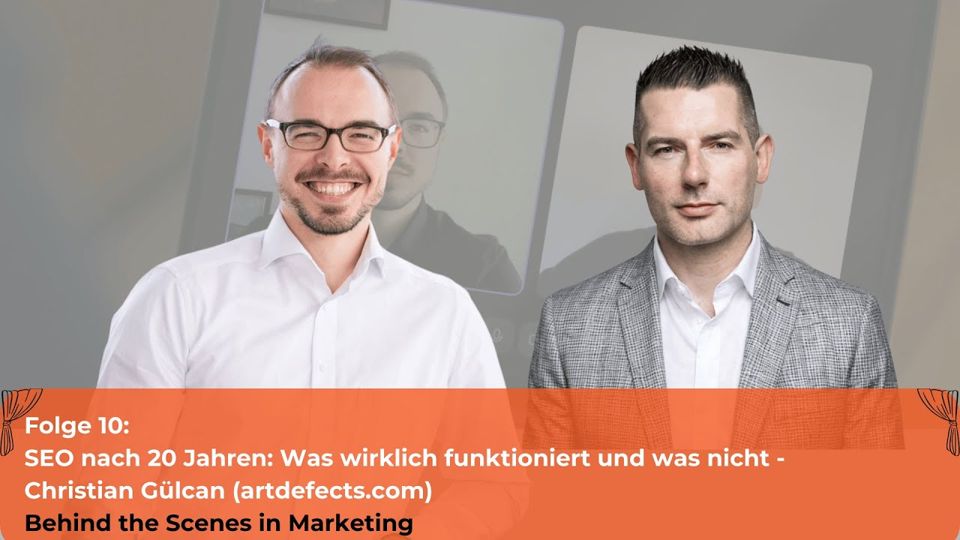
Anyone who wants to improve their Google ranking faces a fundamentally changed reality in 2025. Algorithms are becoming more complex, AI-generated content is flooding search results, and classic tactics are losing their effectiveness. Christian Gülcan, an SEO practitioner with almost 20 years of experience, provides an unsparing insight in an open conversation with marketing host Antonio Blago – from seven-figure losses due to Google penalties to the current AI disruption. This article distills the most important findings for marketing managers, e-commerce professionals, and entrepreneurs who want to improve their ranking on Google.
From the Forum Age to AI Disruption: 20 Years of SEO in Fast Forward
Christian Gülcan started his SEO career in the mid-2000s – initially as an operator of his own web projects. Together with a colleague, he built a portfolio of over 100 websites, monetized through AdSense and affiliate programs. With up to three million visitors per month, the business model was profitable.
To the podcast episode:
The methods used back then were pragmatic: link building through third-party providers, keyword-dominated anchor texts, made-for-AdSense content. What worked then later became a ticking time bomb.
"I had outsourced a lot of link building to a company that had only placed hard keyword anchor texts according to my specifications. That ended up costing me an entire Google account – a six- to seven-figure sum."
This experience with the Penguin update permanently shaped Gülcan's professional mindset: toward clean, sustainable work – and away from rapid scaling at the expense of quality.
The Most Important Google Updates and Their Real-World Impact
Anyone who wants to improve their Google ranking cannot ignore the history of core updates. Three updates have fundamentally influenced Gülcan's work.
Penguin (2012): The End of Link Manipulation
The Penguin update targeted manipulative link building practices. Websites with an unnatural profile of purchased links and keyword-optimized anchor texts were heavily penalized – in some cases entire Google accounts.
Lesson: External link building must be natural, diversified, and high quality. Shortcuts come back to haunt you with considerable delay – and then painfully.
Medic Update (2018): Focus on YMYL Pages
The Medic update hit pages in the "Your Money, Your Life" (YMYL) category particularly hard – health, finance, and legal topics. Google began placing greater emphasis on expertise, authority, and trustworthiness (E-E-A-T).
"The Medic update downgraded some of my portfolios again. But anyone who thought logically knew: this won't only affect YMYL pages."
Helpful Content Update & Core Update 2023/2024: Brands Win
The Helpful Content Update hit many content publishers hard – Gülcan's pages were largely spared because he had focused on E-E-A-T early on. The subsequent core update pushed brands with genuine authority significantly higher.
Conclusion: Those who have not built a real brand, genuine expertise, and entities are today fighting against a structural disadvantage in search results.
Visibly AI: your SEO copilot
Projects, rankings, Search Console data and a copilot that runs the analysis for you. Start for free.
Why AI Content Becomes a Cost Trap
The decision to replace editors with AI-generated texts is tempting – especially for those responsible for finances who only see the cost factor. Gülcan lost a long-standing major client for exactly this reason: the company switched to fully automated AI content.
"Afterwards I looked at what had happened. It just looks like it, you know – these AI slop texts. Conclusion, H3 headings, generic. Let's just slap that everywhere."
The real problem is not AI itself, but the misconception that generated content can rank and convert without editorial revision.
What AI Content Really Costs
Companies that blindly rely on AI content risk:
- Declining rankings, because Google recognizes generic content without added value
- Revenue losses that far exceed the supposed cost advantage
- Reputational damage, because customers perceive low-quality content
- Entity weakness, because AI content does not generate genuine expert signals
Gülcan's own practice: he uses AI as a rough-draft tool – but at least 60–70% of the final result is created through editorial revision and his own expertise.
"60 to 70 percent is like a shell construction. I would never want to publish it like that."
Improving Your Google Ranking: What Really Works Today
1. Brand Signals Beat Technical Optimization
One of Gülcan's central theses: Core Web Vitals and page speed are easy-to-sell topics for many agencies – but they are not the decisive ranking factor for improving your Google ranking.
"Sites with Core Web Vitals scores of 35 and worse still rank in position 1. Brand signals far outweigh that."
What really counts:
- Genuine brand presence with consistent visibility across multiple channels
- Brand search – how often is your company actively searched for?
- Reviews and recommendations on relevant third-party platforms
- Authority through mentions in high-quality sources
2. Entities and the Knowledge Graph
Entities – clearly defined "units" recognized by Google such as people, companies, or concepts – are, in Gülcan's assessment, the be-all and end-all of modern SEO. Anyone who appears in the Knowledge Graph sends strong authority signals. This can be built through:
- Author profiles and expert contributions on external platforms
- Podcasts, YouTube channels, books, or public appearances
- Consistent NAP data (Name, Address, Phone) in directories
- Digital PR and editorial mentions in relevant media
3. Offpage Before Onpage
Once the technical foundation is solid, Gülcan recommends putting around 80% of energy into offpage measures:
- Digital PR: Editorial mentions in relevant online media
- Collaborations: Guest posts and partnerships with thematically relevant sites
- Brand mentions: Even unlinked mentions send signals to Google
- Social proof: Reviews, rating portals, industry directories
"Entities are your friend. You can only build that through third-party platforms where you are mentioned and where you create connections."
4. Content with Real Added Value
High-quality content today means more than well-written text. To achieve a lasting Google ranking improvement, Gülcan recommends:
- Original data and studies as a differentiating feature
- Visuals, tools, and interactive elements for genuine information gain
- Long-tail keywords with specific utility instead of generic head keywords
- Thematic depth through magazine-style structures on your own website
SEO for Online Shops: Specific Challenges and Solutions
SEO for online shops has its own requirements that go beyond classic SEO measures. Anyone who wants to rank sustainably in e-commerce must work on specific levers.
Common Mistakes in E-Commerce SEO
| Problem | Consequence | Solution |
|---|---|---|
| Thin product content | Duplicate content, weak rankings | Unique product descriptions |
| Missing category optimization | Barely any organic visibility | Information-rich category texts |
| No structured data | No rich snippet in the SERPs | Schema markup for products |
| Technical crawling issues | Pages are not indexed | Clean URL structures, XML sitemap |
| No reviews | Weak social proof | Active review management |
Particularly important for online shops: product detail pages and category pages must be designed to be unique. Anyone who copies manufacturer descriptions 1:1 produces duplicate content – and loses out to competitors with their own content.
Offpage Strategies for Online Shops
The following offpage measures are particularly effective for e-commerce sites:
- Product tests and collaborations with bloggers and content creators
- Price comparison portals as an additional source of visibility
- Brand mentions in trade media and consumer magazines
- Trusted Shops, Trustpilot, and Google Reviews actively maintained
Local SEO: Visibility for Regional Businesses
Local SEO is one of the most efficient levers available for businesses with a regional catchment area – and is still underestimated by many SMEs.
The Basics of Local SEO
Anyone who wants to be found locally must build the following foundation:
- Google Business Profile filled in completely and kept up to date
- Consistent NAP data (Name, Address, Phone) on all platforms
- Local citations in industry directories (Yellow Pages, Yelp, Bing Places)
- Local keywords in title tags, meta descriptions, and H1 headings
- Reviews actively solicited and responded to professionally
Local SEO vs. National SEO Strategy
| Factor | Local SEO | National SEO |
|---|---|---|
| Most important signals | Google Business Profile, NAP, reviews | Brand authority, backlinks, E-E-A-T |
| Time horizon | 3–6 months | 6–18 months |
| Competition | Regionally limited | National/international |
| Budget | Low to medium | Medium to high |
| Decisive channel | Local Pack (Maps) | Organic search results |
For local SEO in particular: anyone who does not maintain consistent NAP data loses trust with Google. Every inconsistent variation of an address or phone number weakens the local ranking signal.
The Budget Problem: Why Most Companies Invest Too Little
A recurring theme: German companies – particularly SMEs – structurally invest too little in marketing.
Gülcan's sobering assessment: only around 5% of all companies
Free initial consultation
30 minutes, your website, concrete next steps. No sales pressure.

About the Author: Antonio Blago
SEO Freelancer & AI Visibility Expert
I optimize SEO data-driven with Python, behavioral psychology, and my Neuro-SEO System®. On YouTube, LinkedIn, and Instagram I share hands-on tutorials, insights, and SEO strategies.