AI in Content Marketing: Why Old Models Fail

AI summary
- Organic traffic from Google declined continuously by early 2024 as major publishers like FAZ and Süddeutsche Zeitung entered affiliate marketing with superior authority.
- Traditional affiliate publishing business models collapsed because AI answers user questions directly without routing traffic through websites, fundamentally changing user behavior.
- Publishers should shift from generic SEO content to membership models, niche expertise, community building, and transactional content targeting purchasing decisions.
- Rawshot, an AI photo studio for fashion brands, gained 180 subscriptions within two weeks by solving the expensive problem of product photography without real photoshoots.
Generated with AI, the details are in the article.
Table of contents
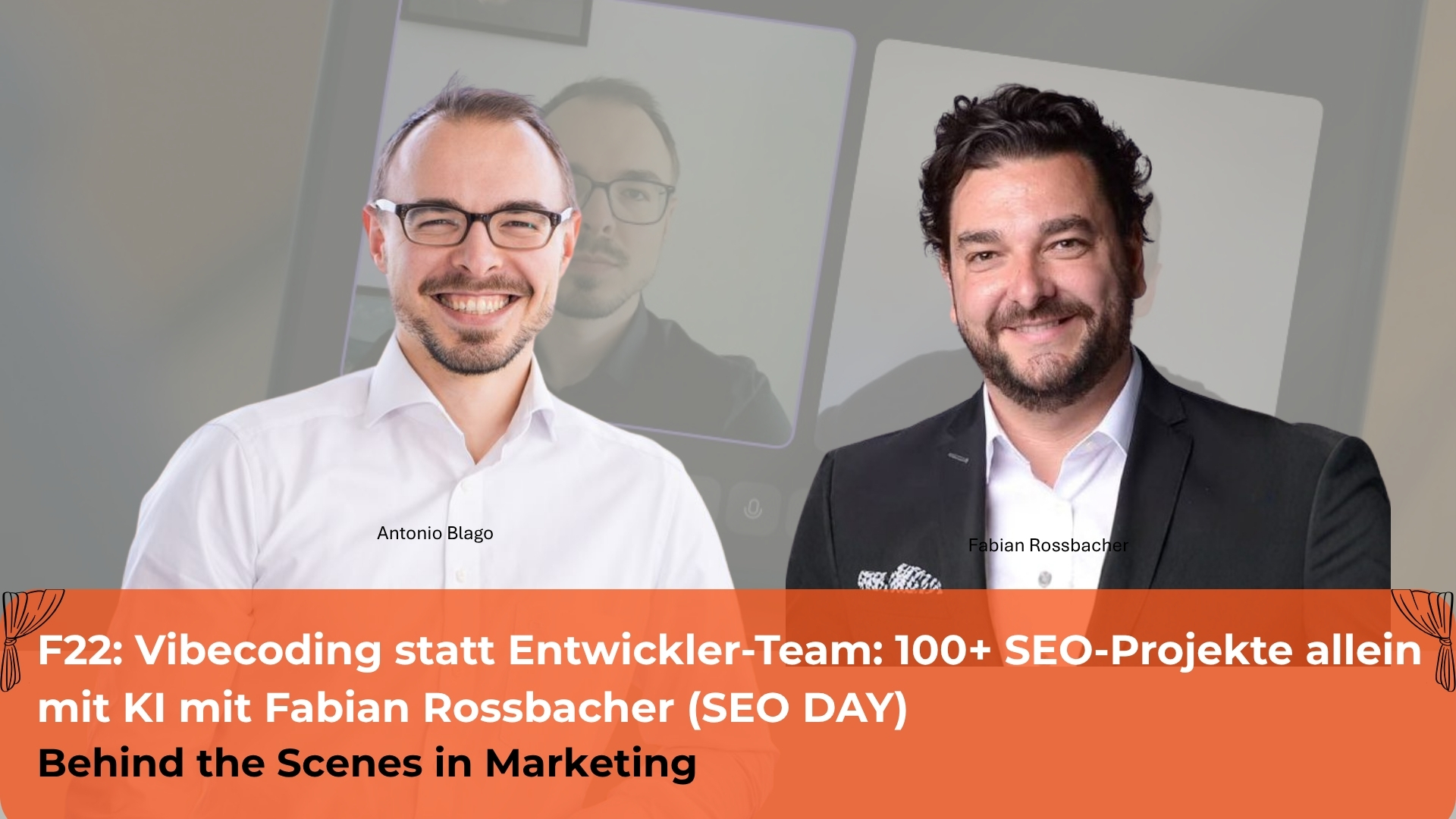
Those who ignore AI in content marketing lose out. Traffic drops, affiliate revenue declines – and AI tools like ChatGPT answer user questions directly, without routing them through a website. In a recent episode of the podcast Behind the Scenes in Marketing, host Antonio Blago speaks with Jannik Lindner, an SEO expert since 2016 and co-founder of several AI software projects, about the structural causes of this development. His analysis provides valuable guidance – not only for publishers, but for anyone involved in digital marketing.
From Affiliate Publisher to AI Founder: Jannik's Journey
Jannik Lindner started out in 2016 as an affiliate marketer and digital nomad. In 2018, he co-founded Global Commerce Media GmbH together with two partners, which managed affiliate projects, collaborated with publishers and e-commerce brands, and generated stable, predictable revenue over many years.
To the podcast episode:

The model worked well for a long time. Then the wind began to shift – by early 2024 at the latest.
"The business model was actually very rewarding, because you had very predictable revenue – very stable. But then at some point it became clear that it was a limited business model that simply wouldn't work indefinitely."
— Jannik Lindner
What initially looked like a temporary dip turned out to be a permanent shift: organic revenue from Google declined continuously, while revenue from Amazon-internal publishing briefly rose – before that too was no longer enough.
Why the Future of Affiliate Marketing Is Uncertain
Jannik describes not a single trigger, but a combination of several factors that make traditional affiliate publishing so difficult today. The future of affiliate marketing depends on how quickly publishers adapt their thinking.
1. Major Publishing Houses Are Entering the Market
Media outlets like FAZ or Süddeutsche Zeitung have entered the affiliate game – and are favored by Google in organic rankings. Small and medium-sized publishers simply cannot compete with this level of authority.
2. AI-Generated Content Is Flooding the Market
With the emergence of GPT-3 and its successors, it became possible to produce enormous amounts of content in a short time. This initially sounded like an opportunity for AI in content marketing – but turned out to be a problem.
"Our business model was essentially content. That's why we thought maybe we could still squeeze something out of it. But that actually didn't really work."
— Jannik Lindner
The quality of generic AI-generated text was not sufficient to differentiate. At the same time, the value of informational content declined overall. AI-generated content without genuine expertise is today a commodity – not a competitive advantage.
3. AI and SEO Are Fundamentally Changing User Behavior
Anyone with a question today gets it answered directly in ChatGPT or in Google AI Mode – personalized and without being routed through a third-party website. The interplay of AI and SEO is thus changing the central mechanism on which traditional publisher models are based.
Visibly AI: your SEO copilot
Projects, rankings, Search Console data and a copilot that runs the analysis for you. Start for free.
The Real Problem: No Viable Business Model
One of the sharpest arguments in Jannik's analysis hits many publishers right at their core:
"Many publishers often lack a real business model behind it all. You just have these advertising revenues – but you need to be very, very large for that to be worthwhile."
— Jannik Lindner
Anyone relying exclusively on display advertising or simple affiliate links is sitting on a very shaky foundation. As soon as traffic drops – and that can happen fast – the entire business model collapses.
What Publishers Should Consider Instead
Jannik and Antonio discuss several alternatives that are structurally more stable:
- Membership models and paid content: Access to premium content for a monthly fee creates predictable revenue that is independent of traffic.
- Consistently building niche expertise: Industry insider knowledge that no AI can replicate – genuine experience reports, primary sources, exclusive data.
- Partnerships and listing placements: As AI systems like ChatGPT increasingly rely on external sources and recommendation lists, a new market is emerging for well-positioned, credible listings and editorial mentions.
- Community building: A loyal readership that actively returns to the website is significantly more valuable than anonymous SEO traffic.
Content Marketing AI: The Top-10 Model Is a Dying Breed
In the field of content marketing AI, a pattern that worked well for years is barely valid today: take a keyword, analyze the top 10 results, adopt the structure, and try to write something "slightly better."
"In the end, it's still always just SEO content. Looking at my own browsing behavior, there are domains I actively return to because I know they've published something new – but those are very few."
— Jannik Lindner
The problem: this approach produces interchangeable content that neither offers real added value nor builds a reader community. In a world where AI generates informational content in seconds, interchangeability is the greatest risk.
What matters instead:
– Original perspectives and genuine expertise
– Content tailored to specific personas and their actual needs
– Transactional content that targets users just before the purchasing decision
– Content that is regularly updated and responds to current developments
Vibe Coding: How Jannik Made the Leap into the Software World
Jannik had recognized early on that he needed to reinvent himself – and chose an unconventional path: he started programming. Without any prior knowledge. With AI as a sparring partner.
What Is Vibe Coding?
Vibe coding describes a development approach in which even non-developers use AI tools like Claude, Cursor, or ChatGPT to create functional code – without possessing deep programming knowledge. The term is deliberately informal: you "feel your way into" building software rather than learning it by the book.
Jannik started with small WordPress plugins that he needed himself. He copied files into ChatGPT, formulated requirements, and had the code generated.
"I had so much fun with it and it really worked. I realized: AI is the ideal sparring partner for me, because I can learn at my own pace and ask as many follow-up questions as I want."
— Jannik Lindner
Today Jannik works with Next.js, React, and JavaScript – a modern, SEO-friendly tech stack – and has built the frontend of his current software projects himself.
The Combination of SEO Know-How and Development Knowledge
Jannik's SEO background proves to be a decisive advantage in this context:
"The typical developer is technically very strong, but lacks the SEO basics. Then mistakes happen: no canonical tags set, internal linking not optimal. I can handle these things myself – I know how to do them better."
— Jannik Lindner
This combination of technical understanding and SEO expertise is rare on the market – and correspondingly valuable.
Rawshot: An AI Photo Studio for Fashion Brands
The biggest project Jannik is currently working on is called Rawshot – an AI-powered photo studio specifically for fashion brands and e-commerce retailers. It exemplifies how AI in content marketing solves concrete business problems.
The Problem Rawshot Solves
Product photos are essential for online shops – but traditional photo shoots are expensive, time-consuming, and legally complex. Image rights, model contracts, limited usage licenses: a small shop owner with two or three employees can barely afford this.
Rawshot makes it possible to visualize products from your own catalog on AI-generated avatars in various poses and settings – without a real photo shoot.
What Sets Rawshot Apart from DIY Solutions
A central design principle: no prompting required from the user. The complex prompts run entirely in the backend.
"What sets us apart are the prompts – that's where most of the work has gone. With prompting, you naturally encounter situations where contradictions arise. That just happens when you build workflows yourself."
— Jannik Lindner
After two weeks of live operation, Rawshot has already gained 180 subscriptions. Technically, Rawshot is based on Google's Imagen model (Nano), which has recently made significant quality leaps.
AI and SEO in Everyday Business: A Pragmatic Approach
It's not only publishers and SEOs who face the question of how to meaningfully integrate AI and SEO. Jannik describes what he repeatedly observes in his consulting work:
"Surprisingly, my consulting sessions often still revolved around very classic SEO – like how to do keyword research. The topic of AI was rarely brought up proactively by the companies themselves."
— Jannik Lindner
Recommendations for Getting Started with AI in Business
1. Designate an internal point of contact
Someone is needed who proactively puts the topic on the agenda – whether that's the managing director, head of marketing, or an engaged employee.
2. Start small, don't wait for perfection
Pre-produce texts with AI, set up a Claude project, test initial workflows – it doesn't need to be a complex system.
3. Use a workshop format
A structured workshop creates shared understanding and identifies concrete use cases for AI in content marketing.
4. Don't use data protection as an excuse
The GDPR topic is real, but shouldn't be a blocker. Anonymized sample data enables productive AI use without legal risks.
"Data protection must not be the reason for not doing things. If you never try it, you'll have a problem at some point."
— Jannik Lindner
Google AI Mode SEO: The Opportunity Many Are Missing
One of the most provocative theses in the conversation concerns Google AI Mode SEO and the future of the SEO industry. Jannik distinguishes between two groups:
The "old hands" stick to established playbooks, argue with traffic-
Free SEO tools
Keyword ranking, SSR text check, sitemap audit and more, right in the browser and without signup.

About the Author: Antonio Blago
SEO Freelancer & AI Visibility Expert
I optimize SEO data-driven with Python, behavioral psychology, and my Neuro-SEO System®. On YouTube, LinkedIn, and Instagram I share hands-on tutorials, insights, and SEO strategies.