The Marketplace Trap: 83% Volume, 95% Merchant Death

AI summary
- Marketplaces generate 83% of global e-commerce volume, but 95% of new Amazon sellers disappear within 12 months, revealing that volume does not equal profitability.
- Marketplace sellers pay 30-50% of gross revenue in commissions and fees, while repeat customers in owned shops cost practically nothing, creating structural margin disadvantages.
- Brand SEO and owned audiences appreciate in value as e-commerce concentrates on platforms, becoming insurance against algorithm changes and providing free traffic through Google and AI search.
- Successful brands use a hybrid approach where marketplaces serve as paid acquisition channels while owned shops function as profit centers, converting expensive marketplace volume into profitable owned audience.
Generated with AI, the details are in the article.
Table of contents
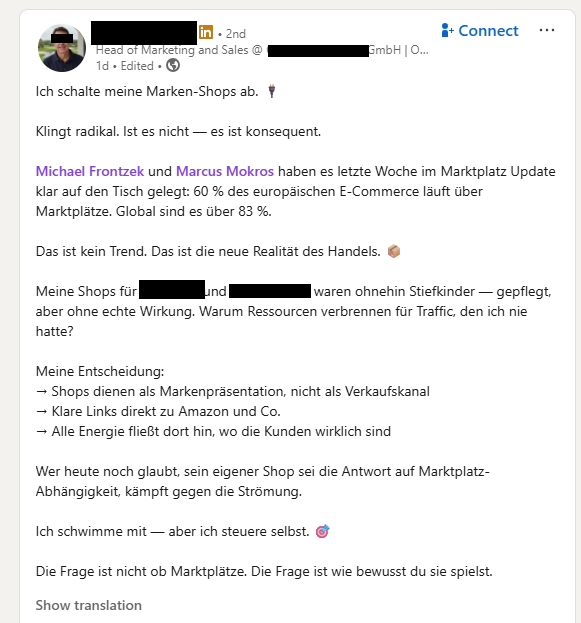
"60 % in Europe, 83 % globally." These figures from the latest Marktplatz Update by Michael Frontzek and Marcus Mokros[1] have stirred up the e-commerce bubble. The message echoing through LinkedIn for days: Anyone not selling on Amazon, Otto, Kaufland, and Zalando no longer exists digitally.
The numbers are correct. But they only tell half the story. In this article, I'll show you why the marketplace euphoria is distorted, why 95 % of new Amazon sellers are gone after 12 months – and why brand SEO and your own owned audience are worth not less, but significantly more in 2026 than they were three years ago.
Core thesis: Marketplace volume is not the same as profit. Anyone building 100 % on rented ground doesn't have a business – they have a dependent sales package. Brand SEO + your own shop are the insurance policy against the algorithm.
1. The Data: Marketplaces Dominate Volume
Let's start with the facts. The eCommerce Data Base (ECDB) regularly publishes market share figures between marketplaces and standalone shops. Wortfilter and Händlerbund have picked up the numbers for 2025/2026[2][3]:
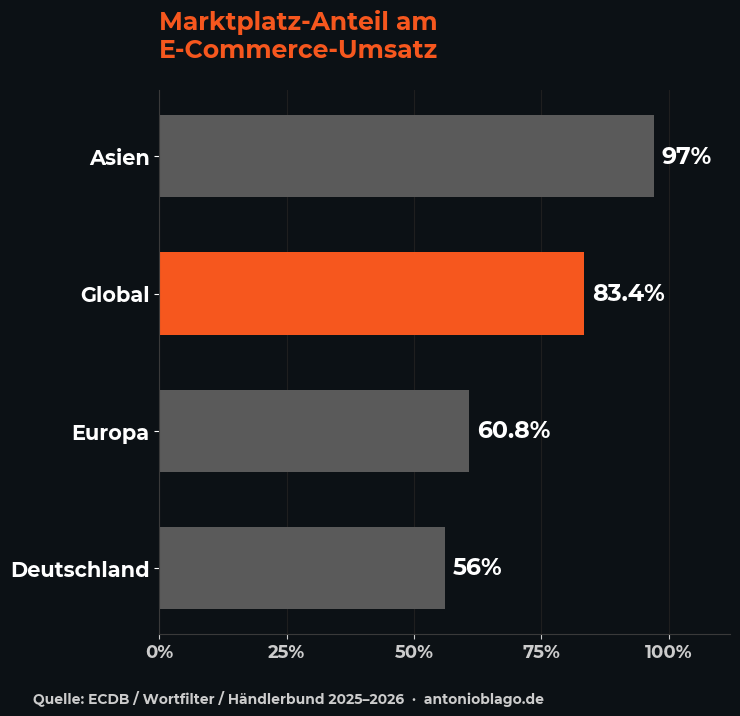
The message is clear: Online marketplaces are the new infrastructure of digital commerce. Anyone seeking reach can hardly avoid platforms anymore. But this is precisely where the honest diagnosis of most marketplace consultants ends.
2. The Uncomfortable Truth: 95 % Seller Mortality
What most reports fail to mention: the brutal churn rate on Amazon. Every year, around 1 million new sellers worldwide launch on Amazon – roughly 2,500 to 3,700 per day. Yet after 12 months, almost nothing remains of this wave[4][5]:
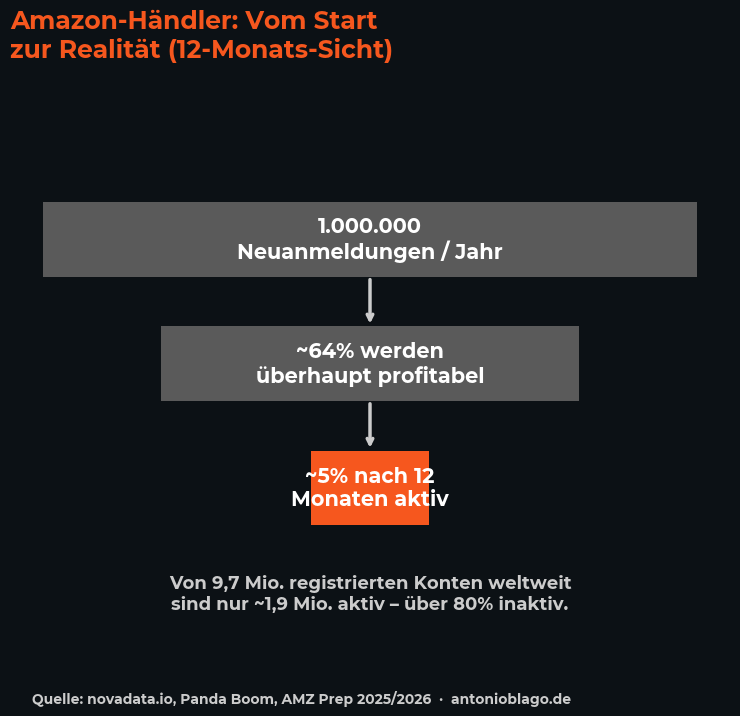
This means: the loud message "Get on Amazon, that's where the money is" is statistically speaking a lottery ticket, not a business model. The professional heavyweights win. Mid-sized businesses and small brands get ground up by the algorithm.
Important: These figures don't contradict Frontzek and Mokros. They refine them. The marketplace share of volume is growing because a few large players are consolidating the market – not because the average seller makes money more easily there.
Free SEO tools
Keyword ranking, SSR text check, sitemap audit and more, right in the browser and without signup.
3. The Margin Reality: Volume ≠ Profit
Let's look at what actually ends up in your account. Net margins differ structurally between marketplaces and your own shop (DTC, e.g. Shopify)[6]:
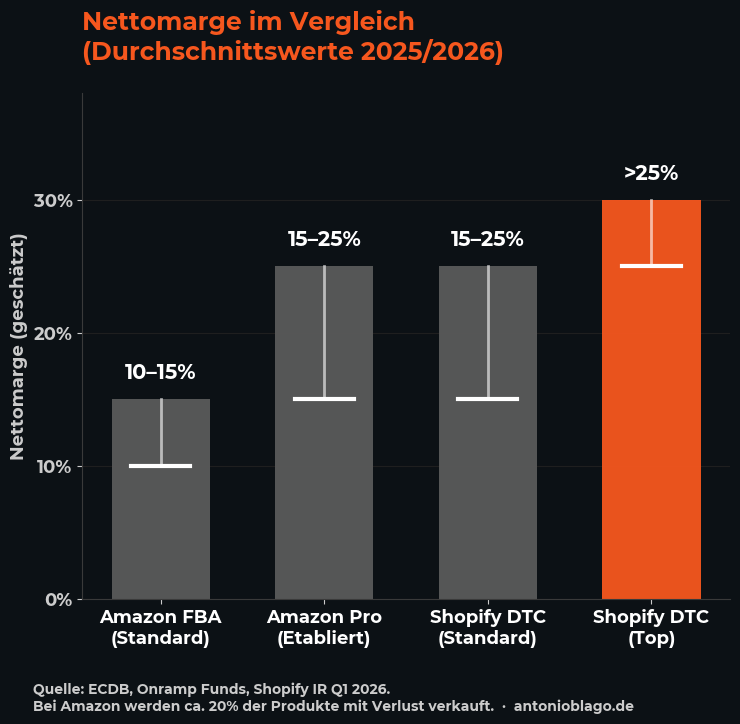
The critical point: On a marketplace, you pay for every single sale. Commission (8 %–15 %, in fashion up to 45 %), FBA fees, advertising. In total, 30 %–50 % of gross revenue often goes directly to the platform. In your own shop, a repeat buyer costs you practically nothing.
Cost Structure: A Direct Comparison
| Cost Factor | Amazon FBA | Own Shop (Shopify) |
|---|---|---|
| Platform fees | 15 %–50 % (commission + FBA + ads) | 27 €–279 € / mo. fixed + 2.4 % transaction |
| Marketing | Internal competition drives up sponsored ads prices | SEO, email, owned channels (scalable) |
| Logistics | FBA economies of scale, but capped margin | Own contracts / 3PL, often more expensive per parcel |
| Customer data | Amazon retains it | Full data ownership + re-marketing |
| Repeat buyers | Virtually no brand loyalty | High customer lifetime value (LTV) |
4. The Bias Factor: Who Is Pushing the Marketplace Recommendation?
This is where it gets political. The current wave of recommendations toward marketplaces is massively distorted. Let's look at who is driving the narrative:
- Amazon consultants and agencies. Their business model is built on the platform's complexity. The deeper a seller is locked into Amazon, the longer they need external help for PPC, listings, and account management.
- Influencers and trade portals. Many are directly or indirectly funded by marketplace ecosystems – advertising, affiliate programs, data licenses.
- The data sources themselves. When reports come from platforms or from providers who license their API/data, caution is warranted. The incentive to portray "growth as inevitable" is built right in.
Key insight: The 83 % is evidence of the market power of the infrastructure – not of the success of the sellers on it. Reach is not the same as profitability.
5. Owned vs. Rented Audience: The Strategic Framework
This is the core of the matter. Every brand today has two types of audiences:
Marketplace Buyers
- Belongs to Amazon / Otto / Zalando
- Fee per sale, every single time
- No data ownership, no email
- Algorithm changes the rules
- Fees rise unilaterally
- Valuable, but temporary
Own Shop, Email, Brand Search
- Belongs to you, no middleman
- Repeat purchases cost practically nothing
- Full data ownership + LTV optimization
- You control assortment + pricing
- SEO + brand search compound over time
- Sellable asset value
The test is simple: If your platform doubles its fees tomorrow – what happens to your cash flow? Anyone 100 % dependent on a marketplace isn't running a business in any real sense. They're a managed department head for a tech corporation, bearing full entrepreneurial risk but without access to their own customers.
6. Brand SEO: Why Classic Search Is Worth More Now, Not Less
Here comes the SEO twist that most marketplace consultants overlook: the more e-commerce concentrates on platforms, the more valuable visibility on your own domain becomes.
Three reasons why brand SEO won't die in 2026 – it will appreciate:
- Google is the brand discovery stage. Even buyers who ultimately purchase on Amazon research on Google first: reviews, comparisons, explanations, Q&A. Anyone visible here influences the marketplace search via the brand name ("Brand X on Amazon").
- AI search is becoming the new discovery layer. Google AI Overviews, ChatGPT, Perplexity, and Gemini cite brand domains that are well-structured and documented – not Amazon listings at random. Anyone without their own brand site with a clear architecture simply won't be mentioned in AI answers.
- Direct brand searches are free traffic. Brand search volume is the only SEO channel that compounds with brand awareness – not with ad spend.
In practical terms: Anyone selling exclusively on marketplaces in 2026 is giving up brand control in two worlds – in platform search and in AI search. The free brand visibility that brand SEO delivers is the insurance policy against both dependencies.
Tool Recommendation · Free
How visible is your brand, really?
The Brand Radar is my free monitoring tool for 308 curated D2C brands in the DACH region. At a glance you can see: monthly brand search volume, 3- and 12-month trends, winners and losers by industry – and where your brand stands in comparison.
7. The Hybrid Approach: Feed the Marketplace, Build Your Own Brand
The most successful brands combine both worlds. Marketplace and own shop are not an either/or question, but a question of role allocation:
| Role | Function in the Hybrid Model |
|---|---|
| Marketplace | Acquisition channel – paid reach, first contact, brand testing |
| Own shop | Profit center – repeat purchases, higher margins, full data ownership |
| Brand SEO | Discovery layer – brand value, free traffic, AI search visibility |
| Email / Owned | Insurance – LTV maximization, resilience against platform outages |
Anyone who deliberately moves marketplace customers into their own ecosystem – via insert cards, QR code incentives, brand communications, brand search queries – converts expensive marketplace volume into profitable owned audience.
8. Diagnostic Checklist: Am I Too Dependent?
Seven questions you should answer honestly:
- What percentage of my revenue comes from just one platform (Amazon, Otto, Zalando)?
- What happens to my cash flow if that platform raises its fees by 20 % tomorrow?
- Do I have my own domain that ranks in Google for my brand terms?
- How many of my customers' email addresses do I actually own (not just Amazon order emails)?
- Am I visible in AI Overviews / ChatGPT answers for my product category – or is it only Amazon?
- How much direct brand traffic does my own domain receive?
- If I were to sell my business today – what would the asset value be without the marketplace account?
Anyone who finds three or more of these questions uncomfortable has a concentration risk, not growth.
9. Conclusion: Profit Is Substance, Not Reach
The figures from Frontzek and Mokros are not a lie. They are evidence that the infrastructure of commerce is being centralized. But drawing the conclusion that every seller should go 100 % to marketplaces is precisely the distortion that the consulting industry lives off.
Revenue is visibility. Profit is substance.
In the long run, you only own what you control yourself: your own shop, your own data, your own brand relationship. Brand SEO in 2026 is not a hobby for marketing romantics – it is the structural insurance policy against the algorithm. Marketplace and owned audience are not a contradiction. But anyone who stops cultivating their own ground will eventually be evicted by the landlord.
Want to know how visible your domain is today in Google and in the AI engines (ChatGPT, Gemini, Perplexity) – and how to build brand SEO as insurance against marketplace dependency? Book a free initial consultation – or get started directly with the free Brand Radar.
Note: All revenue, margin, and seller figures are estimates based on publicly available data and do not represent verified business figures. Sources are listed below.
Sources
- Marktplatz Update Podcast – Episode 2026-04 with Michael Frontzek and Marcus Mokros, discussion of ECDB data on marketplace shares 2025/2026.
- Wortfilter – "Marketplaces dominate 83 % of e-commerce", report on global GMV shares 2025/2026. wortfilter.de
- Händlerbund – Marketplace analyses 2024/2025 based on ECDB surveys. haendlerbund.de
- novadata.io – "Amazon Seller Statistics 2026: 70+ Key Data Points", data on new registrations, active accounts, and churn.
- Panda Boom – "Amazon FBA Success Rate in 2026: Real Data, Real Results", analysis of profitability and dropout rates.
- Onramp Funds – Margin analyses DTC vs. Amazon FBA 2025/2026.
- Shopify Investor Relations – GMV and merchant growth data Q1 2026 (~378 bn USD GMV, +29.3 % YoY).
- HDE Online Monitor 2025 – Market shares in German e-commerce. einzelhandel.de
- IFH Köln – B2B internet retail market analysis 2025. ifhkoeln.de
Brand Radar: where does your brand stand?
Brand and generic traffic, competitors and potential at a glance, free of charge.

About the Author: Antonio Blago
SEO Freelancer & AI Visibility Expert
I optimize SEO data-driven with Python, behavioral psychology, and my Neuro-SEO System®. On YouTube, LinkedIn, and Instagram I share hands-on tutorials, insights, and SEO strategies.