SEO B2B: What Big Brands Will Really Do Differently in 2026

AI summary
- Hansgrohe's SEO lead manages over 50 country websites with a team of two people, acting as an internal agency guiding local marketing managers.
- Sustainable B2B SEO strategy focuses on brand search, product-related searches, and generic advisory content rather than pursuing short-term algorithm hacks.
- Enterprise SEO requires 50% internal communication and stakeholder management, with success measured through brand presence across touchpoints rather than direct conversions.
- AI visibility at Hansgrohe is measured by tracking brand mention percentages in AI responses, with 86% brand inclusion rate demonstrating measurable impact.
Generated with AI, the details are in the article.
Table of contents
SEO B2B: What Big Brands Are Really Doing Differently in 2026
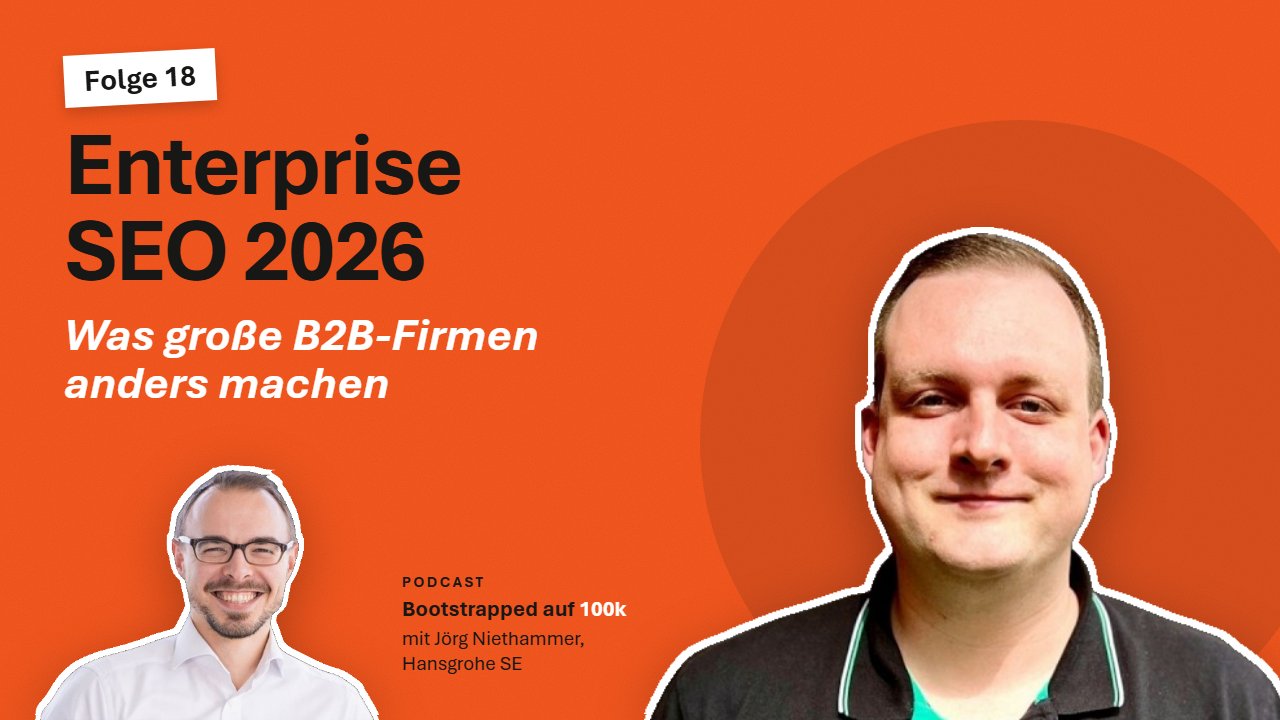
I've been following Jörg Niethammer on LinkedIn for a while and have been wanting to invite him on the podcast for some time. His posts are never loud, but always to the point. As the SEO lead at Hansgrohe, he brings a perspective on B2B SEO that you don't get from just anyone: global structures, over 50 country websites, no own online shop, and yet measurable success with organic visibility. The conversation genuinely surprised me at several points.
To the video:
From Hobby Webmaster to Enterprise SEO
What grabbed me about Jörg's story from the very beginning: he didn't come to SEO through an apprenticeship or a degree, but through a friend group website around 2003. He started building pages at age 12, 13, and at some point he began wondering why some content shows up on Google and other content doesn't.
As Jörg described it himself:
„I didn't even realize I had already discovered SEO for myself in a way.“
That clicked with me immediately. Many of the best SEOs I know got into it exactly that way. Not through a textbook, but through genuine tinkering and experimentation. Jörg then went on to study business administration with a focus on finance, stumbled into the online marketing field through an internship at Allianz, and professionalized his SEO skills as part of a trainee program in Munich.
What I found interesting: he describes that agency period as a real education, especially because of the difficult client moments.
„At first I was always very emotional. Oh God, we need to respond right away. These days I'm very relaxed because of it.“
I know that feeling. And I believe that exact journey from reactive to strategic is what sets experienced SEOs apart from beginners.
Sustainable SEO instead of actionism
One of the recurring themes in our conversation: Jörg witnessed during his agency days how damaging short-term reactions can be. He has consistently carried this insight into his work at Hansgrohe. For him, sustainable SEO means not jumping on every algorithm bandwagon, but instead pursuing a stable strategy that holds up over the long term.
We talked about whether Google favors websites that don't chase every hack. Jörg was honest: you can't make a blanket statement about that. But his own experience proves him right.
„We never engaged in that kind of actionism. Today we benefit from always having thought sustainably.“
What impressed me about this: it's not an empty claim. Hansgrohe has hardly any volatile visibility fluctuations. Partly due to the industry, no doubt, but also due to strategy. Sustainable SEO pays off in measurable ways – especially in a B2B context.
My key takeaways from this:
- No blind reactions to algorithm updates
- No keyword page spam logic from years gone by
- Instead: a holistic content strategy across the entire customer journey
How visible is your brand in ChatGPT and friends?
The AI Check shows you within minutes whether and how AI assistants mention your brand.
B2B SEO Strategy: What This Really Means in Practice
Hansgrohe is a company that actively operates in both B2B and B2C. This sounds contradictory at first, but makes total sense once you understand the logic behind it. The end customer doesn't buy directly from Hansgrohe. They buy from the tradesperson, wholesaler, or hardware store. But they ask the tradesperson for the shower they saw at Hansgrohe.
A successful B2B SEO strategy must reflect exactly this dynamic: whoever reaches the end customer at all relevant touchpoints wins the conversation at the point of sale – even when it happens indirectly.
As Jörg described it:
„Our goal is for the customer to then go to the B2B partner and say: Hey, I want the shower from Hansgrohe.“
This is what makes the SEO strategy interesting. It's not about direct conversions, but about presence at all touchpoints. Jörg mentioned three core areas of his B2B SEO strategy:
- Brand Search: More than half of all search queries already come with a brand reference. That's a strong signal.
- Product-related Search: Search queries around specific products, shower systems, fittings, etc.
- Generic Content: Informational content such as „How do I plan my bathroom with a sloped ceiling?“ or „How do I descale my showerhead?“
This third area is the most exciting one for me. Because there's no direct buying impulse there, yet that's precisely where you build trust. And trust is the only thing that really counts when it comes to a purchasing decision that may only happen once every 20 years.
Corporate SEO: Over 50 Countries, Two Brands, a Team of Two
That's where it got really interesting for me. I asked what the SEO team looks like. The answer:
„In terms of people who explicitly do SEO, there are two of us.“
Two people. For Hansgrohe and Axor. For over 50 country websites. With country-specific domains, different CMS requirements, various sales structures. This is corporate SEO in its purest form: maximum complexity, minimal resources.
What I hadn't expected: the actual implementation lies with the local marketing managers in the respective countries. Jörg and his colleague Jonas essentially act as an internal agency, providing recommendations and guiding processes. That sounds like an enormous challenge when it comes to quality assurance.
Jörg assessed it very matter-of-factly:
„You'll never get it 100% right. Things also need to move quickly.“
That's more honest than what you usually hear from corporate SEO managers. No perfect process documentation will save you when the new colleague in the neighboring country doesn't know they're supposed to seek out SEO recommendations.
Multilingual Website SEO: The Biggest Operational Challenge
One of the most complex tasks in corporate SEO at Hansgrohe is managing a multilingual website across more than 50 country markets. SEO for a multilingual website doesn't simply mean translating – it means understanding local search intent, implementing hreflang correctly, and maintaining a consistent brand message at the same time.
Jörg addresses this through clear responsibilities: the local teams know their markets, the central SEO team provides the strategic framework. What works globally is documented and shared as best practice. What varies locally remains in the hands of the country-specific marketing managers.
Stakeholder Management as a Core Competency in Enterprise SEO
We then moved fairly quickly to the topic I consider the most underrated part of enterprise SEO: internal selling. Those responsible for enterprise SEO often spend more time persuading people internally than optimizing externally.
Jörg put it this way:
„I'm a bit like an internal politician who always has to find good arguments and needs to have a lot of allies.“
What he does specifically, I find quite smart:
- He barely uses the terms „SEO“ or „GEO“ internally at all, because many people immediately fall back into old patterns of thinking when they hear them.
- Instead, he talks about digital visibility, touchpoints, and brand presence.
- And he actively shares successes rather than just making new demands.
The second point really stuck with me. In my own consulting engagements, I've often made the mistake of focusing too much on „you need to change this now“ instead of saying: „Look at what we've already achieved with this.“ That makes a real difference when working within corporate structures.
AI Visibility: What's Really Happening at Hansgrohe
I was naturally curious to know how Jörg views all the AI hype. His perspective was balanced, but clear.
Hansgrohe is not losing any significant traffic through AI systems. And there's a understandable reason for this:
„People don't engage with this topic every day. Maybe only once in their lifetime or every 20 years.“
With decisions like these, people still rely heavily on brand content. This also explains why brand search numbers went up last year, even as AI tools are being used more and more. Jörg's theory: many people first gather information from ChatGPT or similar tools, and then search specifically for the brand on Google.
How does Jörg actually measure AI visibility? He gives an example:
„I can show what percentage of all comparable prompts mention my brand in the AI response. If that's 86%, I can sell that internally with ease.“
That's pragmatic. No buzzword battles – just a number that people understand.
What struck me more, though: internally, even at Hansgrohe there are people who simply ignore AI. And others who want to turn everything upside down immediately. Jörg consciously sees himself as sitting between these two extremes.
„Don't throw everything overboard overnight, but also be clear about where processes need to change.“
Wikipedia as an Underestimated Tool in the SEO B2B Arsenal
Honestly, this was the topic I hadn't expected to feature so prominently. Jörg also consults on Wikipedia articles on the side and has a clear stance on the matter.
Wikipedia is not a company blog. Anyone looking to bury criticism there or sugarcoat articles is working with the wrong consultant. What does make sense, however, is improving articles that haven't been maintained for years, adding sources, and enhancing them with factual content.
And why is this relevant for SEO B2B? Because Wikipedia remains one of the most frequently cited sources in AI systems. A well-maintained, neutral article can therefore influence visibility in generated responses – even in a B2B context.
Jörg also has a note for anyone aiming to get a Wikipedia page for their agency or brand:
„Companies with revenues of over 100 million euros or more than 1000 employees. Anything below that will generally not have encyclopedic relevance.“
Clear, direct, and helpful.
My Personal Key Takeaways
When I summarize the conversation, these are the points I noted down immediately:
- Sustainable SEO pays off: Those who don't jump on every algorithm bandwagon benefit in the long run. This applies in B2B just as much as in B2C.
- B2B SEO needs a clear B2C logic: Even when sales happen indirectly, you need to take the end customer seriously as an SEO target audience.
- Internal visibility is just as important as external: Enterprise SEO is 50% communication work.
- Brand search is a strong signal: When your brand is searched for directly more often, that says something about trust.
- Assess AI tools with a level head: Neither ignore them nor panic. Look at where they are genuinely making a difference.
Conclusion
I've rarely come across someone who talks about B2B SEO so calmly. No big promises, no AI scaremongering, no buzzword bingo. Jörg works with real numbers, real structures, and a very clear understanding of what corporate SEO can and cannot achieve in a global corporation.
What he said at the end has stuck with me:
„Yesterday's hack is tomorrow's penalty.“
Short, apt, true.
If you're responsible for B2B SEO in a larger company, or want to understand how enterprise structures really work, you absolutely have to listen to this episode. I certainly took quite a few things away from it.
You can find the podcast episode right here: F18: Enterprise SEO bei Hansgrohe
You can find Jörg on LinkedIn and his SEO Diary Podcast on Spotify. For Wikipedia consulting, you can reach him through his website seo-diary.de.
FAQ: B2B SEO – Frequently Asked Questions
What is the difference between B2B SEO and B2C SEO?
B2B SEO focuses on longer buying cycles, multiple decision-makers, and often indirect conversion paths. While B2C SEO frequently optimizes for direct purchases, B2B is about building trust and brand presence across many touchpoints. Jörg's work at Hansgrohe illustrates this perfectly: the end customer is won over through content, but makes their purchase through the B2B partner.
What is Enterprise SEO and how does it differ from regular SEO?
Enterprise SEO refers to search engine optimization within large companies with complex website structures, many stakeholders, and often international markets. Jörg and I made it clear in our conversation that technical SEO work often takes less time than internal communication and persuasion. Stakeholder management is at least as important in Enterprise SEO as technical expertise.
How do I develop a sustainable B2B SEO strategy?
A successful B2B SEO strategy rests on three pillars: building brand search, product-related content, and generic advisory content along the customer journey. What matters is avoiding short-term algorithm hacks and instead thinking consistently and long-term. Sustainable SEO means building trust – especially when it comes to purchasing decisions with long cycles.
How does corporate SEO work for a multilingual website?
SEO for a multilingual website requires clear governance structures: who decides what at which level? At Hansgrohe, the central team provides the strategic framework, while local marketing managers are responsible for country-specific implementation. Technically, correct hreflang implementation and consistent brand messaging across all language versions are crucial.
How do you meaningfully measure AI visibility in B2B SEO?
Jörg uses tools that show how often a brand appears in AI responses on specific topics. A simple percentage model: in what proportion of comparable queries is my brand mentioned? This can be communicated well internally and makes AI visibility tangible for stakeholders.
How do I convince internal stakeholders to support B2B SEO initiatives?
Jörg's approach: share successes rather than make demands. Avoid the term „SEO“ wherever possible, because it triggers outdated associations for many people. Instead, talk about digital visibility and brand touchpoints. And use small pilot projects to demonstrate results before requesting major resources.
Brand Radar: where does your brand stand?
Brand and generic traffic, competitors and potential at a glance, free of charge.

About the Author: Antonio Blago
SEO Freelancer & AI Visibility Expert
I optimize SEO data-driven with Python, behavioral psychology, and my Neuro-SEO System®. On YouTube, LinkedIn, and Instagram I share hands-on tutorials, insights, and SEO strategies.