Strategy 2026: Entities SEO & Knowledge Graph Expert Maximilian D. Muhr in Conversation with Antonio Blago

AI summary
- Google's Knowledge Graph, continuously built since 2012, assigns unique identities to entities like people, companies, and places, fundamentally changing SEO from keyword-driven to entity-based optimization.
- Average click-through rate for position 1 ranking dropped to 5.59 percent according to the 2026 Keyword Study, as Google answers queries directly through Knowledge Panels and AI Overviews.
- Brand searches and TV appearances measurably boost organic rankings, with Urlaubspiraten experiencing ranking improvements after television exposure generated direct traffic and brand search queries.
- Companies should establish consistent name spelling across all platforms, sharpen positioning to appear in Knowledge Panel descriptions, and maintain profiles on relevant business directories and review portals.
Generated with AI, the details are in the article.
Table of contents
Anyone who still equates SEO exclusively with keywords and backlinks today is working according to a model that Google has been gradually overcoming for years. Entity SEO, the Google Knowledge Graph and AI-powered search have fundamentally changed the rules of the game. Many companies haven't truly understood this yet.
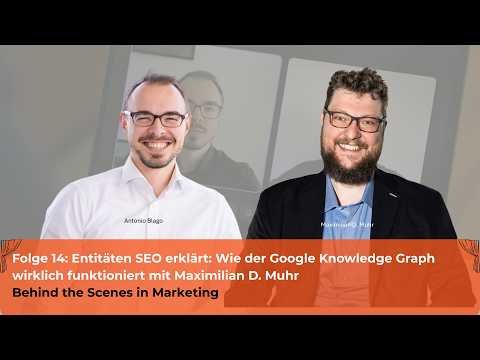
I sat down with Maximilian D. Muhr because this topic has been on my mind for a while. Maximilian is one of the few in the German-speaking region who truly understands Entity SEO in depth. He looks back on over 20 years of practical experience: from the early SEO years at BILD through positions at Urlaubspiraten, Everdrop and international media group Ringier to developing his own tool on poliSYS.de. What started as Knowledge Graph monitoring has now become a platform for Agentic AI entity optimization.
What came out of it: a practical analysis of how search engines really think today and what this specifically means for companies, brands and SEO managers.
To the video:
From Keyword Thinking to Entity: How Google Reinvented Search
What actually is the Google Knowledge Graph?
The Google Knowledge Graph is a huge knowledge database that Google has been continuously building since 2012. It doesn't contain simple text documents, but structured entities: clearly defined objects from the real world such as people, companies, places, products or events.
The crucial difference from classic keyword matching: An entity has a unique identity, regardless of how it's written. The word "Apache" can describe a server, a helicopter or a Native American. An entity, on the other hand, is uniquely assigned. It has a fixed ID in the Knowledge Graph, the so-called KGMID (Knowledge Graph Machine Identifier). For modern search engine optimization, this distinction is crucial.
"In Google's early days, everything was very keyword-driven. You couldn't know exactly what was meant when someone searched for "Apache". That could be a server, a helicopter or a Native American. Through entities, there can be multiple things that are basically written the same but have different meanings because they are a fixed set."
— Maximilian D. Muhr
For companies, this means: It's no longer just the text on your own website that determines visibility. The real question is whether and how Google understands and categorizes a brand as a clearly defined entity.
SEO Entities vs. Large Language Models: What's the difference?
A common misunderstanding: Are LLMs like ChatGPT the same as a Knowledge Graph? Maximilian clearly broke this down in our conversation.
Early versions of language models were primarily based on statistical probability, they guess the most likely next word. Newer systems with reasoning, RAG (Retrieval Augmented Generation) or structured knowledge need Knowledge Graph structures to correctly represent meanings and connections.
"Knowledge systems are rather relevant now for the more modern systems that try to give the whole thing meaning and design a meaning space or connections to other entities."
— Maximilian D. Muhr
Both Google and modern AI search systems like Perplexity, ChatGPT or Bing work entity-based today. Anyone who wants to be visible there must be recognizable as an entity.
Lessons from 20 Years of SEO Practice: From BILD to Global Entity Optimization
Early Structures at BILD: The Predecessor of the Knowledge Graph
Maximilian began his SEO career at BILD in 2008, at a time when SEO was still largely manual work. What's interesting in retrospect: The editorial team was already building a kind of taxonomy that conceptually resembles what Google today calls the Knowledge Graph.
Content wasn't just tagged with free keywords, but structured in a controlled vocabulary of people, places and events. Editors weren't allowed to simply create new nodes, i.e. new entities, themselves. There was a central review body that ensured no duplicates were created.
"This taxonomy was an extremely exciting project. You could build a topic page with all articles where Person A and Person B were linked. That was already a bit of a predecessor to what you see today as a Knowledge Graph."
— Maximilian D. Muhr
What companies can learn from this: Consistency and control over terms and designations aren't bureaucratic trivialities. They are the prerequisite for machines to correctly assign content.
Entity SEO for International Markets: The Ringier Example
It got really interesting when Maximilian told us about his time at Ringier. As Associate Director Marketing in the Classifieds division, he was co-responsible for internationally leading marketplace, job and real estate portals. When Google announced the Search Generative Experience (SGE, now AI Overviews), the question arose: How do you position companies so that they are preferentially recommended by AI searches?
Using the example of the Kenyan real estate portal BuyRentKenya, Maximilian explained the process:
- Standardize the name: The company name was in circulation in various spellings. First step: establish a single, clearly defined spelling, consistent across all platforms.
- Sharpen positioning: In the Kenyan real estate market, trust is a central issue as fraud is widespread. The strategic positioning as "Trusted Real Estate Company" was defined as a clear benefit advantage.
- Influence the Knowledge Graph description: A short type designation appears next to the company name in the Knowledge Panel. This can be specifically controlled through consistent signals.
With the free "poliSYS Entity Discover Tool" anyone can select a search term e.g. "BuyRentKenya" or "Semrush" and a language e.g. "English" and then see whether Google only describes the entity as "Company" or perhaps the description is "Real Estate Company" or "Search Engine Marketing Company", a more exact assignment is a great success.


How visible is your brand in ChatGPT and friends?
The AI Check shows you within minutes whether and how AI assistants mention your brand.
SEO 2026 Trends: Zero-Click-Searches and the Decline of Organic Traffic
Why Classic Traffic Models No Longer Work
One of the most important SEO 2026 trends concerns the dramatic decline in organic click-through rates. Anyone still relying on traffic volume as the primary SEO metric needs to rethink. Today, the average CTR for position 1 in many industries is no longer 30%, as older studies suggested, but just 5 to 8%. My Keyword Study 2026, based on anonymized Search Console data, measures an average of just 5.59 % CTR for position 1.
The reason: Google answers more and more search queries directly in the search results, via Knowledge Panels, Featured Snippets, AI Overviews and other SERP features. The classic business model "lots of traffic, lots of banner ads, revenue" no longer works this way.
"The business model of marketing traffic from Google via CPM and banner impressions will no longer work like this. Google is no longer the traffic gateway that channels millions of SEO visits to websites."
— Maximilian D. Muhr
What this means: Companies need to rethink SEO. It's no longer about generating as much traffic as possible. It's about being present as a trustworthy entity at as many relevant touchpoints as possible, even when no click takes place.
AI Search as New Reality in Modern Search Engine Optimization
Maximilian himself increasingly uses systems like Perplexity, ChatGPT and Claude. We also talked about our own changed search behavior in the conversation, and I'm no exception. Modern search engine optimization therefore means: not only optimizing for Google, but for the entire ecosystem of AI-powered search.
"I think it's good when the user journey becomes easier and I see that how people make purchasing decisions is changing. It's legitimate when Google and others answer questions directly, we shouldn't mourn that there used to be more clicks, but rather adapt to the realities in online marketing."
— Maximilian D. Muhr
For companies, this means: The question is no longer just "Do I rank on page 1?", but: "Am I recommended by AI systems as a relevant, trustworthy source?"
Brand Signals, Digital PR and Reputation: The Underestimated SEO Lever
How TV Appearances and Influencer Campaigns Influence Rankings
One of the most surprising points from Maximilian's career: Brand searches, i.e. direct search queries for a brand name, have a measurable, positive effect on organic rankings.
At Urlaubspiraten, the team tested this empirically. A TV appearance by an HR manager on a television show led to a noticeable increase in traffic with a high proportion of brand search queries during commercial breaks. The result was a temporary ranking boost for the entire domain.
Similar effects were observed with WhatsApp newsletters. When deals were pushed via this channel, the resulting direct traffic demonstrably led to better rankings of the linked pages.
"If you are extremely present with your brand, whether on television or in newspapers or anywhere else, and that leads to people doing brand searches – then Google notices that, sees certain topics and certain brands in combination and that pushes."
— Maximilian D. Muhr
Practical tip: Companies should actively use their own community, newsletter or social media channels to encourage brand searches. I do this myself: I recommend my followers to simply google my name or brand name. In the Google Search Console you can see that it works.
Reputation is an Entity SEO Factor
Maximilian went one step further. Google and AI searches don't just evaluate what companies communicate on their own website. They also analyze:
- Reviews on platforms like Trustpilot, Google Maps, Kununu or Glassdoor
- Mentions in forums and on Reddit
- Tone and sentiment of press reports
- Community discussions on social media
"Google has become extremely strong at evaluating sentiment. It's not about the number of brand mentions and reviews. It's not just about what you write on your own website. Rather, the overall picture on all indexed URLs is decisive, which is why companies should closely observe and influence where and in what way they and their products are written and talked about."
— Maximilian D. Muhr
Negative entries on review platforms or unanswered complaints in forums are thus not just a reputation problem. They are an entity SEO problem.
The Practical Entity SEO Checklist: What Companies Should Do Now
From his experience, Maximilian has distilled a clear process that companies of any size can implement:
Step 1: Clarify Company Name Spelling
Sounds trivial, but it's not. Maximilian recommends the "tour through the departments": Marketing, accounting, IT, social media, everywhere often different spellings of one's own company name appear.
Recommendation: Use the spelling from the commercial register (including legal form like GmbH) and establish this as a binding standard for all internal and external communications.
Step 2: Sharpen Positioning
What does the company do? For whom? What problem does it solve? This positioning should be concise, to the point and clearly aligned with a customer need, not with marketing speak.
Why this is important: A short type designation appears next to the company name in the Knowledge Panel. Anyone who only has "Company" there is wasting potential. Anyone who reads "Trusted Real Estate Company" or "Search Engine Marketing Company" there has already placed a clear message.
Step 3: Build Consistent Profiles on Relevant Platforms
A consistent presence on all relevant platforms is crucial. This includes:
- Business directories: Google Maps, Apple Maps, Bing Places, Waze
- Social networks: LinkedIn, Facebook, Instagram, YouTube, GitHub (depending on industry)
- Review portals: Trustpilot, Kununu, Glassdoor, Google Reviews
- Knowledge databases: Wikipedia/Wikidata (if relevant and verifiable)
- Commercial register: Use registered company description
Important: Not just create profiles, but use the same description, same spelling and same key information everywhere.
Step 4: Structured Data on Your Own Website
Schema.org markup should be used on your own website that describes the company as an entity, including founding date, founders, location and core offering. A well-maintained About Us page as well as a complete imprint are indispensable.
Step 5: Link Entities
In all descriptions, on the website, in profiles, in press releases, relevant entities should be explicitly mentioned: "Founded by [Person] in [Year] in [City]." This helps machines to correctly classify the entity and link it with other known entities.
"Simple sentences with subject, predicate and object are optimal for automated extraction of entities and relationships. If a sentence is too complicated, the meaning can be lost."
— Maximilian D. Muhr
KGMID Google: The Unique Identity of Your Brand in the Knowledge Graph
The KGMID Google (Knowledge Graph Machine Identifier) is the key to entity optimization. Every entity in the Knowledge Graph has such a unique ID, comparable to an ID number for brands, people and places on the web.
Anyone who knows their KGMID can:
- Monitor changes: As soon as Google adjusts the description, name or other attributes of an entity, this can be immediately detected by monitoring the KGMID.
- Check consistency: A comparison of the entity description in different languages and regions shows whether inconsistencies exist.
- Measure targeted optimization: Does the description in the Knowledge Panel change after an optimization measure? The KGMID makes this traceable.
For German-speaking users, the simplest way to query KGMID is the "poliSYS Entity Discover Tool" at: polisys.de/tools/entity/. Technically savvy users can of course also query the Google Knowledge Graph API directly via their own API key and save and evaluate the results locally. This is probably how most SEO professionals already do it.
The Entity Tool poliSYS: Recognize, Monitor and Strengthen Entities
Maximilian has poured his insights into his own tool: poliSYS (polisys.de). The tool is aimed at SEO professionals, agencies and companies that want to take a structured approach to their entity SEO.
What poliSYS Can Do
1. Entity Search (free)
Via the Google Knowledge Graph API, you can check whether a company, person or brand is captured as an entity in the Knowledge Graph at all and how it is described in different languages. Regional differences, for example German vs. English queries, can show relevant deviations.
2. Entity Monitoring (free)
Once a KGMID is known, the tool can regularly monitor the entity. Users automatically receive an email notification when there are changes to the description, name or other attributes.
3. Entity Boost (paid)
The first paid product is aimed at German capital companies. It includes detailed onboarding (up to 300 parameters, partly automatically filled from APIs) and then ensures consistent entry of company information on over 50 relevant platforms.
The product is also available as White Label for agencies. They can purchase the boost for their clients, receive the entries documented and deliver the result as part of their own SEO strategy.
EEAT, Author Entities and Content Quality
A topic that played an important role in the conversation with Maximilian: EEAT, Google's concept of Experience, Expertise, Authoritativeness and Trustworthiness. It directly connects content quality with the author's entity and is a central element of modern search engine optimization.
How Maximilian described the shift away from pure content volume towards genuine, demonstrable experience:
"You have an author who has maybe even used the product before, who has maybe already had real experiences with it. Who doesn't just say, this is a product and you could use it for that, but: I tested this product for three months, pros and cons, alternatives. This authenticity of experience – I find that very exciting."
— Maximilian D. Muhr
What this means for content strategy:
Building authors as entities (own profile pages, social media presence, linking with articles), genuine experience reports instead of generic product descriptions and transparency about expertise and background of authors.
Key Takeaways: What Entity SEO 2026 Means
The most important insights from our conversation summarized concisely:
- Entity SEO is the new foundation: Search engines and AI systems think in entities, not in keywords. Anyone not recognizable as a clear entity loses visibility.
- Consistency is King: A uniform spelling of the company name on all platforms is the first and most important step of any SEO entity optimization.
- Actively use KGMID Google: The Knowledge Graph Machine Identifier should be known and regularly monitored for changes.
- Actively shape Knowledge Panel: The type designation in the Knowledge Panel can be influenced through consistent signals and should reflect the company's core promise.
- Brand searches are a ranking factor: PR measures, TV appearances, influencer campaigns and newsletters that trigger brand searches have a measurable positive effect on SEO.
- Reputation is SEO: Reviews, forum mentions and sentiment on third-party platforms are evaluated by Google and AI searches.
- CTR has declined dramatically: Realistic values in many industries today are 5 to 8%, a central SEO 2026 trend.
- Positioning before optimization: First find a clear, customer-need-driven positioning, then consistently spread it everywhere.
Conclusion: Entity SEO is Modern Identity Management
I take away one main thing from the conversation with Maximilian: Modern search engine optimization is no longer a technical craft based solely on keywords and backlinks. Entity SEO is identity and reputation management for the digital world.
Anyone who wants Google, Perplexity, ChatGPT and other AI systems to correctly understand, categorize and recommend a brand must anchor this brand as a clear, consistent and trustworthy entity throughout the internet. This begins with the spelling of the company name and ends with maintaining customer reviews on third-party platforms.
The good news: Many of these measures are not rocket science. They require consistency, systematicity and the willingness to understand SEO entities as a holistic discipline, not as a collection of technical tricks.
"Find a clear positioning, figure out what the company actually offers – and then very consistently spread that on as many different websites as possible that can be used as sources. Ideally also in journalistic articles."
— Maximilian D. Muhr, on the question of the most important SEO tip for 2026
Act now: Check today whether your company is represented in the Google Knowledge Graph and if so, how it's described there. Maximilian's free tool at polisys.de is a good starting point for this.

Contributor
Maximilian D. Muhr
Maximilian D. Muhr is an expert in entity SEO and founder of poliSYS. With over 20 years of experience at BILD, Urlaubspiraten, Everdrop and Ringier, he develops strategies for optimizing brands in the Google Knowledge Graph.
FAQ: Entity SEO and Knowledge Graph
What is entity SEO and why is it important?
Entity SEO refers to optimizing a brand, person or company as a clearly defined entity in the Google Knowledge Graph. Instead of focusing only on keywords, it's about search engines and AI systems clearly recognizing, correctly categorizing and trustworthily rating a brand. Entity SEO is important because modern search, including AI Overviews and Perplexity, functions entity-based.
What is a KGMID at Google?
The KGMID Google (Knowledge Graph Machine Identifier) is the unique ID that Google assigns to each entity in the Knowledge Graph, comparable to a digital ID number. Anyone who knows their KGMID can specifically monitor their own entity and track changes to the representation in the Knowledge Panel. Tools like poliSYS (polisys.de) enable simple querying and ongoing monitoring.
How do I find out if my company is captured in the Google Knowledge Graph?
The simplest method: Search for the company name on Google and check if a Knowledge Panel appears on the right. Alternatively, the Google Knowledge Graph API can be queried directly. All three poliSYS tools are available online at polisys.de/tools/ and significantly simplify this process. They also enable regular monitoring of changes to one's own entity.
Which SEO 2026 trends should companies know?
The most important SEO 2026 trends are: the continued decline of organic CTR through zero-click searches (realistically 5 to 8% at position 1), the increasing importance of AI Overviews and AI-powered searches, the rise of entity SEO as an alternative to pure keyword focus, and the growing role of reputation and brand signals as direct ranking factors.
<strong

About the Author: Antonio Blago
SEO Freelancer & AI Visibility Expert
I optimize SEO data-driven with Python, behavioral psychology, and my Neuro-SEO System®. On YouTube, LinkedIn, and Instagram I share hands-on tutorials, insights, and SEO strategies.