Creator Brands: How Many Celebrity Brands Survive?

AI summary
- Of 20 documented creator brands reviewed across food, beverage, beauty and spirits, only 8 achieved documented success while 5 were discontinued and 7 collapsed or stopped reporting reliable numbers.
- In beverages, only 3 of 12 creator brands succeeded, compared to 5 of 8 in beauty and spirits, because higher margins and corporate exit buyers exist in those categories.
- New products generally fail at high rates: 90 percent of new US retail products fail annually, with only one third of European launches reaching 1 percent household penetration in 2025.
- Successful creator brands like Gönrgy and More Nutrition maintain growth through continuous engagement, new flavors and product formats after launch, rather than relying solely on initial celebrity reach.
Generated with AI, the details are in the article.
Table of contents
Messi has shut down Más+. Alex Cooper's Unwell only runs until the end of the year. OMR summed it up on Instagram under the headline "Creator brands are dying", and when I commented on that post on LinkedIn in early September, it collected more than 215,000 impressions and 39 comments[1]. The tone: surprised, but not really. One question stayed open: how many creator brands were there in recent years, and how many of them actually work?
The short answer: nobody counts them. Neither IWSR nor Circana nor NielsenIQ keeps a list of brands that carry a creator or celebrity as founder or face. So I reviewed 20 documented cases from beverages, food, beauty and spirits, put the base rate for new products in retail next to them, and sorted the voices from the thread. The result up front: 8 of 20 succeeded, 12 did not. In food and beverage it was only 3 of 12.
What a creator brand is, and what it is not
On the shelf they all look the same: a familiar face, its own brand, its own can. Behind that sit three models with very different risk.
- Licensing model. A beverage company produces, distributes and carries the risk, the creator supplies name and reach. BraTee runs through Unibev[19], Dirtea ran through Drinks&More, a Krombacher subsidiary[20], Más+ through Mark Anthony Brands[2], Unwell through Nestlé[5].
- Equity stake. The creator holds shares, a partner brings production and capital. Casamigos with Diageo as the eventual buyer[11], The Quality Group with CVC as majority owner behind More Nutrition[27].
- Own company. Feastables belongs to Beast Industries[7], Rhode was an independent DTC company until its sale to e.l.f.[9]
Collaborations do not count. An ad deal with a face on the bottle does not make a creator brand. And the market these brands enter is crowded: in 2025 alone, more than 3,500 new brands and sub-brands hit retail in the UK, Germany, France, Italy and Spain[14].
How many creator brands were there, and how many succeeded?
Because there is no full census, I built a sample: 20 creator brands with reliable figures or a documented status. This is a review of known cases, not a statistic. It is skewed towards big names, because nobody writes about small brands when they disappear. That is exactly why the result is more optimistic than pessimistic.
| Brand (creator) | Launch | Revenue | Profit / loss | Outcome |
|---|---|---|---|---|
| More Nutrition (Christian Wolf) | 2017 | group EUR 700M in 2023 [27] | n/a | Success: growing without the face, CVC majority [27] |
| Chamberlain Coffee (Emma Chamberlain) | 2020 | about $22M in 2024 [8] | loss in 2024 [8] | No success: active but loss-making |
| BraTee (Capital Bra) | 2021 | EUR 120M in two years, own figure [19] | n/a | No success: down 70% in 2022, active [20] |
| 4bro (celebrity iced tea) | 2021 | n/a, down 35% in 2022 [20] | n/a | No success: collapsed, no figures since |
| Dirtea (Shirin David) | 2021 | 70M cans by 2024, own figure [21] [22] | n/a | No success: stopped 2024, relaunched at REWE 2025 [23] |
| Feastables (MrBeast) | 2022 | about $250M in 2024 [7] | over $20M profit in 2024 [7] | Success: profitable and growing |
| Prime Hydration (Logan Paul, KSI) | 2022 | UK GBP 32.9M in 2024, after 112M in 2023 [6] | UK GBP 0.9M profit in 2024, after 4.4M [6] | No success: revenue down 71%, active |
| Sugar Mami (Katja Krasavice) | 2022 | EUR 12M retail sales planned, sell-through undocumented [24] | n/a | No success: no figures since 2024 [25] |
| Gönrgy (MontanaBlack) | 2023 | n/a, 58M units in two years [26] | n/a | Success: no. 4 energy brand, 2.4% market share |
| Lunchly (MrBeast, Logan Paul, KSI) | 2024 | n/a | n/a | No success: status not documented [29] |
| Más+ (Lionel Messi) | 2024 | n/a | n/a | No success: discontinued 2026 [2] [3] [4] |
| Unwell (Alex Cooper) | 2025 | n/a | n/a | No success: winding down fall 2026 [2] [5] |
| Brand (creator) | Launch | Revenue | Profit / loss | Outcome |
|---|---|---|---|---|
| Casamigos (George Clooney) | 2013 | n/a | n/a | Success: sold to Diageo in 2017, $1B [11] |
| Flower Beauty (Drew Barrymore) | 2013 | n/a | n/a | No success: discontinued [2] |
| Kylie Cosmetics (Kylie Jenner) | 2015 | n/a, valued at $1.2B in 2019 [10] | n/a | Success: 51% sold to Coty in 2019, $600M [10] |
| Aviation Gin (Ryan Reynolds) | 2018 (joined) | n/a | n/a | Success: sold to Diageo in 2020, up to $610M [12] |
| Teremana (Dwayne Johnson) | 2020 | n/a | n/a | Success: top-10 tequila on Drizly [11] |
| Rhode (Hailey Bieber) | 2022 | $212M net sales in three years [9] | n/a | Success: sold to e.l.f. in 2025, up to $1B [9] |
| Skkn by Kim (Kim Kardashian) | 2022 | n/a | n/a | No success: discontinued 2025 [2] |
| Gxve Beauty (Gwen Stefani) | 2022 | n/a | n/a | No success: discontinued [2] |
Successful
8 of 20
sold or grown profitably
Not successful
12 of 20
5 discontinued, 7 collapsed or no figures
Food and beverage
3 of 12
9 of 12 without documented success
The result in one sentence: 8 of 20 creator brands succeeded, 12 of 20 did not. Success here means: sold to a corporation or grown profitably, with published figures. No success means: 5 brands have been discontinued, 7 have collapsed, relaunched, or no longer provide reliable numbers. By category: in food and beverage, 3 of 12 succeeded and 9 did not. In beauty and spirits, 5 of 8 succeeded and 3 did not. So the gap between categories is bigger than the gap between celebrities. That fits IWSR's finding that celebrity spirits grew faster than their categories in whisky, rum and tequila in 2023[13].
Why beauty and spirits play out differently from beverages
Three reasons. First, margin: a $50 bottle of tequila or a $30 skin tint can absorb marketing, sampling and retailer discounts. A can of iced tea at EUR 1.19 cannot. Second, the buyer at the end: Diageo bought Casamigos and Aviation Gin[11][12], Coty bought Kylie Cosmetics[10], e.l.f. bought Rhode[9]. In beverages, such exit buyers for creator brands barely exist. The corporations show up as production partners instead and pull out when the numbers do not add up, as Nestlé did with Unwell and Mark Anthony with Más+[2][5]. Third, velocity: a slot in the cooler has to sell a certain quantity per week, otherwise the brand is out[2]. A lipstick waits more patiently for its buyer.
Free SEO tools
Keyword ranking, SSR text check, sitemap audit and more, right in the browser and without signup.
The base rate: what new products generally achieve on the shelf
Before blaming celebrities for the failures, it pays to look at the base rate. New products fail in series without any celebrity involved.
- One third reaches households. NielsenIQ counted more than 3,500 new brands and sub-brands across five European countries in 2025. Only a third of them reached 1 percent of households. Germany sits above average: an average launch reaches almost 1.5 percent household penetration in year one, and non-alcoholic beverages build trial and repeat fastest[14].
- 90 percent fail. IRI, now Circana, puts the number of new products in US retail at more than 10,000 per year, an estimated 90 percent of which fail. Fewer than ten reach $100 million in first-year sales[16].
- The top carries the growth. The 200 most successful new products of 2025 in the US generated $6.2 billion in year-one sales combined. That is 1 percent of retail sales but 21 percent of the growth[17].
- It gets better after the listing. 52 percent of new items with national distribution grow their sales in year two. Across all new items it is 31 percent[15].
- The repeat purchase is the cliff. According to Viral Nation, citing Nielsen data, it takes about seven repeat purchases before a buyer becomes a loyal customer. Nearly half of buyers are lost between first trial and first repeat[16].
The German cases: BraTee, Dirtea, Sugar Mami, Gönrgy
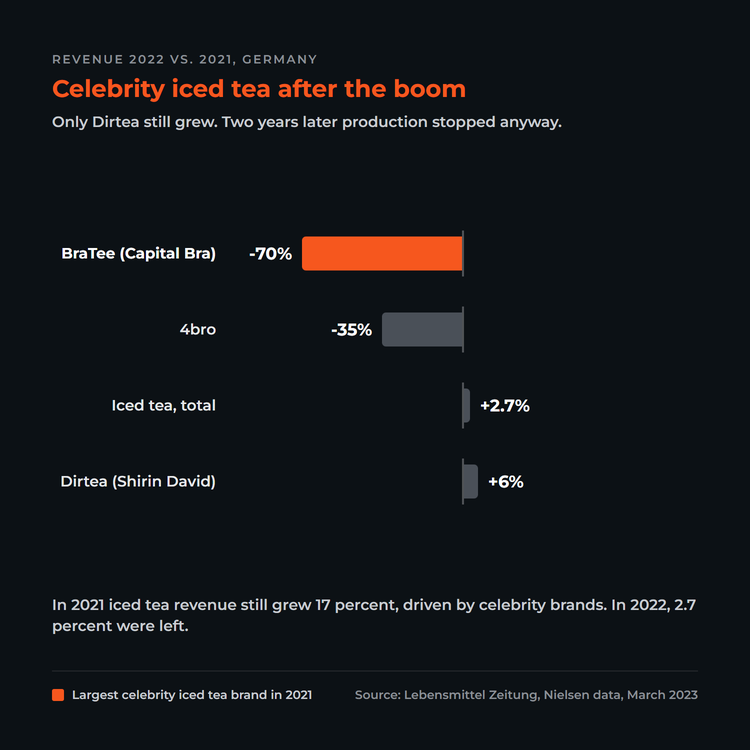
The German iced tea boom is the cleanest dataset on creator brands, because the trade paper Lebensmittel Zeitung tracked it with Nielsen data. In 2021 iced tea revenue grew 17 percent, driven by BraTee, Dirtea and their imitators. In 2022, 2.7 percent of that remained[20].
BraTee: EUR 120 million, then minus 70 percent
Capital Bra shared his own numbers for the second anniversary in February 2023: 80 million packs sold and EUR 120 million in revenue since launch[19]. The catch is in the distribution over time. In 2022 revenue fell by about 70 percent versus 2021 according to Lebensmittel Zeitung, and the imitator brand 4bro lost about 35 percent of its retail sales. The managing director of Drinks&More put it plainly: the many copycat products were cannibalising each other[20]. BraTee stayed in the market nonetheless and added a Bali Edition with Katja Krasavice in 2024[25]. That is exactly what Sebastian Schaan, a lead buyer in international procurement, described in the thread as the survival strategy: renew the occasion.
Dirtea: the only growing brand in 2022, production stopped in 2024
Dirtea was the only celebrity iced tea brand with growth in 2022, plus 6 percent[20]. For its second anniversary the brand reported 65 million cans sold[21]. In November 2024 production stopped: according to Shirin David the quality no longer met her expectations, the partnership with producer Krombacher ended, and about 70 million cans had been sold by then[22]. In March 2025 came the relaunch with three new flavours, produced by Pfanner, exclusively at REWE[23]. A nationwide brand became an exclusive item of one retailer. The brand lives on, at a much smaller scale.
Sugar Mami: why EUR 12 million is not EUR 12 million
A reader asked about Sugar Mami in the thread, and the case shows how misleading revenue figures for creator brands can be. At launch in August 2022 the message was: 10 million cans, retail price EUR 1.19. That quickly turned into headlines like "EUR 12 million in revenue"[24]. Except: 10 million cans produced or shipped are not 10 million cans bought by consumers. That sell-through figure is nowhere to be found. And even if every can had sold: EUR 12 million in retail sales is not EUR 12 million in revenue or profit for the creator, once retailer margin, production and logistics are taken out[1]. In 2024 Katja Krasavice appeared as collaboration partner of the BraTee Bali Edition[25], and there have been no reliable figures for her own brand since. That does not mean it was a bad business. When production and distribution run through partners and you mainly contribute reach, a launch can be very lucrative for the creator. It just is not a sustainable FMCG brand yet.
Gönrgy and More Nutrition: the counterexamples
Gönrgy by MontanaBlack is the case several commenters cited as counterevidence. Seventeen months after launch, the brand held a 2.4 percent market share at the end of 2024 according to Nielsen and ranked fourth among energy drink brands in Germany, with more than 58 million units sold to consumers within two years. In June 2025 it entered the sugar segment at REWE, Kaufland and EDEKA[26]. So: new flavours, new segments, a steady stream of new occasions instead of a single launch firework.
More Nutrition is a different league. Christian Wolf built the brand from 2017, CVC took over 81 percent of The Quality Group in 2022, and in 2023 group revenue rose by more than 50 percent to EUR 700 million, even though Wolf had stepped back after a wave of criticism[27]. The brand works without the face because product and community carry it. I broke down the brand demand behind it in a separate analysis of More Nutrition.
Beverage entrepreneur Andreas Herb, founder of effect, described the pattern in early 2024: "Pop in briefly and take the fame with you, anyone can do that." He said he knew companies that had burned 100 million that way[28].
What the community says: seven voices from the thread
The comments under the post came from retail, beverage development, influencer marketing, sales and consulting. I quote them by role rather than name, except where the person agreed to be named, all from the thread and translated from German[1].
BraTee surprises me a bit. I initially dismissed it because of the famous name, but then gave the teas a chance out of curiosity. They were actually really good. A bit more expensive than other iced teas, but otherwise very tasty. Maybe they should have priced them a little lower. Which reminds me that, at least in Switzerland, I have not seen Prime drinks for quite a while either.
Performance marketing consultant from Switzerland
That is the trial purchase in its purest form: scepticism, curiosity, a good product, a price too high for the repeat. And the observation about Prime matches the numbers: in the UK, revenue fell 71 percent to GBP 32.9 million in 2024[6].
It is obvious. When did Shirin last do anything for the brand? Those who do it right: Gönrgy and Monte. Creator and brand have to work together permanently and be fuelled again and again.
Creative producer in influencer marketing
With the creator brands we work with, we see rather the opposite. There, this exact topic is handled deliberately, even if it is not easy.
Consultant who works with creator brands
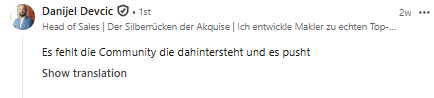
What is missing is the community that stands behind it and pushes.
Danijel Devcic, Head of Sales
Three voices, one point: the brand needs the creator after the launch just as much as before. Whoever posts the can once and moves on to the next deal has made an announcement. Marketing looks different.
The two problems: product and branding. None of them get it right and then wonder why they fail. On the product side it usually fails on taste, then on the other ingredients that are not there for taste. Influencer brands are dead, to put it bluntly, now it is about community brands.
Beverage developer behind several well-known brands
That is the product side, from someone who develops beverages for a living: taste first, then the recipe, and both before branding. The line about community brands closes the loop to the missing community above.
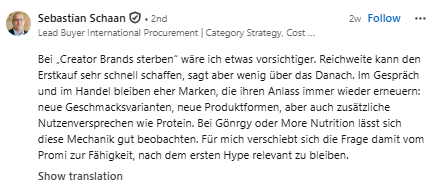
I would be a bit careful with "creator brands are dying". Reach can generate the first purchase very quickly, but says little about what comes after. In conversation and in retail, the brands that stay are the ones that keep renewing their occasion: new flavours, new product formats, but also additional benefit claims such as protein. This mechanism is easy to observe with Gönrgy or More Nutrition. For me the question shifts from the celebrity to the ability to stay relevant after the first hype.
Sebastian Schaan, Lead Buyer International Procurement
That is the retail view, and it matches almost word for word what a US beverage sales manager told Modern Retail: the name converts the first purchase, taste, effectiveness and price convert the second. And: "Retail is a velocity business. Those are not the same currency."[2] The seventh voice was the question about Sugar Mami, answered above.
Why creator brands fail and what the survivors do differently
Lay the sample, the base rate and the thread on top of each other and five factors remain. None of them has anything to do with the size of the celebrity.
| Factor | What fails | What survives | Source |
|---|---|---|---|
| Product | Me-too recipe from the same co-packer as the competition, no reason for a second purchase | A real advantage in the product: Feastables with a profitable recipe and a fair cocoa supply chain, Gönrgy with a maintained range | [7] [26] |
| Repeat purchase | Price above the category, taste merely "okay", patchy availability | Price, taste and distribution are right before the reach is ignited | [2] [16] |
| Retail | Launch listing without price architecture, secondary placement, sampling and sell-through per shelf metre | Treat retail as a velocity business and actively manage the rate of sale | [2] |
| Sustained push | One launch post, then silence | Renew the occasion: new flavours, formats, segments, collaborations | [1] [26] |
| Partners | A corporation as production partner that exits when the numbers are weak | Own substance that carries the brand without partner and without the face | [2] [5] [27] |
And now the bitter part. The category is growing. Functional beverages are up more than 29 percent year over year in 2026 according to Tastewise[18], and in the US alone dozens of new beverage brands launched in 2026 according to The New Consumer[2]. So the market carries these brands. They fail on their own terms. Más+ had Mark Anthony on board, the company behind White Claw. Unwell had Nestlé as partner[2][5]. Neither was enough.
One early indicator you can watch yourself is brand demand: how many people actively search for the brand every month, and does that number keep rising after launch or fall back? For 308 DTC brands in the DACH region you can check this for free in the Brand Radar. How to position a brand so that it earns the second purchase is something I covered in my article on brand positioning in e-commerce.
Conclusion
Reach is not distribution. Awareness is not a brand. In my sample of 20 creator brands, 8 succeeded and 12 did not. In food and beverage it was 3 successes against 9 failures. That is no worse than the base rate for new products, but no better either, and that is the real insight: the celebrity buys you the first purchase, nothing more. Everything after that is product, price, retail and the willingness to keep fuelling the brand for years.
The question before the next launch is therefore not "Is the creator big enough?" but "Why would anyone buy the second can when they already know the face?". If you are answering that question for your brand right now, with or without a celebrity, let's talk in a free initial consultation about how to make the demand behind it measurable.
Sources
- Antonio Blago: LinkedIn post "Promi auf ein Produkt reicht nicht, auch wenn es Messi ist", September 2026, including comments (215,277 impressions, 39 comments, as of 15 Sep 2026). Trigger was an Instagram post by OMR (@officially_omr) headlined "Creator Brands sterben" on Más+ and Unwell. Comments quoted anonymously and translated from German, Sebastian Schaan and Danijel Devcic named with their consent. linkedin.com (accessed 15 Sep 2026)
- Modern Retail (Gabriela Barkho): Why more celebrity-led brands are shutting down, 25 Aug 2026. modernretail.co (accessed 15 Sep 2026)
- BevNET: Messi, No Más: World Cup Winner's Hydration Brand Phased Out After Objectives Missed, 2026. bevnet.com (accessed 15 Sep 2026)
- The Grocer: Prime rival Más+ by Messi withdrawn less than a year after UK launch, 2026. thegrocer.co.uk (accessed 15 Sep 2026)
- Bloomberg: Podcaster Alex Cooper Is Shutting Down Unwell Beverages, 13 Aug 2026. bloomberg.com; corroborated by Fortune, 14 Aug 2026, fortune.com (accessed 15 Sep 2026)
- The Grocer: Energy drink brand Prime crashes as sales suffer 71% collapse, 24 Jun 2025. thegrocer.co.uk (accessed 15 Sep 2026)
- Bloomberg: MrBeast Makes More Money From Feastables Chocolate Than YouTube, 10 Mar 2025 (investor documents). bloomberg.com; figures corroborated by Fortune, 27 Feb 2025, fortune.com (accessed 15 Sep 2026)
- Sprudge: Internal Documents Don't Paint A Rosy Picture Of Chamberlain Coffee. sprudge.com (accessed 15 Sep 2026)
- CNBC: e.l.f. Beauty to acquire Hailey Bieber's Rhode in $1 billion deal, 28 May 2025. cnbc.com (accessed 15 Sep 2026)
- Forbes: Billionaire Kylie Jenner To Cash In On Her Cosmetics Line With $600 Million Sale To Coty, 18 Nov 2019. forbes.com (accessed 15 Sep 2026)
- CNBC: Celebrity liquor brands grow from Rock, Kendall Jenner, Ryan Reynolds, 21 Jul 2023. cnbc.com (accessed 15 Sep 2026)
- CNBC: Diageo to buy Ryan Reynolds-backed Aviation Gin for up to $610 million, 17 Aug 2020. cnbc.com (accessed 15 Sep 2026)
- IWSR: How impactful are celebrity-backed brands?, 5 Sep 2024. theiwsr.com (accessed 15 Sep 2026)
- NielsenIQ: Launch Fast, Learn Faster (European Innovation Report), April 2026. nielseniq.com (accessed 15 Sep 2026)
- NielsenIQ: The CPG Innovator's Guide to Vitality, 26 Jun 2023. nielseniq.com (accessed 15 Sep 2026)
- Viral Nation: The Second Purchase Problem: Why Creator Brands Fly or Flop, 7 May 2026, citing IRI New Product Pacesetters and Nielsen. viralnation.com (accessed 15 Sep 2026)
- Circana: Circana Unveils 2025 New Product Pacesetters as Top Innovations Drive $6.2 Billion in Year-One Sales, 21 May 2026. globenewswire.com (accessed 15 Sep 2026)
- Tastewise: 2026 Gen Z Beverage Trends. tastewise.io (accessed 15 Sep 2026)
- Raptastisch: 120 Millionen Euro Umsatz: Capital Bra enthüllt Verkaufszahlen von BraTee, 12 Mar 2023 (brand's own figures). raptastisch.net (accessed 15 Sep 2026)
- watson.de: Supermarkt: Influencer-Getränke werden zu Ladenhütern, außer eine Marke, 27 Mar 2023, based on Lebensmittel Zeitung with Nielsen data. watson.de (accessed 15 Sep 2026)
- hiphop.de: Dirtea: Verkaufszahlen von Shirin Davids Eistee bekannt gegeben, 2023 (brand's own figures). hiphop.de (accessed 15 Sep 2026)
- NEXTG.tv: Dirtea von Shirin David eingestellt: Qualität stimmte nicht, 16 Nov 2024. nextg.tv (accessed 15 Sep 2026)
- rap2soul: Shirin David bringt Dirtea zurück in den Handel, March 2025. rap2soul.de (accessed 15 Sep 2026)
- Raptastisch: Katja Krasavice legt 8-stelligen Umsatz ihres Getränks offen, 18 Jul 2022. raptastisch.net (accessed 15 Sep 2026)
- LZ direkt: BraTee Bali Edition mit Katja Krasavice, 27 Jun 2024. lzdirekt.de (accessed 15 Sep 2026)
- OTS/APA: Gönrgy erreicht 17 Monate nach Launch einen Marktanteil von 2,4 % und setzt mit dem Einstieg ins Zuckersegment die strategische Expansion fort, 5 Jun 2025 (Nielsen data). ots.at (accessed 15 Sep 2026)
- Yahoo Finance Germany (dpa-AFX): Nach heftiger Kritik: So lief das Geschäft bei More Nutrition, 2024. de.finance.yahoo.com (accessed 15 Sep 2026)
- watson.de: Supermarkt: Getränke-Boss mit heftigen Vorwürfen gegen Rapper und Influencer, 12 Jan 2024. watson.de (accessed 15 Sep 2026)
- Fortune: MrBeast's Lunchly faces mold allegations, 22 Oct 2024. fortune.com (accessed 15 Sep 2026)
Visibly AI: your SEO copilot
Projects, rankings, Search Console data and a copilot that runs the analysis for you. Start for free.
About the Author
SEO Freelancer & AI Visibility Expert
I optimize SEO data-driven with Python, behavioral psychology, and my Neuro-SEO System®. On YouTube, LinkedIn, and Instagram I share hands-on tutorials, insights, and SEO strategies.