Startups in Germany 2026: Record Founding, Capital Gap

AI summary
- Germany saw 3,053 startups founded in the first half of 2026, up 52% compared to the second half of 2025, with 1,038 having an AI focus.
- Venture capital in 2025 reached EUR 8.4 billion across only 716 deals, down from 1,160 deals in 2021, with 67% going to deals above EUR 50 million.
- Germany's venture capital as share of GDP averages 0.24% from 2020 to Q3 2025, below France at 0.34% and the UK at 0.73%.
- B2B startups using SEO with thought-leadership content achieve customer acquisition cost of USD 647, half the average paid channel cost of USD 1,907.
Generated with AI, the details are in the article.
Table of contents
Germany has never seen as many new startups as in 2026. In the first half of the year alone, 3,053 startups were founded, more than in the whole of 2024[1]. At the same time, the number of funding deals is falling, and capital is flowing into fewer and larger rounds[6]. Founding a company is no longer the bottleneck. Growth, capital and customer acquisition are.
This report puts the key data on startups in Germany from 2000 to September 2026 into context. It covers company formations, Berlin and other hubs, venture capital and unicorns. It also looks at exits and compares Germany with the US, the UK and France. The second part covers the question that matters most to me as an SEO consultant: what does the boom mean for marketing, SEO and visibility in AI search?
New startups 2025
3,568
+29% vs. 2024, a record
New startups H1 2026
3,053
34% with an AI focus
Funding deals 2025
716
down from 1,160 in 2021
Startups Germany 2026: how many tech startups are founded?
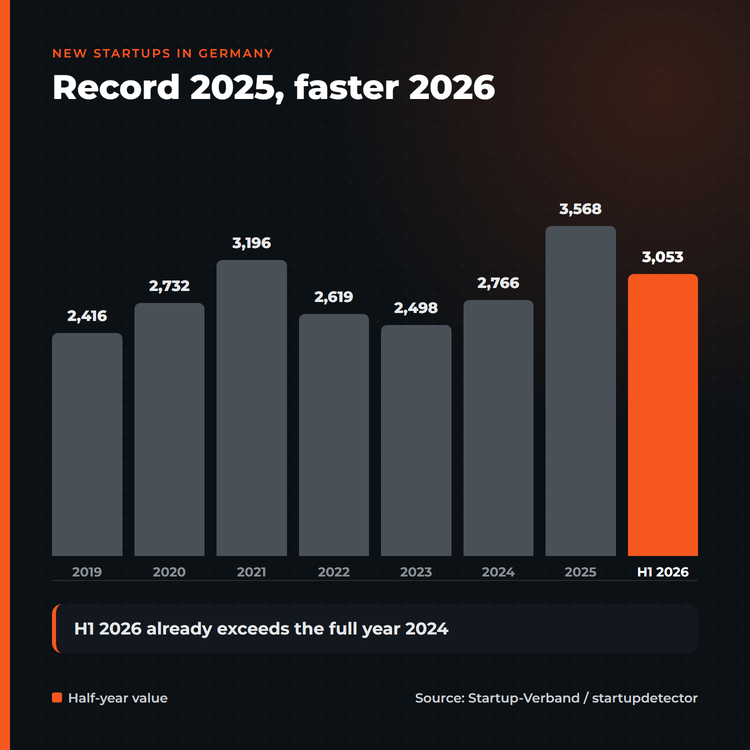
According to its latest report, the Startup Association (Startup-Verband) counts technology and growth-oriented tech startups based on commercial register data (startupdetector). After 2,416 startups in 2019, the number rose to 3,196 in 2021 and fell back in 2022 and 2023. In 2025 it reached a record of 3,568 companies, up 29 percent[2]. In 2026 the trend is accelerating: 3,053 startups in six months, up 52% on the second half of 2025. June 2026 was the strongest month since the series began, with more than 600 formations[1].
Which sectors dominate? AI, fintech and deep tech
The strongest driver is artificial intelligence. 1,038 of the startups founded in the first half of 2026 have a clear AI focus, roughly one in three[1]. In the German Startup Monitor (DSM) 2026, 53% of respondents say AI is a central part of their product, up from 45% a year earlier. 77% of revenue comes from B2B business[9]. AI startups are no longer a niche. They shape tech entrepreneurship across the country. Next to AI, fintech, deep tech, cleantech and legal tech remain strong sectors, and many AI startups sit inside them. Innovation in Germany increasingly comes from software built on AI models rather than from hardware alone, and AI-first tech startups attract a growing share of attention. Part of the boom is therefore technology-driven. It does not automatically mean that every aspect of Germany as a startup location has improved.
Founding culture since 2000: how entrepreneurship in Germany has changed
"New businesses" can mean very different things. The KfW Start-up Monitor has tracked every kind of business formation since 2000, from side businesses to takeovers. By that measure, Germany starts far fewer businesses than it used to. KfW counted around 1.29 million founders in 2000, 1.46 million in 2002 and 936,000 in 2010. In 2025 the figure was 690,000, 53% below 2002[19][3]. In 2025, however, it rose again from 585,000 to 690,000, driven by part-time businesses (70%). KfW cites the long-strong labour market as a key reason for the long-term decline[3]. A decline in traditional self-employment and a boom in tech startups are therefore not a contradiction.
Which cities are best for tech startups in Germany?
Berlin remains the largest hub, but it is no longer the only engine. After its 2021 peak of 702 new startups, the capital fell to 470 by 2023. In 2025 it jumped to 619 (+24%), and another 429 followed in the first half of 2026[2]. Investitionsbank Berlin (IBB) counted 4,137 active startups with around 82,000 employees in August 2026, while the number of funding deals has fallen by 22.5% since 2022[4].
The boom is spreading regionally: in 2026 several other locations are growing faster than Berlin in percentage terms. The Berlin startup scene is still the biggest. Munich is strong in deep tech and industrial tech thanks to its universities and corporates. The Hamburg startup scene has a strong base in e-commerce, logistics and media. Smaller university cities are catching up, often with a focus on cleantech, legal tech or industrial innovation. Which city suits your tech startup best depends on your sector, the talent pool and proximity to investors and customers. Statistics alone do not decide that.
Visibly AI: your SEO copilot
Projects, rankings, Search Console data and a copilot that runs the analysis for you. Start for free.
How much venture capital goes into tech startups in Germany?
Venture capital is available, but it is unevenly distributed. For young companies, that means a few get a lot and many get little. EY recorded almost EUR 8.4 billion in venture capital for 2025 (+19%), spread across only 716 deals, compared with 1,160 in 2021[5]. In the first half of 2026, volume rose to around EUR 5.3 billion (+14%), while the number of deals fell to 354 (down 11%). 67% of the capital went into deals above EUR 50 million, up from 55% a year earlier[6].
German Startup Monitor 2026: unicorns and first rounds
A unicorn is a young company valued at USD 1 billion or more. The DSM 2026 reports EUR 8.0 billion in investment up to September, 39 unicorns in total and ten new unicorns in 2026 alone[7][8]. Some of the most successful German startups with unicorn status include Celonis, DeepL, Helsing, Personio, N26 and Trade Republic. The downside, according to the same report: the number of deals is about a quarter below 2021, and first rounds in particular are declining[7]. According to KfW, only about 16% of the startups founded in Germany since 2005 have ever received venture capital[11].
Startups in Germany in a European and global comparison
Between 2020 and Q3 2025, KfW and Dealroom put average annual venture capital at around USD 10.4 billion for Germany, USD 23.8 billion for the UK, USD 10.0 billion for France and USD 229.1 billion for the US[10]. Relative to economic output, the picture is clearer:
Venture capital as a share of GDP, average 2020 to Q3 2025
US: 0.87%
UK: 0.73%
France: 0.34%
Germany: 0.24%
EU-27: 0.23%
Source: KfW Research based on Dealroom[10]
The US also shows strong concentration: in 2025, USD 320 billion went into 15,352 deals, 65.4% of deal value went to AI, and 487 mega-deals above USD 100 million accounted for 67% of the total[12]. The difference lies in the size of the capital base, not in the pattern. Globally, AI attracts the largest share of capital on both sides of the Atlantic.
Within Europe, Germany sits just above the EU average but behind France and well behind the UK. The biggest difference from British startups is capital relative to economic output. Germany does not lack ideas. Smaller countries such as Estonia or Israel also have a denser scene relative to their population. They lack a large home market, so teams plan internationally from day one.
Scale-up and exit: where the real gap is
The clearest weakness shows up at the far end of the funnel. 62% of startups planning an IPO prefer a US exchange, only 27% a domestic one[7]. In successful VC exits of startups from Germany, 57% of acquirers come from abroad. 44% of IPOs take place on foreign exchanges, and the US is the top destination in both cases[11]. According to a J.P. Morgan report, more than 85% of VC exits across EMEA over the past five years were acquisitions, and VC-backed IPOs hit a ten-year low in 2025[13]. For tech startups that want to scale globally, the late growth stage lacks depth. That is where private equity, large funds or public markets would need to step in. The US has this follow-on financing. In Germany, private equity often only enters after the exit.
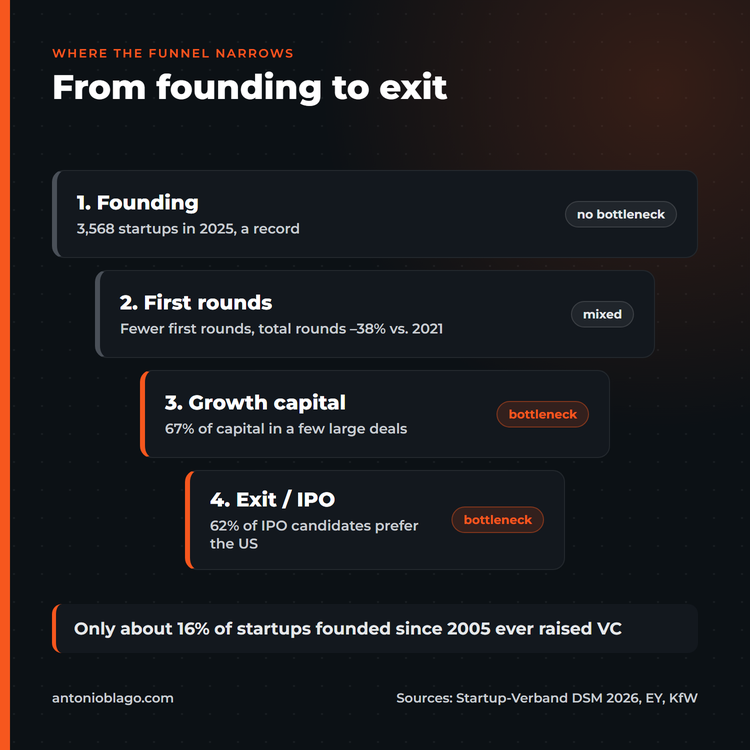
This also explains why so few domestic startups are listed on the stock exchange: the typical exit is an acquisition, not an IPO in Frankfurt.
Important: a foreign buyer does not automatically mean that jobs or research leave Germany. But it does show that ownership, returns and part of the follow-on capital circulate outside the domestic ecosystem. 89% of respondents call for more venture capital from Germany and Europe[7].
What challenges do founders face in Germany?
In the DSM 2026, only 25.6% of respondents rate their access to capital as positive, and 59.5% name finding investors as their main problem. Collaboration between tech startups and established companies has fallen to 54.1%, from 71.8% in 2020[8]. A year earlier, respondents already named sales, fundraising and the lack of digital public administration as their biggest issues[14]. Bureaucracy remains a topic, but sales is just as big a challenge.
How bureaucratic is starting a company in Germany? Founders have listed the lack of digital administration among their biggest hurdles for years. The commercial register, the notary, the tax number and funding applications take time that is then missing in sales.
Funding programmes, accelerators and incubators
Early-stage startups have several funding routes: the EXIST grant for university spin-offs, the High-Tech Gründerfonds as a seed investor, business angels, startup competitions, and accelerator and incubator programmes at universities and in the major hubs, such as UnternehmerTUM in Munich. They help you get started, but they do not replace a solid business plan with revenue. Startup competitions bring contacts as much as prize money.
You will find networks and communities through the Startup-Verband, regional founder centres, university incubators and industry meetups. Investors, in turn, use data sources such as startupdetector or Dealroom, demo days and pitch events to find promising teams. If you are looking for a technical co-founder, university networks, accelerator programmes and founder communities are the most common places to meet one.
Founders from outside the EU usually need a residence permit for self-employment. The details depend on the business plan and the local immigration office, so check the requirements early. Founders with paying customers negotiate from a stronger position, or need less outside capital in the first place.
What the startup boom means for SEO and marketing
More startups, fewer first rounds, capital concentrated in a few large deals. For most young companies, the question shifts from "How much money can we raise?" to "How do we win customers before the money runs out?". That is where marketing and SEO come in.
Customer acquisition has to be capital-efficient
Without a large funding round, you cannot buy growth through paid ads indefinitely. Scalability then comes from channels whose costs do not rise with every additional customer. An analysis by First Page Sage of about 120 B2B clients shows clear differences in customer acquisition cost (CAC) by channel[15]:
Average B2B customer acquisition cost by channel (USD)
SEO with thought-leadership content: 647
PPC / paid search: 802
Organic channels, average: 942
Basic SEO without expert content: 1,786
Paid channels, average: 1,907
Source: First Page Sage, average December 2021 to November 2024, agency data[15]
The honest reading: organic channels cost about half as much as paid channels on average. Basic SEO without real expertise, however, is more expensive than Google Ads. The lever is content that shows genuine knowledge, such as your own data, studies and case studies. You can model what this means for your business with the SEO ROI Calculator.
B2B buyers decide before they call you
77% of startup revenue is B2B[9]. And B2B buyers do their own research: according to a 6sense study of around 4,000 buyers, 61% of the buying journey is complete before buyers contact a vendor. In 80% of cases, the vendor contacted first wins, and 95% of winners are already on the shortlist on day one[16]. If you do not show up during research, you are not in the running. That applies to Google as much as to ChatGPT.
"Ninety-five percent of the time, the winning vendor is already on the Day One shortlist."
6sense, 2025 Buyer Experience Report
For B2B startups, visibility is part of sales. More on this in my article on B2B SEO.
AI search changes which tech startups get seen
At the same time, AI is changing search. According to Pew Research, users click on a search result in only 8% of visits with an AI summary, compared with 15% without one. Only 1% click the source inside the summary itself[17]. Seer Interactive measured an organic CTR of 2.36% for queries with an AI Overview in February 2026, compared with 3.82% without. In December 2025 it had dropped as low as 1.3%[18].
For AI startups this matters twice over. If one in three founders builds with AI, many tech startups compete for the same search terms and the same mentions in AI answers. Visibility then depends less on a single ranking and more on a clearly defined brand, citable content and mentions on pages that AI systems use as sources. I explain how this works in AI SEO and GEO and in my GEO study on AI search systems.
Five steps for startups with a small marketing budget
- Validate demand before building: search volume and search intent show whether and how customers look for your problem.
- Own a category: dominate a clear niche instead of competing with hundreds of other AI startups for generic AI terms.
- Publish your own data: benchmarks, studies and case studies are citable, for Google and for AI systems alike.
- Do not depend on one channel: my article on the disabled Meta ad account shows what happens when an ad account is shut down.
- Measure visibility in AI answers: check regularly whether ChatGPT, Gemini and Perplexity mention your brand for relevant questions. My study on how LLMs rank brands is a good starting point.
My view as a founder in Germany
I do not look at these numbers only as an SEO consultant. I am a founder in Germany myself: alongside my consulting work, I am building Visibly AI from Koblenz, a software for SEO and visibility in AI search. All of it is bootstrapped. I financed it as a freelancer from my own revenue, without investors, without a funding round and without grants. Koblenz is not a startup hub. There is no investor around the corner and no network like the Berlin startup scene. The capital bottleneck in the data is my everyday reality. Every euro that goes into the product has to be earned first with client projects.
Three things I have learned from my own case study as a bootstrapped founder:
- Customers before capital: my most important channel is what you are reading right now. Ad budget plays almost no role. The blog, free tools and my podcast bring people to my site who have a concrete problem. Some of them become users and customers. It scales more slowly than paid ads, but every article keeps working long after an ad budget would have run out.
- Own data beats opinion: the posts that move the most are those with my own analyses, such as my studies on AI visibility. They get cited, linked and picked up by AI systems. For a young company, that is the cheapest form of authority.
- A business plan needs a sales plan: with AI tools, building the product was faster than ever. The real work is making sure the right people hear about it. That matches the DSM: sales has been one of the biggest hurdles for years.
So the findings do not surprise me. Founding a company in Germany in 2026 is easier than ever, especially with AI. You hardly need capital to start anymore. What remains hard is turning a fresh company into a growing one, especially without a major hub and without an investor behind you. Bootstrapping forces you early on to do what the market demands anyway: win paying customers.
Methodology: what this report measures and what it does not
This report is my own analysis. For this original research, I compared time series from six sources. They are the KfW Start-up Monitor, the Startup-Verband with startupdetector and the DSM, the EY Startup Barometer, IBB, NVCA/PitchBook and J.P. Morgan. I only compare trends within a single source. The table summarises the findings.
| Dimension | Finding | Key data |
|---|---|---|
| All business formations | Lower long term | 2002: 1.46m, 2025: 690,000 |
| New startups | Record high | 2025: 3,568, H1 2026: 3,053 |
| Berlin | Strong, not alone | 2025: 619, H1 2026: 429 |
| VC volume | High | 2025: EUR 8.4bn, H1 2026: EUR 5.3bn |
| Funding deals | Declining | 2021: 1,160, 2025: 716 |
| Capital distribution | Concentrated | 67% in deals above EUR 50m |
| Exits | International | 57% of acquisitions by foreign buyers |
The numbers show patterns, not causes. They do not prove a direct link between any government, tax policy or regulation and the number of new companies. The 62% refers only to startups planning an IPO, not to all German startups. A foreign exit is not a relocation. KfW business formations and startupdetector startups are not directly comparable, and neither are VC volumes from different providers. The AI cycle, interest rates, the economy, the labour market, institutional capital and stock market depth all play a role at the same time.
Conclusion: innovation is not the problem
According to this report, Germany does not have a founding problem in 2026. With 3,568 startups in 2025 and more than 3,000 in the first half of 2026, the number of startups founded has never been higher. The problem is scalability. There are fewer first rounds, capital sits in a few large deals, and exits and IPOs often happen abroad. Innovation is founded here but too often scales elsewhere.
For most startups in Germany, this has a practical consequence. If you are starting a company today, plan for growth from your own revenue early on. Capital-efficient customer acquisition through content, clear positioning and visibility in Google and AI answers become part of your funding strategy.
Sources
- Startup-Verband: Founding boom accelerates, more than 3,000 new startups in just six months, 7 July 2026. Link (German), accessed 30 September 2026.
- Startup-Verband / startupdetector: Next Generation, new startups in Germany, January to December 2025. PDF (German), accessed 30 September 2026.
- KfW: KfW Start-up Monitor 2026, 690,000 business formations in 2025. Link (German), accessed 30 September 2026.
- Investitionsbank Berlin: Berlin startup location report 2026. Link (German), accessed 30 September 2026.
- EY: Startup Barometer Germany, January 2026. Link (German), accessed 30 September 2026.
- EY: Startup Barometer Germany, July 2026. Link (German), accessed 30 September 2026.
- Startup-Verband: DSM 2026, startups defy the economy, 28 September 2026. Link (German), accessed 30 September 2026.
- Niedersachsen.next: German Startup Monitor 2026 published, 29 September 2026. Link (German), accessed 30 September 2026.
- Startup City Hamburg: Key findings from the German Startup Monitor 2026, 29 September 2026. Link, accessed 30 September 2026.
- KfW Research: National venture capital markets compared. Link (German), accessed 30 September 2026.
- KfW Research: Start-ups in Germany, growth and exit routes via VC, Focus on Economics No. 521, November 2025. PDF (German), accessed 30 September 2026.
- NVCA: 2026 Yearbook. Link, accessed 30 September 2026.
- J.P. Morgan: M&A dominates EMEA startup exits as IPOs hit decade low. Link, accessed 30 September 2026.
- Niedersachsen.next: DSM 2025 published, 29 September 2025. Link (German), accessed 30 September 2026.
- First Page Sage: Customer Acquisition Cost by Channel, updated 18 June 2025. Link, accessed 30 September 2026.
- 6sense: 2025 Buyer Experience Report. Link, accessed 30 September 2026.
- Pew Research Center: Google users are less likely to click on links when an AI summary appears in the results, 22 July 2025. Link, accessed 30 September 2026.
- Seer Interactive: AIO Impact on Google CTR, 2026 Update, 24 April 2026. Link, accessed 30 September 2026.
- KfW: KfW Start-up Monitor 2012, historical founder numbers 2000 to 2011. PDF (German), accessed 30 September 2026.
Brand Radar: where does your brand stand?
Brand and generic traffic, competitors and potential at a glance, free of charge.

About the Author: Antonio Blago
SEO Freelancer & AI Visibility Expert
I optimize SEO data-driven with Python, behavioral psychology, and my Neuro-SEO System®. On YouTube, LinkedIn, and Instagram I share hands-on tutorials, insights, and SEO strategies.