AI SEO & GEO: Becoming Visible in AI Search

AI summary
- AI Overviews reduce click-through rates by 34.5% overall and 44.6% for position 1 informational queries between March 2024 and March 2025.
- More than 80% of brand mentions in AI responses come from third-party domains, with 90% of mentions appearing in comparison and list content.
- AI evaluates brand mentions independently of backlinks, with unlinked mentions weighted equally to linked ones in citation decisions.
- SEO remains the foundation for AI visibility because AI Overviews draw from organic rankings, and without ranking positions, brands won't be cited.
Generated with AI, the details are in the article.
Table of contents
Summary in one click: AI SEO (also GEO – Generative Engine Optimization) is the optimization of content and brand presence for AI search systems like ChatGPT, Google AI Overviews, Gemini, and Perplexity. While classic SEO controls visibility in the results list, GEO ensures that your brand is mentioned and cited within the AI response itself. SEO remains the foundation – if you don't rank, you won't be cited.
What is AI SEO (GEO)?
AI SEO refers to all measures you take to optimize your content and brand for AI-based search systems – including ChatGPT, Google AI Overviews, Gemini, Perplexity, Claude, and Microsoft Copilot. The most common technical term for this is GEO: Generative Engine Optimization.
The key difference from classic SEO lies in where visibility is created:
- SEO → Visibility in the search results list (you want to rank in position 1).
- GEO → Visibility within the AI response itself (you want to be mentioned, cited, or recommended).
Several terms have emerged around this concept that overlap significantly in meaning. At their core, they all share the same goal: being visible in generative AI systems.
| Term | Meaning | Focus |
|---|---|---|
| GEO | Generative Engine Optimization | Optimization approach (most common term) |
| GSO | Generative Search Optimization | Search engine perspective |
| LLMO | Large Language Model Optimization | Model focus |
| AEO | Answer Engine Optimization | Answer focus |
| GAIO | Generative AI Optimization | Overall AI approach |
One more quick term worth defining, since it comes up constantly: an LLM (Large Language Model) is an AI system trained on vast amounts of text that predicts the next word based on probabilities. It has no real understanding – it calculates. That is precisely why the way we need to optimize content is changing.
SEO vs. GEO: the difference at a glance
With classic search, Google sorts content by relevance and displays a list of websites. The old rule was: early placement equals higher relevance equals more clicks. AI search systems work differently: the user asks a question, the AI delivers a consolidated answer and cites individual sources. Visibility is created without a click.
| Dimension | Classic SEO | AI SEO / GEO |
|---|---|---|
| Output | List of links (SERP) | Generated answer with citations |
| Ranking logic | Keywords, backlinks, relevance | Semantics, topics, entities, mentions |
| Success looks like | Position 1–10 | Mentioned / cited in the answer |
| Click required? | Yes | Often no (zero-click) |
| Key levers | OnPage, OffPage, Technical | EEAT, citation worthiness, brand mentions, sentiment |
Important: this is not an either/or. GEO extends SEO. A Similarweb analysis shows that 95.3 % of ChatGPT users still also use Google.[6] The two worlds exist in parallel – and the foundation in both cases is solid SEO.
Free SEO tools
Keyword ranking, SSR text check, sitemap audit and more, right in the browser and without signup.
Why AI SEO is relevant right now
The reason so many companies are currently on edge is traffic loss. An Ahrefs study of 300,000 keywords (comparing March 2024 vs. March 2025) found that AI Overviews reduce click-through rates by around 34.5 %. For informational queries in position 1, the CTR drops by as much as 44.6 %.[2] My own Keyword Study 2026 points the same way: position 1 now averages just 5.59 % CTR.
Consequence: Position 1 is no longer what it used to be. Impressions are rising, clicks are falling – a portion of the value disappears into the AI response. Anyone who still measures visibility purely by Google rankings is missing a growing share of their reach.
How do AI search engines work?
To optimize for AI, you need to understand how it processes content. AI does not read keywords – it recognizes meaning. A modern AI search query typically goes through these steps:
- Embedding: The question is converted into numerical vectors that represent its meaning. This allows the AI to find contextually relevant information even when the exact wording differs.
- Reasoning: The AI considers what the user actually wants to know – is it about prices, reviews, or background knowledge?
- Query fan-out: For complex questions, the AI expands the query into several sub-questions, answers them in parallel, and combines the results.
- RAG (Retrieval-Augmented Generation): When the model's existing knowledge is insufficient, the AI searches additionally – in vector databases, on the web, or in specific contextual knowledge – and pulls in current, relevant sources.
Two concepts are central to GEO:
- Embeddings & semantics: What matters is whether your content semantically matches the question and covers the topic comprehensively – not exact keyword repetition or classic keyword density.
- Entities: AI thinks in entities (brands, people, products, categories). The more clearly your brand is recognizable as an entity – through well-structured about pages, structured data, and consistent external mentions – the higher the chance of being cited.
The fan-out is, incidentally, the bridge back to classic SEO: the sub-questions an AI generates are exactly the informational, comparative, and problem-oriented keywords you want to rank for anyway. Generative responses don't replace SEO – they are an additional entry point.
The 4 levels of AI visibility
In my GEO workshops, I use a simple tier model to show what AI visibility is made of. Each level builds on the one before it.
| Level | What | Why |
|---|---|---|
| 1. SEO Foundation | Technical SEO, OnPage, content, backlinks, EEAT | AI Overviews draw from organic rankings. If you don't rank, you won't be cited. |
| 2. Citation Worthiness | Citable content: clear heading structure, one idea per paragraph, schema markup, precise answers | AI extracts individual sections, not entire pages. Each paragraph must work in isolation. |
| 3. Brand Visibility | Authoritative external sources: digital PR, industry portals, Wikipedia, Reddit, review platforms | LLMs prefer to cite trusted third-party sources. Your own website alone is not enough. |
| 4. Sentiment | Brand perception: positive, neutral, negative; review and reputation management | Positive mentions lead to more prominent placement. Those who don't manage this leave it to chance. |
EEAT as the foundation
EEAT stands for Experience, Expertise, Authoritativeness, and Trust. According to Google's guidelines, Trust is the most important component: if a page appears unreliable, even high expertise won't help. Trust grows through clarity, not volume – a visible author, verifiable claims, cited sources, clear publication dates, and a clean legal notice. For YMYL topics (health, money, safety), Google requires particular diligence here.
Citations & mentions: where AI gets its sources
This is, for me, the most important insight from current research – and the point where GEO most clearly diverges from classic link building:
- More than 80 % of brand mentions in AI responses come from third-party domains, not from the brand's own website (AirOps, based on 177 million AI citations, April 2025).[3]
- 90 % of third-party mentions come from comparison and list content; 80 % of mentioned brands appear in the top 3 positions there (Semrush & Profound 2025).[4]
- Mentions beat backlinks: AI evaluates brand mentions independently of any link. Unlinked mentions are processed with equal weight – classic link building has no direct influence on AI visibility (Semrush & Claneo 2025).[5]
- Freshness matters: AI assistants like ChatGPT demonstrably cite more recent content than classic Google search – on average around one year fresher.[4]
Practical takeaway: Digital PR, expert articles, interviews, and a presence on Reddit and LinkedIn often have more impact in AI systems than classic SEO measures. Anyone who wants to appear in AI responses needs to be mentioned where AI gets its sources – not just on their own domain.
Is AI visibility measurable?
Yes. AI visibility can be measured just like SEO – just with different KPIs. Instead of position and clicks, what counts is how often and at what position your brand appears in AI responses. For statistically reliable measurement, I have published an open-source framework that quantifies brand visibility across multiple LLMs.[7] The core metrics:
| Metric | Definition |
|---|---|
| Mention Rate | How often the brand is mentioned at all (binary 0/1, averaged across many runs). |
| Rank Position | At which position in a listed recommendation the brand appears. |
| Top-3 Rate | How often the brand appears in positions 1 through 3. |
| Visibility Score | Weighted value (Pos 1 = 10, Pos 2 = 8, Pos 3 = 6 … not mentioned = 0). |
Because LLMs give different answers to the same question, multiple runs per prompt are required (30 runs per prompt in the framework), along with statistical tests to separate real differences from random noise. That is the key point: AI visibility is not a snapshot – it is a distribution.
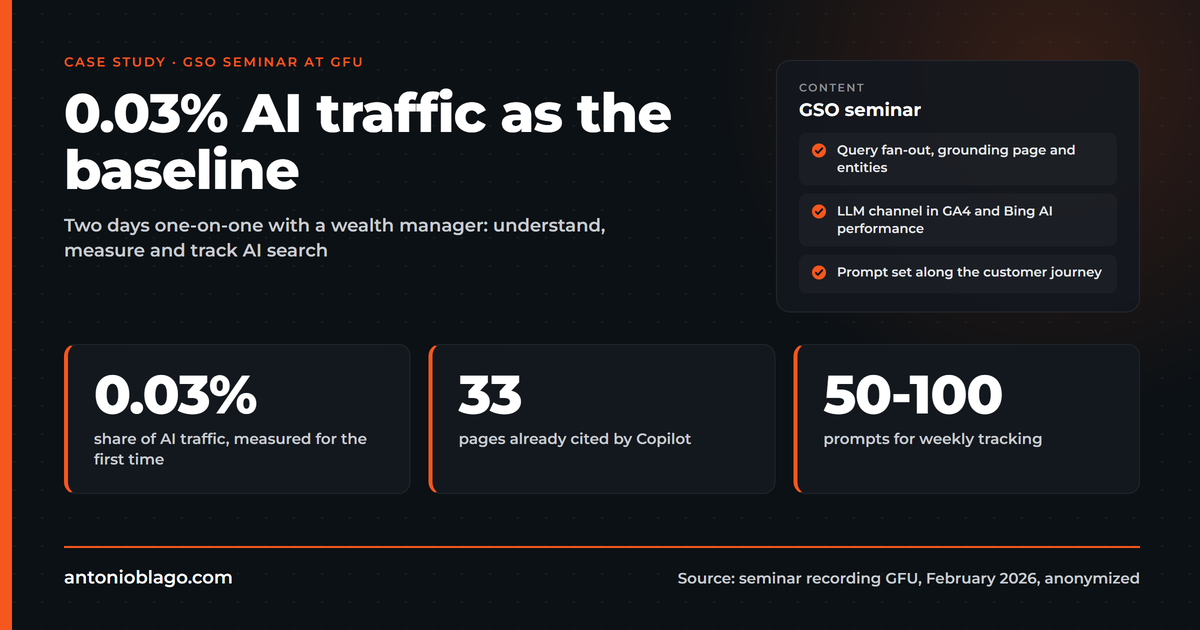
For ongoing practice, no one needs to write their own code. Established tracking tools measure prompt visibility, mentions, and sentiment automatically – for example Peec.ai, SE Ranking, Sistrix (with AI extension), or Rankscale. The principle is always the same: define relevant prompts across the customer journey, track regularly, and benchmark against competitors.
Is GEO just a trend?
No. The search engine landscape is shifting structurally: ChatGPT is among the most visited websites worldwide, Gemini is catching up, and Google is integrating AI directly into search (AI Overviews, AI Mode). At the same time, Google remains dominant with 85–90 % market share and billions of searches per day. This means: digital visibility is becoming cross-platform. GEO doesn't replace SEO – it adds a second layer on top.
Conclusion: SEO is the foundation, GEO is the second stage
AI SEO, or GEO, is the logical evolution of search engine optimization for a world where machines generate answers rather than simply listing links. Three things to take away:
- SEO remains essential. Without organic rankings and EEAT, there are no citations. Start with the SEO basics.
- Write for citability. Clear structure, one idea per paragraph, precise answers, structured data – this is how AI can extract your content.
- Build brand mentions. External, trusted mentions matter more in AI systems than backlinks – and you should actively measure your AI visibility.
If you want to become visible in AI, book a free initial consultation here: https://antonioblago.de/termin
Sources
- Antonio Blago – GEO / AI SEO Seminar (GFU Training), 2026. Own workshop materials.
- Ahrefs – „AI Overviews Reduce Clicks“ (300,000 keywords, March 2024 vs. March 2025). ahrefs.com
- AirOps – „The Influence of Offsite Signals in AI Search“ (177,183,136 AI citations, April 2025).
- Semrush & Profound – Studies on AI citations and content freshness, 2025.
- Semrush & Claneo – „Mentions beat backlinks“, 2025.
- Similarweb – „ChatGPT vs. Google Search Usage“. similarweb.com
- Antonio Blago – „LLM Brand Visibility and Ranking Framework“ (48 brands, 3 LLMs: Claude, GPT-4o, Gemini). github.com/AntonioBlago/llm-visibility-framework
Visibly AI: your SEO copilot
Projects, rankings, Search Console data and a copilot that runs the analysis for you. Start for free.

About the Author: Antonio Blago
SEO Freelancer & AI Visibility Expert
I optimize SEO data-driven with Python, behavioral psychology, and my Neuro-SEO System®. On YouTube, LinkedIn, and Instagram I share hands-on tutorials, insights, and SEO strategies.