Meta Ad Account Disabled: When One Channel Is Your Revenue

AI summary
- In early 2025, Meta banned health and wellness shops from sending purchase events, causing one shop a revenue shortfall of approximately 200,000 euros.
- Meta's data source restrictions for health and wellness sites block lower-funnel events like Purchase and Add to Cart, forcing optimization toward weaker signals like landing page views.
- Six high-volume German keywords related to back pain generate roughly 61,600 monthly searches and could deliver approximately 22 to 52 orders monthly through organic ranking.
- Shops earning 100 percent revenue through Meta lack demand foundation; diversified shops with 40 percent organic revenue retain 40 percent income during complete Meta outages.
Generated with AI, the details are in the article.
Table of contents
I hear this sentence in discovery calls more often than you would think: "We control 100 percent of our revenue through the Meta budget. If we switch it off, nothing happens." In early 2025, Meta pulled the plug on exactly these shops, without warning and without support being able to explain what had happened. Anyone classified as "health and wellness" was suddenly no longer allowed to send purchase events to Meta. For a performance setup, that is flying blind. For one shop I spoke to shortly afterwards in a first call, the shortfall was already in the region of 200,000 euros in revenue.
This article answers two questions. First: what exactly do you do when your Meta ad account is disabled or restricted? Second, and this is the more important one: why is the restriction only a symptom, and how do you build a shop where a platform decision cannot take away your revenue? SEO is the path to stability here, carrying the business independently of any single platform. The basis is Meta's help pages, expert analyses from the DACH market and current keyword data.
Meta ad account disabled or restricted: what is actually happening
"Disabled" is an umbrella term for three different things. They have different causes, different points of contact and different chances of success. Before you submit anything, you should know which case applies to you.
| Case | What you see | Typical cause | Where to start |
|---|---|---|---|
| Ad account disabled | Campaigns do not run, notice in Ads Manager | Violation of the Advertising Standards, problems with payment method or verification, unusual activity[1][8] | Open Account Quality, request a review[1] |
| Advertising access restricted (person or business) | "Your advertising access is restricted" | Repeated rejections, policy violations, additional rules in the health sector[9] | Request a review[2] |
| Data source restricted | The pixel is running, but Purchase and Add to Cart are no longer available for optimization, notice "Data Sharing Restrictions Applied" | Website classified as "health and wellness" or financial services[5][13] | Events Manager, data sources, data sharing settings[13][15] |
The Sensitive Ads Update: the silent ban
The third case is the one that caught most shops in 2025, and it does not feel like a ban. The account is active, ads are running. But since early 2025 Meta has been categorizing data sources, meaning websites and apps, much more narrowly and applies restrictions to sensitive categories, from limited data sharing up to a full block of event tracking.[5] For health and wellness this means: mid- and lower-funnel events such as Add to Cart and Purchase can no longer be tracked or used as campaign objectives, regardless of whether the data arrives via the pixel or the Conversions API.[13] Exactly which events disappear depends on the classification: some reports list Purchase, Leads and Registrations as blocked with Add to Cart still usable, others see Add to Cart affected as well.[17][13] Since March 2025 the so-called Core Setup also fully applies to financial services.[13]
There are partial and full restrictions. In the full variant all relevant events are blocked, in the partial one Landing Page View or ViewContent remain usable.[13] Without purchase events, Meta's algorithm no longer sees your real buyers and optimizes for weaker signals such as landing page views. Lookalike audiences based on buyers are no longer built.[7] Audience building as a whole is restricted too.[3][4] Specialist agencies call it the next milestone after the iOS update, one that forces advertisers to rethink paid communication.[4]
The insidious part: Meta does not publish a list of which terms or pages trigger the classification. You can only read your status from what is marked as restricted in Events Manager or what suddenly stops optimizing.[13] There is an appeal, but it is automated, does not allow supporting evidence, and as of early 2025 no case was known in which a classification had been successfully overturned.[6] Even the experts speak of a lack of options to defend yourself against the restrictions.[3]
What you can do right now if the account is disabled
The order matters. If you write an appeal immediately without knowing the reason, you burn the one attempt you have.
- Read the reason, do not guess. Open Account Quality in Business Manager. It tells you whether an ad account has been disabled, whether your advertising access is restricted and which policy area is affected.[1]
- Request a review. For advertising restrictions there is an official review path.[2] Write specifically what you have changed instead of merely objecting. For a data source classification, the re-review runs through Events Manager. Document why your site does not belong in the sensitive category.[13]
- Check your data sources. In Events Manager under data sources and in the pixel settings you will see notices such as "Data Sharing Restrictions Applied" or "Core Setup is enabled". Meta usually also informs you by email or directly in Ads Manager.[13] The data sharing settings are located in your business settings.[15]
- Payment method and verification. Some deactivations have a mundane cause: an expired card or a missing business verification.[1] That is the fastest fix if it applies.
- Clean up website and events. Check pages and ads for statements close to a diagnosis or strongly health-related.[13] Meta does not want to receive sensitive health information through its Business Tools, and event names must not reflect a sensitive category either.[14] Neutral custom event names are therefore a legitimate step.[6] Disguised purchase events are not.
- Adjust campaign objectives. Without lower-funnel events you are left with optimizing for upper-funnel goals such as reach, traffic or landing page views.[5] That keeps campaigns alive but does not replace purchase optimization: if you want purchases, you have to feed the algorithm purchase signals, not page views.[7][12]
- First-party data and broader audiences. Build direct customer relationships through email, SMS and loyalty programs, and test interest-based or broad targeting instead of retargeting, which shrinks anyway without website signals.[17] What you should leave alone: relabeling purchase events through Tag Manager as a different standard event. It circulates as a trick,[17] but it is exactly the circumvention Meta penalizes.[8]
- No second account. Attempts to circumvent the system are themselves a violation of the Advertising Standards and, in doubt, lead to a permanent restriction.[8]
Honestly: points 5 to 7 buy you time. What they do not solve is the dependency that got you into this situation in the first place.
And when Google does the same
Meta is not the only platform that enforces rules without notice. Google Merchant Center requires the landing page and checkout to be in the language of the product data source. Elements that enable the purchase must be in the same language, otherwise disapprovals loom.[10] In another project, exactly that cost a Merchant Center account in the same January: a few English terms in a German checkout. The Shopping traffic was gone overnight, and the damage was likewise around 200,000 euros in revenue. If your revenue hangs on one channel, you carry this risk with every platform, not just Meta.
The real problem: one channel is not a business model
"We can control 100 percent of our revenue through the Meta budget" sounds like control. It is the opposite. You control the budget, but not the rules, not the classification of your website and not the question of whether your purchase event will still arrive tomorrow. A platform whose support cannot explain its own classification and whose restrictions you have practically no way to contest[3] is no foundation. It is a tenancy where only one side has the right to terminate.
The pattern behind it is channel thinking: Meta is "the performance channel", SEO would be "the organic channel", and both are evaluated separately. Customers do not think that way. They have neck pain, google it, read, see an ad later and buy weeks afterwards. What SEO contributes in this picture is described in the SEO glossary under "SEO is not an isolated marketing channel": visibility along the entire customer journey instead of one traffic bucket next to another.
What the ban exposes is a structural problem. A shop that earns all of its revenue through a rented channel does not just have a tracking problem. It has no demand foundation of its own. The math is trivial, but worth doing:
| Scenario | Revenue share Meta | Share organic, email, direct | Meta down for 8 weeks: remaining revenue |
|---|---|---|---|
| Shop A, everything via Meta | 100 % | 0 % | 0 % |
| Shop B, diversified | 60 % | 40 % | 40 % |
| Shop C, organically supported | 35 % | 65 % | 65 % |
The point is not to switch Meta off. For push and fast scaling, Meta is hard to replace. The point is that the second and third building blocks are missing, and that building them takes time you no longer have after the ban.
The terms Meta forbids you are the terms your customers google
Here lies the irony of the situation. The language that pushes your website into Meta's "health and wellness" category is exactly the language people use when searching for your products. A look at current keyword data for the German market in the area of recovery and back pain shows how large this demand is:[16]
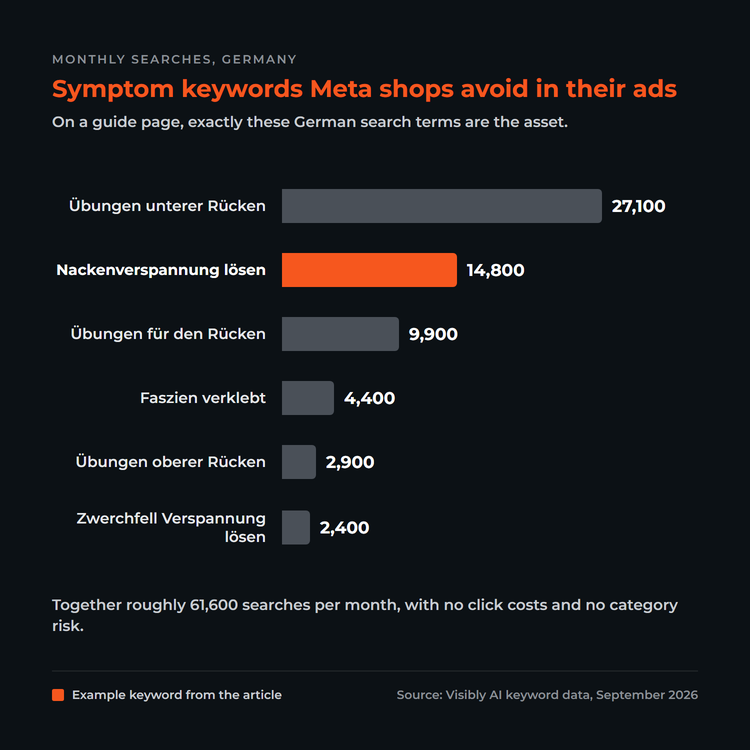
"Nackenverspannung lösen" (release neck tension) is searched 14,800 times a month, "Übungen unterer Rücken" (lower back exercises) 27,100 times, "Faszien verklebt" (stuck fascia) 4,400 times.[16] These are symptom terms, not diagnoses. In a Meta ad they are a risk. On a guide page they are the asset: demand that returns every month without you bidding for it, and that no platform can switch off with a category update.
Worked example: what six guide topics can deliver
Let us stay with the six keywords from the chart, together roughly 61,600 searches per month.[16] The click-through rates come from my Keyword Study 2026, which evaluates Search Console data across many domains: position 1 achieves 5.59 percent on average, position 3 still 2.37 percent.[11] Not the 30 percent that older tables promise.
| Assumption | Clicks per month | Orders at 1.5 % conversion |
|---|---|---|
| All six topics at position 3 (2.37 %) | around 1,460 | around 22 |
| All six topics at position 1 (5.59 %) | around 3,440 | around 52 |
This is no replacement for a Meta budget that scales daily. It is a base that does not collapse. And it grows: a guide article at position 3 delivers the same clicks in month twelve as in month one, without additional budget. For health topics there is one condition. Google evaluates such content strictly by experience, expertise, authority and trust. A guide that only carries keywords and sells the product at the end does not rank and helps nobody. Qualified authors, honest statements and real instructions are mandatory, not optional.
SEO as the path to stability: how to build the backup
The mistake would be to rebuild the shop in a panic and delete every medical term. That way you lose the organic demand before you ever had it. A separation makes more sense: the shop itself stays factual and describes products and their application. A guide section, on its own subdomain depending on your risk assessment, carries the symptom topics and links to the matching products. That keeps the classification of your purchase pages cleaner, and the demand still lands with you. The large players in the segment show how it is done: guide content as the entry point, which may still run as an ad, plus email marketing, own courses and apps for retention. The shop sells, the guide builds the relationship.
A realistic roadmap for the first three months:
- Weeks 1 to 2, status: Set up or evaluate Google Search Console and attribute organic revenue properly. Many shops simply do not know how large their organic share is because their tracking only knows paid. Then the potential check: which symptom and application topics fit your range, and what do people actually search for?
- Weeks 3 to 6, foundation: Five to ten guide clusters around the strongest symptom topics, each with a clear application and product reference. Collection pages by application such as "back" or "neck" instead of by diagnosis.
- Weeks 7 to 12, trust and a second leg: Qualified authors and guest articles for the guides, author profiles, sources. In parallel, build an email list from the guide traffic and start YouTube as a second organic channel. Both belong to you, and no platform can categorize either.
And the budget question? With ads the math is simple: budget in, revenue out, measurable the same day. SEO needs six months before the effect shows, and for a self-funded shop that is a real argument. The answer lies in the sequence: ads finance the time in which the foundation is built. If you only look for that time after the ban, you no longer have it. If you want to know where your shop stands, a potential check in a first call is the fastest way to an honest number.
Conclusion
A disabled Meta ad account has three possible causes, and only two of them can be resolved with a request. The third, the classification of your data source as sensitive, has been reality for health and wellness shops since 2025 and is practically impossible to contest.[6] The immediate measures above help to keep the business running. They do not solve the real problem.
The real problem is dependency on a rented channel. If you control 100 percent of your revenue through Meta, you are running a tenancy. The good news: there is a path to stability, and it is SEO. Demand for exactly the topics Meta forbids you is large, measurable and organically reachable. Occupying it takes months, not days. Which is why the best time to start is before the next ban.
Sources
- Meta Business Help: Troubleshoot a disabled or restricted account. facebook.com/business/help/422289316306981 (accessed 14 Sep 2026)
- Meta Business Help: Request a review if you are restricted from advertising on Meta platforms. facebook.com/business/help/530209463124901 (accessed 14 Sep 2026)
- Hutter Consult AG, Adi Zumbühl (29 Jan 2025): Meta: Neue Einschränkungen für Finance & Health (German). thomashutter.com (accessed 14 Sep 2026)
- TWT Group GmbH: Meta Sensitive Ads Update 2025 (German). twt.de (accessed 14 Sep 2026)
- WITHIN (12 Dec 2024): Understanding Meta's New Data Sharing Restrictions. within.co (accessed 14 Sep 2026)
- Freshpaint: Meta's New Data Restrictions for Healthcare: What We Know So Far. freshpaint.io (accessed 14 Sep 2026)
- Polar Analytics: Meta's Health & Wellness Tracking Restrictions: How to Fix Attribution. polaranalytics.com (accessed 14 Sep 2026)
- Meta Transparency Center: Introduction to the Advertising Standards. transparency.meta.com (accessed 14 Sep 2026)
- Meta Transparency Center: Health and Wellness (Restricted Goods and Services). transparency.meta.com (accessed 14 Sep 2026)
- Google Merchant Center Help: Supported languages and currencies. support.google.com (accessed 14 Sep 2026)
- Antonio Blago: Keyword Study 2026: Organic Search CTR. antonioblago.com (accessed 14 Sep 2026)
- CustomerLabs (5 Mar 2025): Meta's Health & Wellness Restrictions: The Guide to understand. customerlabs.com (accessed 14 Sep 2026)
- Jakob Strehlow: Meta Sensitive Ads Update (as of January 2025, German). jakobstrehlow.de (accessed 14 Sep 2026)
- Meta Business Help: About prohibited information (sensitive health information). facebook.com/business/help/361948878201809 (accessed 14 Sep 2026)
- Meta Business Help: Visit the data sharing settings. facebook.com/business/help/1140588116438901 (accessed 14 Sep 2026)
- Visibly AI: keyword data (search volume, Germany, German), accessed 14 Sep 2026. visibly-ai.com
- AdShark (19 Feb 2025): How Meta's New Health & Wellness Advertising Restrictions Will Affect You. adshark.com (accessed 14 Sep 2026)
Brand Radar: where does your brand stand?
Brand and generic traffic, competitors and potential at a glance, free of charge.
About the Author
SEO Freelancer & AI Visibility Expert
I optimize SEO data-driven with Python, behavioral psychology, and my Neuro-SEO System®. On YouTube, LinkedIn, and Instagram I share hands-on tutorials, insights, and SEO strategies.