Nomads in Germany: Web Design, Positioning & Success

AI summary
- Stina built a digital nomad web design business in Indonesia, acquiring 35 clients within two years, almost all from German-speaking countries.
- She positions herself specifically for female photographers and uses LinkedIn as her primary client acquisition channel, posting up to five times weekly.
- Successful websites require positioning and strategy before design, with clear target audience definition and unified messaging across all pages to maximize conversions.
- Stina gained her first paying client four weeks after emigrating by simply getting started, proving action without perfect planning beats endless preparation.
Generated with AI, the details are in the article.
Table of contents
Nomads in Germany: Web Design, Positioning & Remote Success
Nomads in Germany and worldwide face a common challenge: How do you build a stable business when you're not rooted anywhere? Stina has done exactly that. As a digital nomad in Indonesia, she has won 35 clients within two years – almost all from German-speaking countries. What lies behind this success is less coincidence than strategy: clear positioning, LinkedIn as a channel, and the willingness to simply get started.
To the video:
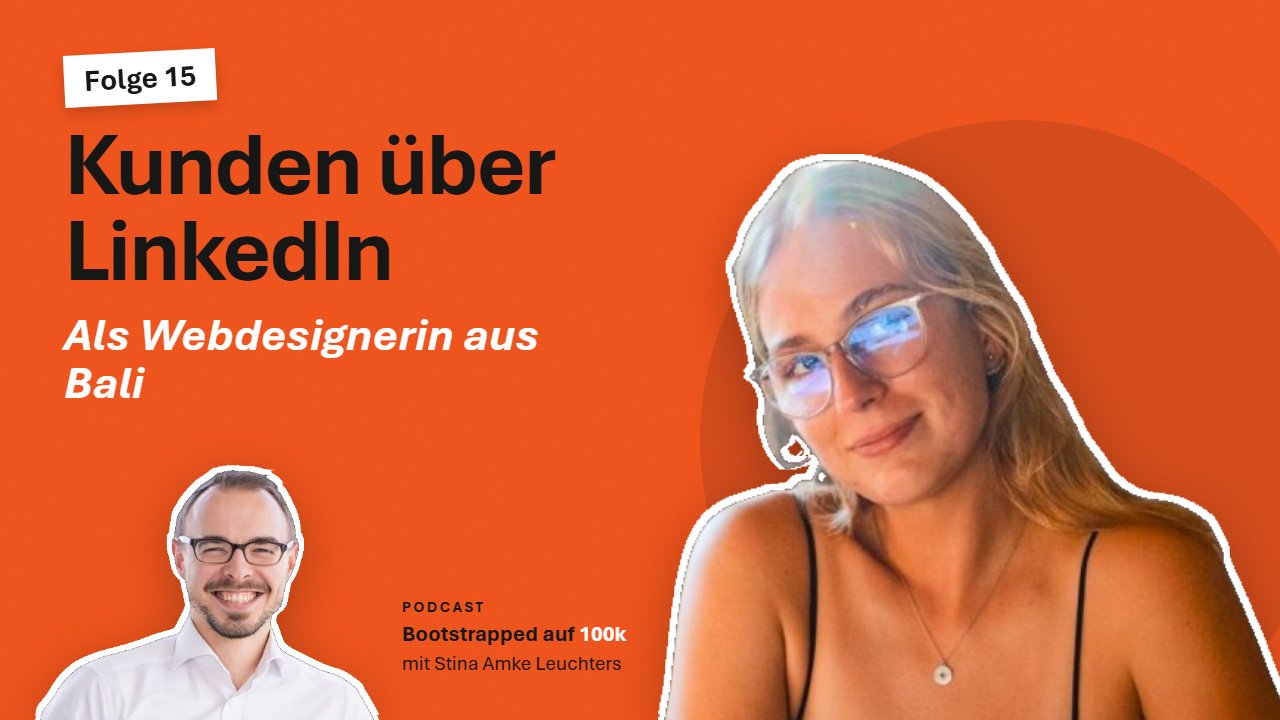
Emigrated without a plan – and suddenly an entrepreneur
Stina's story begins classically unclassical. After her bachelor's degree, she wanted to travel, learn to surf, and find somewhere to settle. No master's degree, no job, no fixed plan. First two weeks in Indonesia, then two months, then the decision: this is where I want to live.
What immediately grabbed me about her story is the order of events. She didn't emigrate because she had a finished business. She built a business because she had emigrated and needed money. This difference sounds like a minor detail, but it's actually a complete mindshift.
As Stina described it:
„Ich habe meinen Job gekündigt und war dann so: okay, was mache ich jetzt eigentlich? Ich habe keinen Job und kann ja hier nicht einfach ins nächste Café gehen und kellnern.“
From handing in her notice to landing her first two clients took four weeks. Not because she had a perfect plan, but because she simply got started. She had never done web design before. Her first projects were for friends and free of charge. Then came a networking event in Bali, a conversation just before leaving – and suddenly her first paying client.
Today, after nearly two years, Stina has worked with 35 clients. Almost all from German-speaking countries, almost all female photographers. A prime example of what's possible when digital nomads deliberately target their audience in Germany and Europe.
Why Photographers? The Power of a Clear Target Audience
That's exactly the question I asked her. And the answer was one of the most practically relevant moments in the entire conversation for me.
Stina didn't specialize in photographers from the very beginning. It developed over time. But at some point she made a conscious decision to position herself clearly. And since then, everything runs through it: website, LinkedIn content, newsletter, offerings.
What particularly stuck with me was her perspective on what keeps going wrong with photographers' websites:
„Imagine Aldi sends you two flyers on a Sunday. One lists the products, the other lists the prices. You have to figure out yourself what costs what. That's exactly what many photographers do on their website.“
Offerings on one subpage, prices on another, reviews somewhere else entirely. Who's still going to make an inquiry? That's not a minor issue – it's conversion killer number one. And the reason is usually the same: you look at what others are doing, copy it, and in doing so unknowingly adopt their mistakes too.
I know this all too well from the world of SEO. Anyone who only looks at what others are ranking for, without understanding why, ends up making the same structural mistakes.
Visibly AI: your SEO copilot
Projects, rankings, Search Console data and a copilot that runs the analysis for you. Start for free.
Digital Nomad Germany: LinkedIn as a Client Channel
For many people working as digital nomads from Germany, the same question comes up: which channel actually works when you don't have a local network? Stina's answer is clear: LinkedIn.
She has been posting for exactly two years now, up to five times a week today. But what I was curious about: did she plan this strategically from the start?
No. And that's perhaps exactly why it worked.
In the beginning, she simply posted about her life. Indonesia, surfing, everyday moments. No product, no target audience, no positioning. And yet it built a community, because she got one thing right from the very start: she was relatable.
As she put it:
„There are web designers a dime a dozen. There aren't quite as many Stinas out there. And if that Stina also happens to be a web designer living in Bali – well, there you go.“
Personal branding isn't the collection of buzzwords you write on your profile. It's whether people feel like they already know you before they reach out.
But – and this was important to me in our conversation – at some point that alone isn't enough. Stina herself mentioned that after half a year she noticed that many people were following her but didn't actually know what she was selling.
Her solution was simple: a mix. Three posts per week on strategy and professional topics, two posts per week on personal insights. It sounds straightforward, but for many people it's the crucial step – especially for nomads in Germany who don't meet their clients in person.
What a website really needs to deliver
This is where it gets really interesting from a consulting perspective. Stina does web design, yes. But she made it clear in our conversation that the actual core of her work lies somewhere else.
These are the three points I jotted down right away:
- Positioning first. Who are you, for whom, at what price, with what promise?
- Target audience, specifically. "Families“ is not a target audience. Which families, with what budget, with what problem?
- Strategy before design. A beautiful website built on a weak foundation won't bring in any customers.
As Stina put it:
„I can't put a beautiful roof on a house when the foundation beneath it is sliding away.“
It's so simple you could almost read right past it. But I know this pattern from my own experience in SEO: many people invest in visible things before the basics are in place. Rankings without structure, design without strategy, content without purpose. The result is always the same.
That's why Stina today deliberately works at the point where most web designers don't even start: with the offer, the unique selling proposition, and the question of what exactly should happen on the website before a single line of code is written.
AI, Vibecoding, and Why Experience Is Irreplaceable
We also briefly talked about the topic of AI. Stina's take on it is refreshingly clear:
„AI doesn't know what has worked and what hasn't with my 35 clients. I do. And as long as that's the case, it can't replace me.“
That hits the nail on the head. A language model learns from what exists on the web. So if all photographer websites separate services and prices, AI will eventually think that's the right approach – simply because everyone does it that way. No model has experience from real projects, with real numbers and real results.
In my own work, I encounter exactly this problem all the time. Clients come in with AI-generated SEO strategies that sound logical at first glance, but in practice miss the mark when it comes to the specific industry or target audience. Because the context is simply missing.
AI is a great sparring partner. But the plan has to come from you.
Leaving Germany as a Digital Nomad – Tax and Legal Considerations
Part of the conversation was definitely not marketing, but still relevant for many who want to go down this path – and especially for nomads in Germany who are considering giving up their residence.
What I took away from it:
- Anyone who does not live in Germany for more than six months must deregister there.
- Having a company in Germany makes little sense after deregistering.
- The legal structure depends heavily on the country. In Indonesia, foreigners cannot set up a local online business.
- Taxes in Indonesia are significantly lower than in Germany.
Stina also made it clear that she communicates all of this very openly. Anyone who has a problem with that is simply not her client. That is a healthy attitude – and one that many nomads in Germany should allow themselves more often.
What I took away from this conversation
This was one of those conversations where I had to pause for a moment, because something just clicked right then and there.
For me personally, there were three of those moments:
1. Positioning is not a luxury – it's a foundation.
Whether it's web design or SEO: anyone who doesn't clearly state who they work for and why their offer is better will lose clients before they've even reached them.
2. Relatability beats perfection.
Stina's LinkedIn success isn't based on perfect copy or a sophisticated content strategy from the start. It's based on the fact that she simply was herself. That sounds like a cliché, but in practice it's harder than you'd think.
3. Less fear, more doing.
Her advice about emigrating, in my opinion, also applies to many other decisions: What is the absolute worst that could happen? Most of the time, it's far less bad than you imagined beforehand.
Conclusion: What Nomads in Germany Can Learn from Stina's Journey
If you work in web design, positioning, or personal branding, give this episode a listen. Stina is someone you enjoy listening to because she doesn't pretend she had everything figured out perfectly from the start. And that's exactly what makes her insights so valuable.
Whether you're a nomad still living in Germany or have already taken the leap abroad: the principle is the same. Position yourself clearly, communicate consistently, and start before everything is perfect.
You can find the full episode here:
Behind the Scenes in Marketing, Episode 15 with Stina on YouTube
And if you want to see more from Stina:
webdesignmitstina.de
FAQ: Nomads in Germany and the Path to a Remote Business
What do nomads in Germany need to consider before emigrating?
Anyone planning to live abroad for more than six months must deregister in Germany. This eliminates the obligation to file a German tax return – but also access to social benefits. Running a local business in Germany in parallel after deregistering is not practical in most cases. Legal and tax advice before taking this step is strongly recommended.
How does the digital nomad Germany model work for freelancers?
Many freelancers who are digital nomads from Germany retain their German clients and use LinkedIn as their primary acquisition channel. Stina is a great example: she lives in Bali, works with German-speaking photographers, and founded her company in the USA. The key is a clear positioning and a consistent online presence.
How do you win German clients as a nomad without a physical office?
Through trust and visibility. Stina has shown that regular, personal content on LinkedIn is enough to attract 35 clients – without ads, without cold outreach. What matters is that potential clients feel like they know the person behind the offer.
Why isn't a beautiful website enough for nomads in Germany?
Because design without strategy doesn't trigger purchasing decisions. If you spread your offer, prices, and references across multiple subpages, you lose potential clients on their very first visit. The website needs a clear structure that leads visitors to make an inquiry – and that's true regardless of whether you work as a nomad or not.
What are the biggest mistakes when starting out as a digital nomad from Germany?
Lack of positioning, no clear offer, and too much focus on perfection before getting started. Stina's journey shows: you don't need to have everything figured out to begin. Four weeks after handing in her notice, she had her first two clients – without a finished website, without a strategy, without a LinkedIn presence. Those who wait until everything is perfect usually wait too long.
Free SEO tools
Keyword ranking, SSR text check, sitemap audit and more, right in the browser and without signup.

About the Author: Antonio Blago
SEO Freelancer & AI Visibility Expert
I optimize SEO data-driven with Python, behavioral psychology, and my Neuro-SEO System®. On YouTube, LinkedIn, and Instagram I share hands-on tutorials, insights, and SEO strategies.