SEO Case Study Vape and Tobacco: +23 % Clicks After Audit

AI summary
- Swiss e-cigarette shop implemented technical SEO audit priorities and gained 23.4 percent more organic clicks over eleven months from September 2025 to September 2026.
- Average search position improved from 10.6 to 8.5 while click-through rate increased 0.54 percentage points by implementing faceted navigation noindex tags and hreflang x-default.
- October 2025 audit identified five priority construction sites with filter pages causing indexing problems and language version canonical issues across four language subdomains.
- August 2026 delivered 30,935 clicks as best month representing 35 percent gain over audit month October 2025 with growth driven by generic searches like vape and lost mary.
Generated with AI, the details are in the article.
Table of contents
An online shop whose rankings largely hold and that still loses clicks for a whole year: that was the starting point at a Swiss online shop for e-cigarettes, liquids and tobacco accessories running on Magento 2 in four language versions. At the client's request I do not name the shop, the figures are unchanged. I audited the shop in October 2025. Eleven months later, Search Console shows 23 percent more organic clicks, an average position of 8.5 instead of 10.6, and the best month of the year in August 2026.
This case study covers the starting point, the audit priorities, the honest implementation status after eleven months, and the result from Google Search Console. All figures come from the shop's domain property in Google Search Console, period 11 September 2025 to 11 September 2026.[1]
Starting point: a shop loses clicks although the rankings hold
The shop runs on Magento 2 with language versions for German, French, Italian and English on separate subdomains. The shop had grown quickly over the years and is managed by a web agency. In September 2025 the agency came to me with a clear question: why are clicks declining although positions are largely stable?
At the time, Search Console showed larger click losses since the end of October 2024. In the comparison period the shop had lost around 29,000 brand clicks, and generic clicks were 33 percent below the previous year. The pattern was striking: for many keywords the position was not the problem, the click-through rate was. On top of that came a real shift in demand. For individual product models, impressions and clicks collapsed together because demand itself had dropped.[2]
Part of this has a regulatory background. Since 1 October 2024 the Swiss Tobacco Products Act has been in force. It covers electronic cigarettes with and without nicotine, introduces a uniform ban on sales to minors and sets requirements for the products themselves.[7] Popular models disappeared from the range, and with them part of the search demand. Brand searches accounted for 17 percent of traffic, generic searches for 50 percent, the rest was anonymized.[2] A shop that lives half on generic searches has to keep the technical basis for them clean. That is exactly where the audit started.
The audit: five construction sites in order of priority
The audit in October 2025 included a ranking analysis, indexing, page speed and a technical crawl. The result was a prioritized list in three tiers and a 30-60-90 plan so the agency could start right away.[2]
| Priority | Area | Recommendation |
|---|---|---|
| P1 | Faceted navigation | Filter pages set to noindex,follow, canonical pointing to the unfiltered category, filter parameters excluded from crawling in robots.txt, sitemaps with indexable URLs only[3] |
| P1 | Hreflang and canonical | Add x-default, fix language mix-ups between the subdomains, check canonicals across the project[4][6] |
| P1 | Unavailable products | Keep pages with SEO value and link alternatives, otherwise 301 to the successor or category, close orphaned products with 410[5] |
| P1 | Cart and checkout | Fewer pop-ups, variant selection directly in the category, guest checkout, express payment methods, shipping costs visible early |
| P2 | On-page technology | Remove duplicate title tags, add missing H1s, Open Graph and Twitter tags, alt texts, duplicate sitemap entries, structured data errors for WebSite, Organization and MerchantReturnPolicy |
| P2 | Performance and accessibility | Core Web Vitals passed, but render-blocking resources, unused JavaScript and main-thread load; viewport without zoom lock, touch targets of at least 48 pixels |
| P3 | Monitoring and content | Search Console export to BigQuery, separate brand and generic via regex, KPI board, deepen brand and product landing pages |
Why faceted navigation came first: Magento creates a separate URL for every filter combination. Google describes exactly this pattern as a cause of overcrawling and slower discovery crawls and recommends excluding filter parameters from crawling via robots.txt and letting only the unfiltered listing page be crawled.[3] The effect was visible in the indexing report: the share of pages with noindex and of pages crawled but not indexed had risen noticeably shortly before the audit.[2]
What is live eleven months later
A case study without an implementation status is only half the picture. So on 14 September 2026 I checked the home page, a category, a filter URL and the robots.txt.[8]
| Recommendation | Status 14 Sep 2026 |
|---|---|
| Filter pages set to noindex,follow | Implemented: filter URLs carry NOINDEX,FOLLOW, the category INDEX,FOLLOW |
| Hreflang with x-default | Implemented: five entries for de, en, fr, it and x-default on the home page and categories |
| Viewport without zoom lock | Implemented: maximum-scale set to 5, no more user-scalable=0 |
| Structured data | Present: OnlineStore, Organization, MerchantReturnPolicy, WebSite with SearchAction, CollectionPage with ItemList and Offer, BreadcrumbList |
| One title, one H1 per page | Implemented |
| Canonical tags | Open: home page and categories deliver no rel=canonical |
| Open Graph and Twitter tags | Open |
| Facet disallows in robots.txt | Open: the robots.txt only contains the bot rules managed by Cloudflare |
So the most important levers are live: filter pages no longer end up in the index, the language versions are cleanly linked, and the viewport no longer blocks zooming. The open items are not a disaster, but they cost something. Without a canonical, Google relies on indirect signals such as the hreflang cluster to consolidate duplicates.[6] That works, but it is less reliable than an explicit tag.
The result in Search Console
For the comparison I take two 90-day windows: the 90 days around the audit and the last 90 days before retrieval. Both windows include all four language versions and all devices.[1]
| Period | Clicks | Impressions | CTR | Position |
|---|---|---|---|---|
| 11 Sep to 9 Dec 2025 (around the audit) | 68,834 | 2,126,190 | 3.24 % | 10.6 |
| 13 Jun to 11 Sep 2026 (last 90 days) | 84,968 | 2,247,069 | 3.78 % | 8.5 |
| Change | +23.4 % | +5.7 % | +0.54 points | 2.1 positions better |
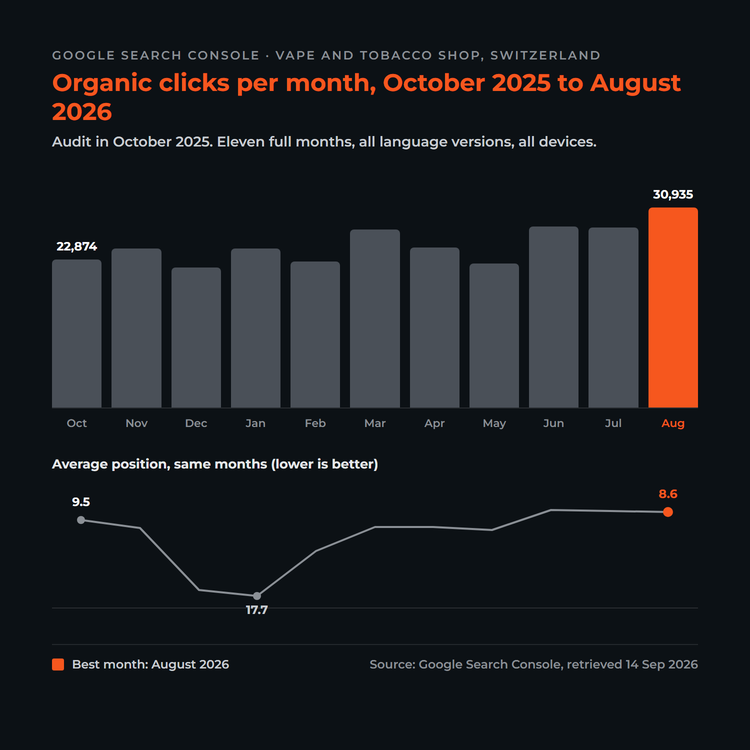
At the monthly level the picture looks like this: in October 2025, the audit month, the shop had 22,874 clicks. In August 2026 it was 30,935, a gain of 35 percent and the best month of the year. Over twelve months, 301,964 clicks add up from 9.5 million impressions.[1]
Winter is the outlier. From December to February, impressions rose to as much as one million per month while the average position slipped to 17 to 18 and the click-through rate fell to 2.6 percent. That is typical for broad search terms where a shop appears far down with many impressions but hardly any clicks. A current example from the last 90 days: the term "terea" brings 20,560 impressions at a click-through rate of 0.54 percent.[1] From March the position normalized, and from June it stayed stable between 8.4 and 8.6.
Where the growth comes from is shown by the split by search term. The brand share of clicks in the last 90 days is 14.5 percent, slightly below the 17 percent at the time of the audit.[1][2] The gain comes from generic searches: "vape" with 4,310 clicks at position 6.1, "lost mary" with 1,211 clicks at position 3.0 and "vape ohne nikotin" (nicotine-free vape) with 460 clicks at position 3.3. At page level, the home page leads with 24,801 clicks, followed by the Lost Mary brand page with 3,628 clicks at position 2.7 and the nicotine-free vapes category with 2,480 clicks at position 5.2. The French and English versions each deliver around 2,000 clicks per quarter as well.[1]
What I take away from the project
- With Magento, faceted navigation comes first. Every filter combination is a URL with almost the same content as the category. If you do not control that, you burn crawl budget, fill the index with variants nobody searches for, and let filter pages compete with your own category. Why noindex,follow instead of simply blocking: noindex takes the variants out of the index, follow keeps the links counting towards the products. The robots.txt exclusion Google recommends for filter parameters saves crawl budget afterwards, but it only comes into play once the URLs are out of the index, otherwise Google never sees the noindex.[3] Filters with real demand are the exception: they belong in a proper category, just as the shop did with nicotine-free vapes.
- Losing clicks is not the same as losing rankings. In this case the positions held, click-through rate and demand dropped away. A law can remove an entire product range from search.[7] If you only watch rankings, you see that too late.
- An audit only works as far as it is implemented. Hence the prioritization into P1 to P3 and a 30-60-90 plan. The agency implemented the indexing and language items, but not the canonicals. The result is visible anyway, but it would stand more stable with the open items done.
- Hreflang and canonical belong together. In a four-language shop, hreflang clusters are one of the signals Google uses to consolidate duplicates. An explicit canonical turns that into a clear statement.[6][4]
- Organic demand is the stabilizer. In this niche there is no Meta channel at all: Meta prohibits ads for tobacco and nicotine products entirely, explicitly including e-cigarettes, vapes and nicotine-free vapes.[9] It is similarly tight for alcohol, gambling, online pharmacies, adult products and weapons, which Meta allows only with restrictions or not at all,[10] and since 2025 for health, wellness and financial services, whose purchase events fall under the Sensitive Ads Update. For such shops, organic search is the main channel for new customers, and a clean technical foundation is mandatory rather than optional. What channel dependency costs otherwise, I described in the article Meta ad account disabled.
Conclusion
After the audit in October 2025, the shop implemented the decisive technical items: filter pages out of the index, clean language linking with x-default, an accessible viewport. Eleven months later, organic clicks are 23 percent higher in the 90-day comparison, the average position improved from 10.6 to 8.5, and August 2026 was the best month of the year with 30,935 clicks.[1] Canonicals, social tags and the robots.txt remain open. That is the next step, and it is a small one.
If your shop is losing clicks although the rankings hold, it pays to look at click-through rate, indexing and demand before you invest in new content. A potential check in a first call shows within an hour where you stand.
Sources
- Google Search Console, the shop's domain property (not named at the client's request), period 11 Sep 2025 to 11 Sep 2026, retrieved via Visibly AI on 14 Sep 2026. search.google.com/search-console
- SEO audit of the shop, October 2025: ranking, indexing, page speed, crawling and technology, summary with prioritization. Internal document, not public.
- Google Search Central: Managing crawling of faceted navigation URLs. developers.google.com (accessed 14 Sep 2026)
- Google Search Central: Tell Google about localized versions of your page. developers.google.com (accessed 14 Sep 2026)
- Google Search Central: How HTTP status codes affect Google's crawlers. developers.google.com (accessed 14 Sep 2026)
- Google Search Central: How to specify a canonical with rel="canonical" and other methods. developers.google.com (accessed 14 Sep 2026)
- Swiss Federal Office of Public Health (BAG): FAQ on the implementation of the Tobacco Products Act (German). bag.admin.ch (accessed 14 Sep 2026)
- Live check of the shop on 14 Sep 2026: home page, category, filter URL and robots.txt. Domain not named at the client's request.
- Meta Transparency Center: Tobacco and Related Products (Advertising Standards, Restricted Goods and Services). transparency.meta.com (accessed 14 Sep 2026)
- Meta Transparency Center: Introduction to the Advertising Standards, section Restricted Goods and Services. transparency.meta.com (accessed 14 Sep 2026)
Brand Radar: where does your brand stand?
Brand and generic traffic, competitors and potential at a glance, free of charge.
About the Author
SEO Freelancer & AI Visibility Expert
I optimize SEO data-driven with Python, behavioral psychology, and my Neuro-SEO System®. On YouTube, LinkedIn, and Instagram I share hands-on tutorials, insights, and SEO strategies.