Claude Code Pricing 2026: Plans, Limits and API Cost

AI summary
- Claude Code costs $20 per month on Pro, $100 or $200 on Max, or $25 to $125 per seat on Team, cheaper with annual billing; the free claude.ai plan does not include it.
- Pro and Max have a five-hour and a weekly limit shared across the Claude apps and Claude Code; at the limit you can upgrade, enable usage credits or use API credits.
- Calculation: the author's 25.98 billion tokens in 30 days would have cost about $6,260 to $25,040 through the API depending on the model; the Max 20x plan costs $200 per month.
- The biggest lever is context: 96.55 percent of the tokens came from the prompt cache, and /clear between tasks, Sonnet as default and Haiku for subagents cut costs further.
Generated with AI, the details are in the article.
Table of contents
Claude Code series, all parts:
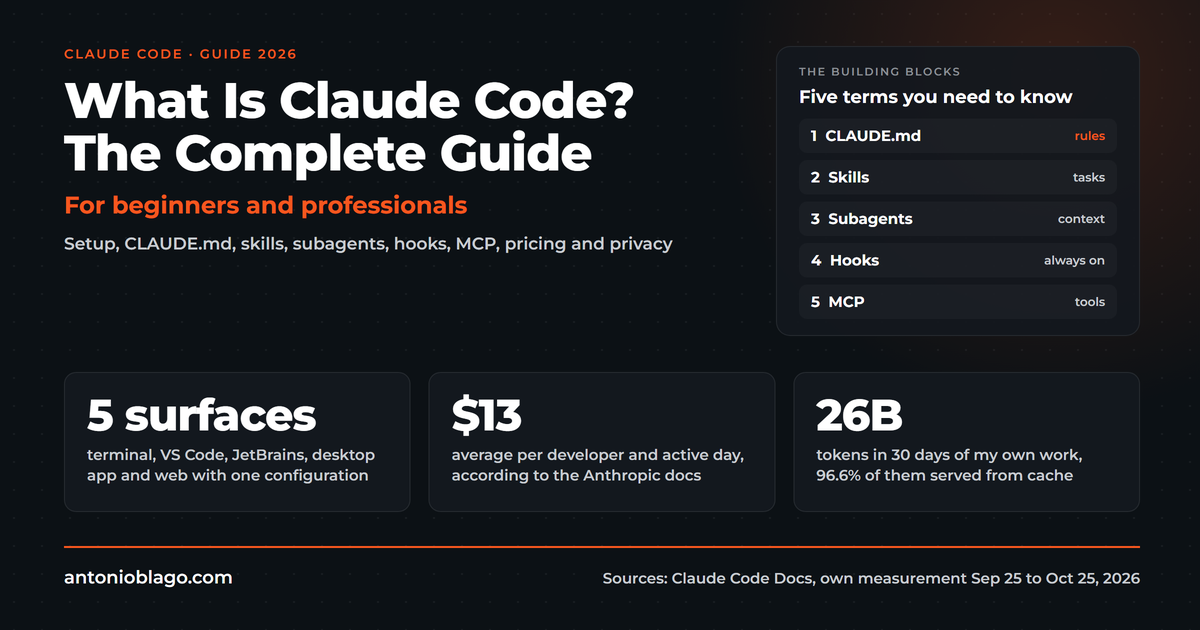
- What is Claude Code? The complete guide
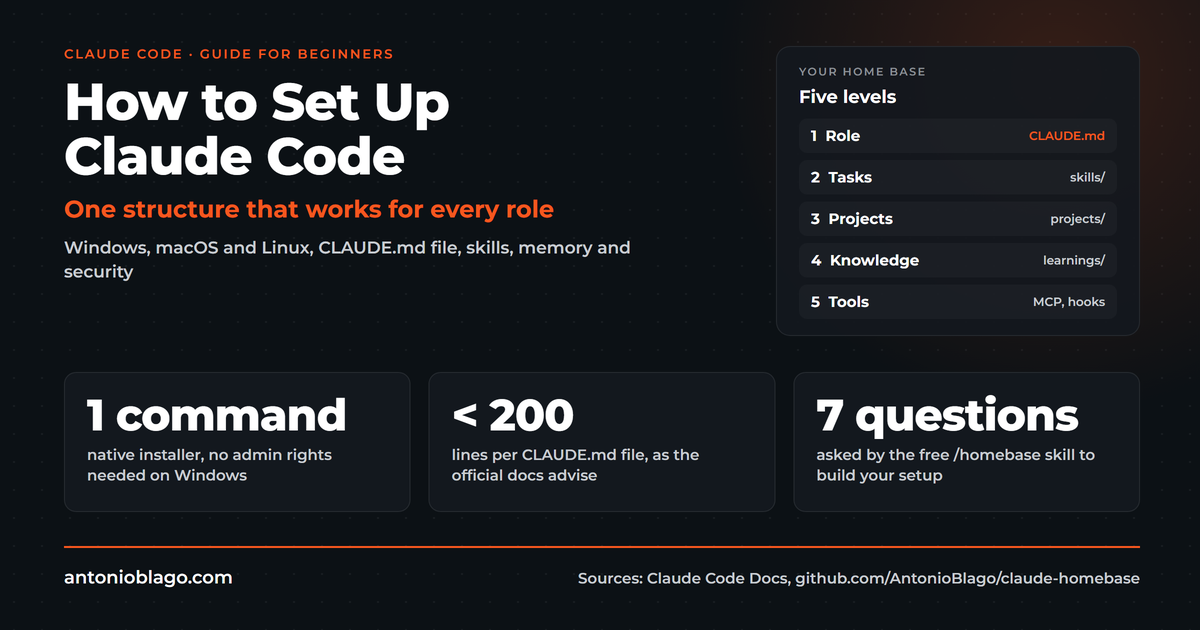
- How to set up Claude Code: a guide for beginners
- Claude Code pricing 2026: plans, limits and API cost (this article)
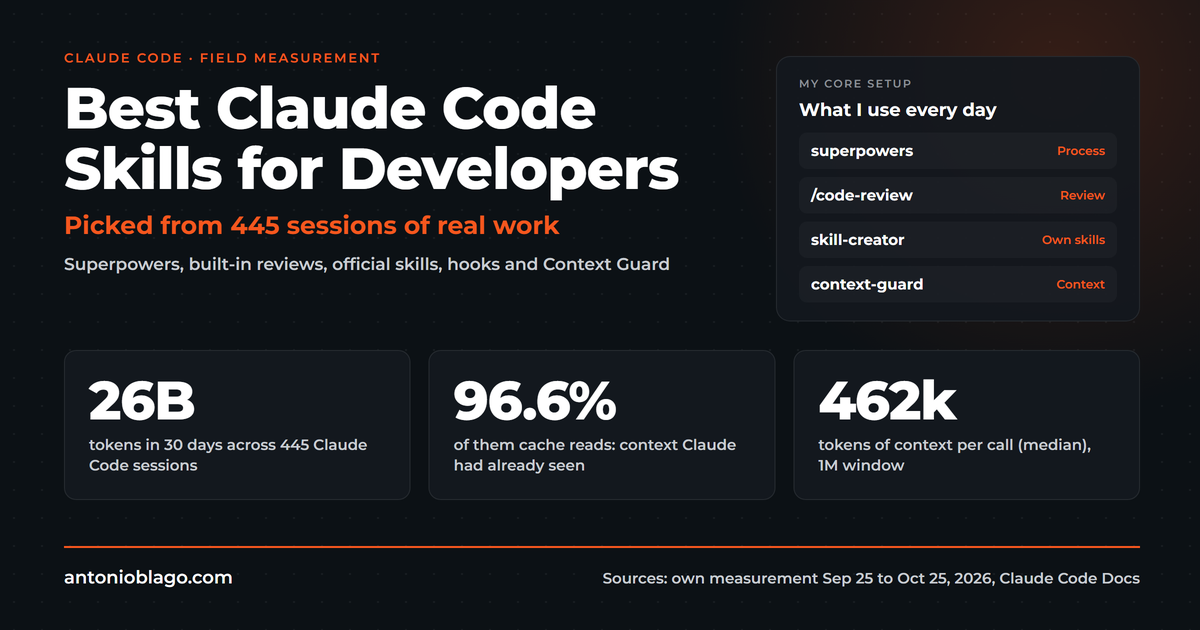
- Best Claude Code skills for developers
- AI hallucinations: what DELEGATE-52 shows for businesses
- Agentic SEO systems 2026: Claude Code as an SEO control center
- Agentic engineering: 100+ SEO projects solo with AI
- Claude skills in practice: winning the Peec AI MCP Challenge
- Build an online shop with Claude Code: Happy Coffee
- Be Ahead #1: prompt sets, chat charts, Claude routines
- How LLMs rank brands: a statistical study
Anthropic's pricing page lists plans, the documentation lists prices per million tokens, and neither answers the question most people have: how much does Claude Code cost in real use, and what is the current Claude pricing for each plan? I analyzed my own session logs, 26 billion tokens in 30 days[10], and in this article I calculate what that would have cost through the API and what it costs on a plan.
The question is common: in the United States "claude code pricing" gets around 27,100 searches a month, "claude code subscription" 22,200, "claude api pricing" 8,100 and "claude code free" 2,900[12]. All prices in this article are as of October 25, 2026, exclude tax and may change. What Claude Code is and how to set it up is covered in the Claude Code guide and the setup guide.
How much does Claude Code cost? Claude pricing at a glance
There are four ways to pay for Claude Code: an individual plan (the Anthropic Claude Pro plan or Claude Max), a Team or Enterprise plan, or the API billed per usage. Claude Code is no chatbot in the browser but an agent in the terminal that runs on the same artificial intelligence models as the Claude apps. The free claude.ai plan does not include Claude Code[2].
| Access | Price per month | Usage |
|---|---|---|
| Pro | $20, $17 with annual billing | base allowance, five-hour and weekly limits |
| Max 5x | $100 | 5x the usage of Pro |
| Max 20x | $200 | 20x the usage of Pro |
| Team, standard seat | $25, $20 with annual billing | more usage than Pro, administration |
| Team, premium seat | $125, $100 with annual billing | 5x the usage of a standard seat |
| Enterprise | seat price on request plus usage at API rates | SSO, administration, analytics |
| API (Console) | per token used | no session limits, spend limits available |
Claude Pro plan: $20 per month
The Anthropic Claude Pro plan costs $20 per month or $17 with annual billing, in which case $200 is billed up front[1]. The plan covers the Claude apps in the browser, on the desktop and on your phone as well as Claude Code in the terminal and in your IDE, and everything counts against the same limits[3]. Claude Opus is available from Claude Pro upwards, Claude Sonnet and Claude Haiku in any case[1]. When you hit a limit, you can turn on usage credits and use up to 50 percent of your weekly limits on top, billed per usage[1].
Claude Max 5x and 20x: $100 or $200
Anthropic Claude Max comes in two tiers: $100 per month for five times the usage of Pro, $200 for twenty times[1]. On top you get Fable as the strongest model with its own weekly limit[3], priority access at high traffic times and $100 or $200 in monthly API credits for the Claude Platform[1]. Those credits are meant for your own applications: they cannot be used in Claude Code or in the Claude apps, not even as usage credits[3].
Claude Team plan and Enterprise
The Claude Team plan covers 2 to 150 users. A standard seat costs $25 per month, $20 with annual billing, and comes with more usage than Pro. A premium seat costs $125 or $100 and has five times the usage of a standard seat. The Claude Team plan includes Claude Code and Claude Cowork, seat types can be mixed, and the plan adds up to $500 in pooled API credits per month, central billing, single sign-on and no model training on your content by default[1]. Enterprise bills a seat price on request plus usage at API rates[1]. In both plans the seat allowance is the ceiling; to let members continue past it, you turn on usage credits and set spend limits per organization, group or member[4].
Is Claude Code free?
No, and there is no free tier or trial either. Around 2,900 people a month search for "claude code free" in the United States[12], but Claude Code needs a paid plan or a Console account with credits[2]. The cheapest way in without a subscription is a Console account that you top up with a small amount and pay per token[3]. A few dollars are enough for a first try; for daily work the plan is almost always cheaper, as the calculation below shows.
Claude Code usage limits: five-hour window, weekly limit and usage credits
Claude Pro and Claude Max have two limits: a session limit that applies to a five-hour window and a weekly limit. Both are shared across the Claude apps and Claude Code, and usage in VS Code or JetBrains counts too[3]. Max additionally has a separate weekly limit for Fable[3]. Claude Code warns you before you reach a limit; if you hit it in the middle of a step, the agent keeps working briefly to finish that step and shows "Usage limit reached, wrapping up"[3].
What happens at the limit
At the limit you have four options[3]: an upgrade (from Pro to Max 5x, from Max 5x to Max 20x), turning on usage credits and continuing per usage, a Console account with API credits for intensive phases, or waiting until the limit resets. With /usage you see how much of your allowance is used, which skills, subagents and MCP servers account for it and how much you have spent on usage credits this month[4]. You can set a monthly spend limit for usage credits, and Claude Code asks you right in the terminal whether to raise it when you reach it[4].
The API key trap
One detail costs some users unexpected money: if the environment variable ANTHROPIC_API_KEY is set on your machine, Claude Code uses that key instead of your plan, and every session is billed at API rates[3]. Check with /status. If you want to stay strictly within your plan, run claude logout, log back in with claude login using only your plan credentials and decline the prompt for API credits[3].
Claude API pricing: token prices and prompt caching
Through the API you pay token pricing per million tokens, split into input, output and cache. Every model is its own large language model with its own rate, and current prices differ by a factor of 100 between models[5]:
| Model | Input per million | Output per million | Cache read per million |
|---|---|---|---|
| Claude Fable 5.1 | $10 | $50 | $0.25 |
| Claude Opus 5.5 | $4 | $20 | $0.20 |
| Claude Sonnet 5.5 | $2 | $10 | $0.10 |
| Claude Haiku 5.5 | $0.10 | $0.50 | $0.01 |
Prompt caching: the biggest lever
Claude Code sends the entire previous context with every call: system prompt, CLAUDE.md, files it read, tool results. Without a cache every call would pay for that context in full. Prompt caching stores the unchanged beginning of the prompt; writing costs 1.25 times the input price with a five-minute lifetime and twice the input price with one hour, while reading costs only a tenth, a twentieth on Claude Opus 5.5 and Claude Sonnet 5.5 and a fortieth on Fable 5.1[6]. Claude Code uses this automatically[4]. With /cost you see per session what share of your input tokens came from the cache and whether the cache is currently warm[4].
What a developer pays on average
For companies running Claude Code through the API, Anthropic quotes an average of around $13 per developer per active day and $150 to $250 per developer per month; 90 percent of users stay below $30 per active day[4]. The range depends on the model, the size of the codebase and habits. For control, the Console automatically creates a workspace called "Claude Code" on first login, where you set spend limits and track cost per user[4].
Calculation: 26 billion tokens in 30 days
Between September 25 and October 25, 2026, I evaluated my local session logs with my own script, deduplicated by message and request ID[10]. The result: 445 sessions, 61,415 model calls and 25.98 billion tokens. Of those, 96.55 percent were cache reads, 3.33 percent cache writes and 0.11 percent output; uncached input stayed below one million tokens[10]. A good half of the tokens went to subagents, and a main-session call carried a median of 462,000 tokens of context[10]. The methodology and the script are in Best Claude Code skills for developers.
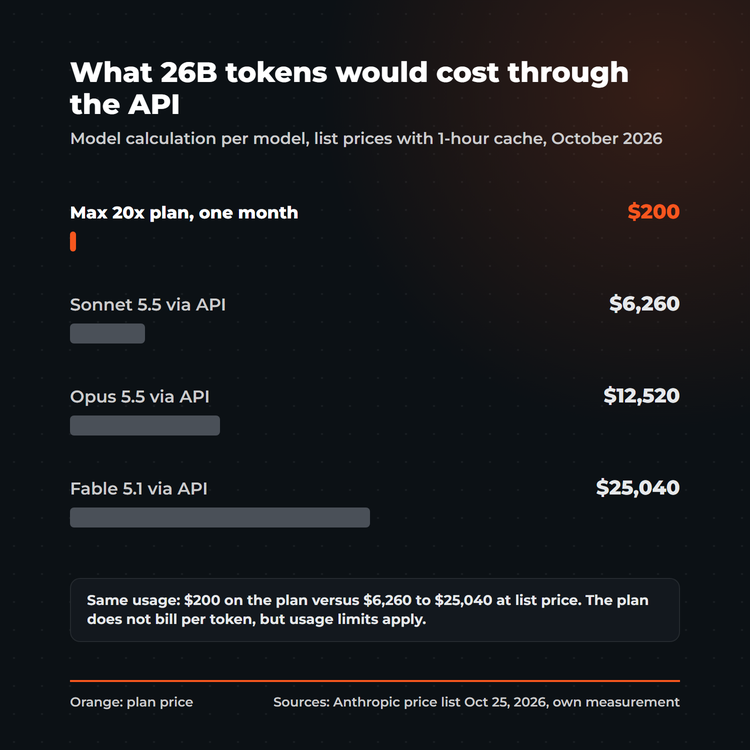
What the same usage would cost through the API
Running those token volumes through the current list prices with the one-hour cache gives, per model[11]:
| Everything on | Cache reads | Cache writes and output | Total |
|---|---|---|---|
| Sonnet 5.5 | $2,508 | $3,464 + $288 | about $6,260 |
| Opus 5.5 | $5,016 | $6,928 + $576 | about $12,520 |
| Fable 5.1 | $6,270 | $17,320 + $1,440 | about $25,040 |
With the shorter five-minute cache the totals would be about $4,960, $9,930 and $18,550[11]. For comparison: the Max plan in its 20x tier costs $200 per month[1].
What the numbers mean for your plan
Three things stand out. First: the cache is everything. 96.55 percent cache reads mean that every call mostly touches context the model already knows; without the cache the API bill would be many times higher. Second: context per call is the cost driver, with a median of 462,000 tokens per main-session call[10]. Anything that keeps context small saves directly. Third: subagents make up half of the tokens[10], so it pays to give them a cheap model. The eight levers in the next section follow from that.
How to reduce Claude Code costs: eight levers
/clearbetween tasks. Stale context costs with every further message. Run/renamefirst so you can find the session again with/resume[4][9]./compactwith instructions. "Focus on code samples and API usage" tells Claude what the summary should keep; a standing compact instruction belongs in CLAUDE.md[4].- Claude Sonnet as default, Claude Opus for architecture. The docs name sessions that were never cleared and Opus as the default model as the most common causes of unexpectedly high spend[4]. The alias
opusplanplans with Opus and executes with Sonnet[7]. - Claude Haiku for subagents. Simple helper work runs in a subagent with a cheap model and its own context window[8]. In my case subagents account for half of all tokens[10].
- Prune MCP servers.
/contextshows what takes up space,/mcpdisables servers you do not use; CLI tools likeghare leaner than an MCP server[4]. - Hooks and skills instead of exploring. A hook filters a log down to the error lines before Claude reads it; a skill delivers project knowledge instead of the agent reading ten files[4].
- Context guard and handoff. My hook Context Guard warns when the context gets expensive, and a skill writes a handoff briefing that the next session loads after
/clear[14]. - Set a spend limit. For usage credits on a plan, for workspaces on the API, for members in a team.
/usageshows where you stand at any time[4].
If you use agent teams, several Claude Code instances in parallel, keep them small, give them Sonnet and shut them down when their work is done; every instance consumes tokens until it exits[4].
Claude Pro vs. Max: which Claude plan fits?
| Profile | Recommendation | Reason |
|---|---|---|
| Occasional, a few sessions a week | Pro | $20, Opus included, usage credits as a buffer[1] |
| Daily, one codebase, Sonnet is enough | Max 5x | 5x usage for $100, the first step when you hit limits regularly[3] |
| Several hours a day, subagents, Fable | Max 20x | 20x usage, separate Fable limit, priority access[1] |
| Team with administration and data rules | Team | mix seats, no training, spend limits per member[1][4] |
| Automation, scripts, CI | API | no session limits, billing per token, workspace limits[4] |
Teams see their usage in the dashboard at claude.ai/analytics/claude-code, with usage and contribution metrics and export; API organizations in the Console at platform.claude.com/claude-code[13]. My own rule: the plan is for humans, the API is for machines. Everything I do myself in the terminal runs on the plan; everything that runs overnight or by script runs through the API with a spend limit.
From my own practice: what this means day to day
A case study from my own setup: every morning at seven a script pulls calendar, inbox and open tasks into a daily briefing and emails it to me. It runs without me at the terminal, so it goes through the API, and costs about $3.40 per run, roughly $70 a month[15]. That is the price of a routine that saves me half an hour every day, and it stays predictable because the workspace has a spend limit. My interactive work, the 26 billion tokens from the calculation above, runs on the plan, where the limits cap consumption instead of a bill. Three lessons from that: first, long sessions with a large context hit the five-hour limit faster than many short ones, which is why I built the context guard. Second, moving subagents to Claude Haiku and Claude Sonnet noticeably reduced consumption in the main window without worse results. Third, a daily look at /usage pays off: the split across skills and MCP servers shows which building block is eating tokens right now[15].
Frequently asked questions
How much does Claude Code cost per month?
$20 with Pro, $100 or $200 with Max, $25 or $125 per seat in a team, each cheaper with annual billing. Through the API you pay per token, on average $150 to $250 per developer per month in companies[1][4].
Is Claude Code free to use?
No. The free claude.ai plan does not include Claude Code. You need Pro, Max, Team, Enterprise or a Console account with credits[2].
Pro or Max for Claude Code?
Pro is enough for occasional work. If you regularly hit the five-hour or weekly limit, move to Max 5x, and to Max 20x for long daily sessions with subagents[3]. Max also brings Fable with its own weekly limit[1].
When do usage limits reset?
The session limit applies to a five-hour window, the weekly limit to the week; both are shared across the apps and Claude Code. Claude Code warns you beforehand and can finish a running step[3]. /usage shows where you stand[4].
API or plan: which is cheaper?
For daily interactive work the plan, because the API bill for the same usage is many times higher, as the calculation shows[11]. For automation without a human at the terminal the API, because no session limits apply there and workspace limits cap the cost[4].
Can I use the API credits from Max in Claude Code?
No. The $100 or $200 in monthly API credits on the Max plans are for your own applications on the Claude Platform, not for Claude Code and not for the Claude apps[3].
Is Claude Code billed flat rate or usage-based?
Both exist. On Claude Pro, Claude Max and Team you pay a flat monthly price and get an allowance with five-hour and weekly limits; only usage credits beyond the allowance are billed per use[1][3]. Through the API everything is usage-based, per token[5].
Is Claude Code worth $200 a month?
For me yes, because the same usage would cost many times more through the API, as the calculation shows[11]. For occasional use it is not: start with Claude Pro at $20 and move up only when you hit the limits regularly[3].
Is there an affordable plan for students or beginners?
Two options: the Claude Pro plan at $20 per month if you code a few hours a week, or a Console account with a small balance if you only try things now and then and prefer paying per token[1][3]. A free version of Claude Code does not exist[2].
How do I see my costs?
/cost shows the cost of the current session and the cache share, /usage the load on your plan limits and the split across skills, subagents and MCP servers, /status your remaining allowance[4][3]. Plan users do not need the dollar figure from /cost for billing; it only shows the API equivalent[4].
Conclusion
Claude Code costs between $20 per month for Claude Pro and $200 for Claude Max 20x, teams pay per seat, and the API bills per token. The prices are the smaller part of the answer. The bigger part is how you handle context: 96.55 percent of my 26 billion tokens came from the cache, and every lever that keeps context small lowers the cost and protects your limits. If you start with one thing, start with /clear between tasks and Sonnet as the default model.
All parts of the Claude Code series:
- What is Claude Code? The complete guide
- How to set up Claude Code: a guide for beginners
- Claude Code pricing 2026: plans, limits and API cost (this article)
- Best Claude Code skills for developers
- AI hallucinations: what DELEGATE-52 shows for businesses
- Agentic SEO systems 2026: Claude Code as an SEO control center
- Agentic engineering: 100+ SEO projects solo with AI
- Claude skills in practice: winning the Peec AI MCP Challenge
- Build an online shop with Claude Code: Happy Coffee
- Be Ahead #1: prompt sets, chat charts, Claude routines
- How LLMs rank brands: a statistical study
Sources
- Anthropic: Plans and pricing, retrieved October 25, 2026
- Official documentation: Advanced setup, retrieved October 25, 2026
- Claude Help Center: Use Claude Code with your Pro or Max plan, retrieved October 25, 2026
- Official documentation: Manage costs effectively, retrieved October 25, 2026
- Claude Platform Docs: Pricing, retrieved October 25, 2026
- Claude Platform Docs: Prompt caching, retrieved October 25, 2026
- Official documentation: Model configuration, retrieved October 25, 2026
- Official documentation: Create custom subagents, retrieved October 25, 2026
- Official documentation: Best practices for Claude Code, retrieved October 25, 2026
- Own measurement of local Claude Code session logs, September 25 to October 25, 2026, script token_stats.py, published in Best Claude Code skills for developers
- Own model calculation based on sources 5, 6 and 10: list prices with one-hour cache writes, model mix not reflected, as of October 25, 2026
- Own keyword data: monthly Google search volume for the United States and Germany, collected with Visibly AI on October 25, 2026
- Official documentation: Track team usage with analytics, retrieved October 25, 2026
- Own experience: cost log of the daily briefing job through the API (workspace with a spend limit) and own usage on the plan, as of October 25, 2026
- AntonioBlago/claude-context-guard. github.com/AntonioBlago/claude-context-guard, MIT license, October 25, 2026
Free SEO tools
Keyword ranking, SSR text check, sitemap audit and more, right in the browser and without signup.

About the Author: Antonio Blago
SEO Freelancer & AI Visibility Expert
I optimize SEO data-driven with Python, behavioral psychology, and my Neuro-SEO System®. On YouTube, LinkedIn, and Instagram I share hands-on tutorials, insights, and SEO strategies.