Becoming Self-Employed: What Meta Ads & Organic Really Delivers

AI summary
- Julia Hinger completed her Online Marketing degree in 2020 and became self-employed during the pandemic after securing a freelance contract for financial security.
- Effective Instagram growth requires consistency of two to three posts weekly over months, personality over sterile content, and three to four Stories per week with clear goals.
- Paid and organic marketing must work together as an integrated system, not separately, combining year-round organic visibility with targeted ads and retargeting campaigns.
- A retargeting campaign with only seven to ten euros daily budget generated over 75,000 euros in revenue for an e-commerce client, proving its underestimated potential.
Generated with AI, the details are in the article.
Table of contents
Going Self-Employed: What Paid & Organic Marketing Really Deliver
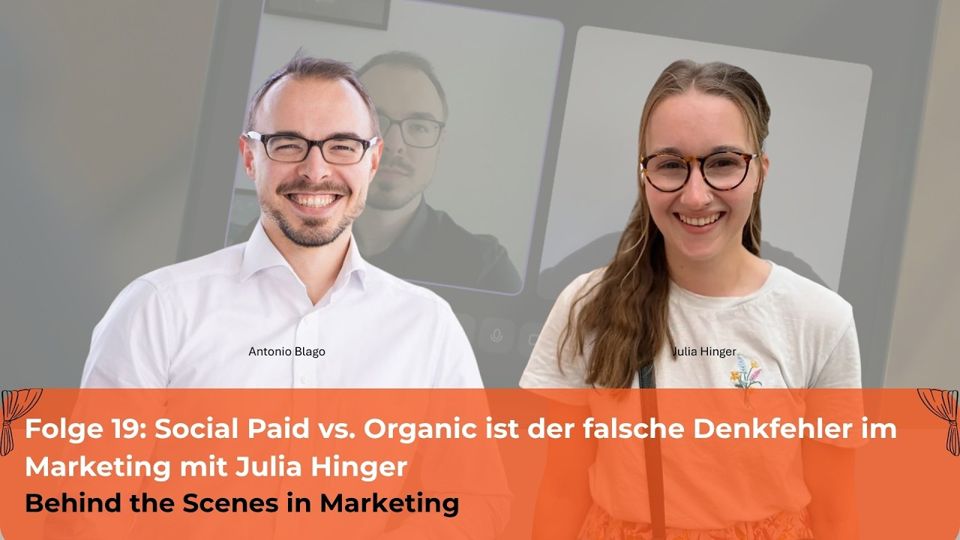
Anyone who wants to go self-employed will sooner or later run into the same question: Should I rely on paid advertising or organic content? Julia Hinger, owner of a Meta Ads agency, gave me an answer on my podcast that I never would have expected – and one that I haven't been able to get out of my head since. This article summarizes what I took away from our conversation: about starting out as self-employed, building an Instagram content plan, and the mistakes most people make when it comes to paid vs. organic.
The video:
From Thesis to Running Her Own Meta Ads Agency
Julia Hinger completed her Bachelor's degree in Online Marketing in 2020 – and then the pandemic wiped out all her job plans. Two options remained: unemployment benefits or taking the leap into self-employment. She chose the latter, even though in her graduation presentation she had said that going freelance would never be an option for her.
What makes her story so instructive: she didn't pretend this had been her grand plan from the beginning. She stumbled into it and made the best of it. She did have one real advantage – she was able to continue working freelance for her previous part-time student job, which provided financial security during the early phase. A kind of head start in self-employment that she had arranged for herself before she even knew that such a thing existed in any formal sense.
She found her first external client through freelance.de, and further clients through Facebook groups that were absolutely booming during the pandemic.
What I find instructive about this: she didn't wait around for the perfect client at the beginning. She also worked for testimonials at times, built up reviews, and simply got started.
Getting started with self-employment: What really helps
Many people who want to become self-employed don't know what support they're entitled to. This is a topic we only touched on briefly in our conversation, but I'd like to expand on it here: startup capital for self-employment from the employment office is a real option – the so-called Gründungszuschuss (startup grant) from the Bundesagentur für Arbeit. Anyone who is entitled to unemployment benefit I can apply for this grant to cover living expenses and social insurance during the startup phase.
Julia's path was different: her safety net was an existing freelance contract. Both paths illustrate the same principle – anyone who wants to become self-employed needs a financial bridge in the early stages, whether from the employment office or from their own savings.
What both paths have in common:
- Know your costs before you start. Health insurance, advance tax payments and living expenses all need to be factored into your calculations.
- Work backwards. Not “What do I want to earn?“, but “What do I actually need?“
- Win clients early, even if the conditions aren't perfect yet.
Another form of support for self-employment that is often underestimated: your own network. Julia's first contracts didn't come from cold acquisition outreach, but from existing connections and community platforms.
Free SEO tools
Keyword ranking, SSR text check, sitemap audit and more, right in the browser and without signup.
Instagram Content Plan: How Julia Really Built Her Account
Julia launched her Instagram channel only after a year and a half of being self-employed. The idea was simple: she does this every day for her clients – so why not for herself as well?
What surprised me was the sheer amount of effort involved in the early days:
„I was actively engaging for up to three or four hours a day: commenting, liking, writing DMs. I wouldn't do it that way today, but it worked.“
That's refreshingly honest. And it's important to hear, because many people nowadays act as though an account can grow on good content alone.
What a Working Instagram Content Plan Looks Like
According to Julia, a structured Instagram content plan that actually works follows these principles:
- Consistency beats frequency. It's better to post two to three times a week consistently than to post every day for 30 days and then take a three-month break. In practical terms: if you have 30 pieces of content, spread them over three months – not one.
- Showing personality was a turning point. Moving away from a sterile business account towards genuine glimpses into real life. Gymnastics, travel, working from the couch. That builds trust.
- Making testimonials public. Julia was hesitant for a long time about sharing client feedback. Once she started doing it, trust within her community grew noticeably.
- Scheduling Stories as a fixed to-do in the calendar. Three times a week, five to seven minutes each. With a clear goal: sharing a testimonial, communicating an offer, or inviting people to an initial consultation.
Instagram Content Plan with AI Support
For writing, Julia uses ChatGPT in a way that makes a lot of sense to me. She records her idea as a voice memo, has a baseline generated from it, and then adapts the text to her own tone. Her GPT is already trained on her style of writing.
That's not the point: letting AI write the content for you.
That is the point: using AI as a tool to reach a result more quickly – one that still sounds like you.
Virality Is Not a Goal in an Instagram Content Plan
This is where our conversation got particularly interesting. Julia is sceptical about virality – and rightly so. In her experience, viral posts often attracted completely the wrong audience: angry comments, irrelevant followers, zero business value.
„Virality can really blow up in your face when the algorithm serves your content to the wrong people.“
Why Paid and Organic Belong Together – the Core Message
This is the real heart of the conversation, and I believe it's also what most people get wrong in practice. Julia put it directly:
„Paid and Organic are often treated like two completely separate departments that don't talk to each other. That's the real mistake.“
I see this time and again in client projects. One team runs ads, another team handles content – the strategies don't align. The result is mediocre.
The Year-Round Marketing Mix: How a Meta Ads Agency Thinks
Julia used the example of a coach to explain how she plans the year-round interplay:
- Stay organically visible all year round. This is the foundation. No ads budget replaces genuine community work.
- Simultaneously promote an evergreen freebie via ads. A mini-course, a checklist, or a webinar that continuously collects leads while organic content keeps building trust.
- Run targeted campaigns during the launch phase. For example, for webinar registrations shortly before a product launch.
- Don't forget retargeting. This is the part that gets completely overlooked most often.
On the topic of retargeting, Julia shared an example that genuinely impressed me: with an e-commerce client, she generated over 75,000 EUR in revenue using nothing but a retargeting campaign with a daily budget of 7 to 10 euros. This shows how much potential lies in abandoned cart users who just need a small nudge.
Mistakes Beginners Make with Meta Ads
From her day-to-day work as a Meta Ads agency, Julia knows these typical mistakes:
- Choosing the wrong campaign objective. If you run a reach campaign, you get reach – but no leads.
- Spending too much budget too soon. Start with 20 to 30 euros per day, not 100 euros, as long as there are no benchmark values yet.
- Not calculating backwards. How many leads do I need to win a client? What can a lead cost me? This determines the budget – not the other way around.
Finances: The 10k Myth and What Freelancers Really Need to Know
Julia's counter-question to the blanket 10,000 Euro target that is so often promoted in marketing for the self-employed:
„What are your actual costs? Without knowing that, the 10k figure is simply a number without meaning.“
Health insurance, tax prepayments, living expenses – all of this varies enormously. Julia herself had five-figure months as early as her second year in business, but lives modestly and keeps her costs under control.
We also talked about retirement planning – a topic that many people going self-employed neglect shamefully. Julia thinks about it every day. Anyone who wants to become self-employed should factor this in from the very beginning, not only once the first good months start coming in.
My Key Takeaways from the Conversation
- Separating paid and organic costs you results. Those who treat both channels as a system get further ahead.
- Consistency is worth more than frequency. That applies to the Instagram content plan just as much as to any other channel.
- Retargeting is the most underrated tool in e-commerce. Small budget, big impact.
- Personality builds trust. More than any perfect AI-generated text.
- 10k is not a magic number. Knowing your own costs and working backwards is more important.
Conclusion: Going freelance means thinking in systems – not in channels
What I took away from the conversation with Julia is above all this: most marketing problems don't arise from a lack of knowledge, but from false either-or thinking. Paid or organic. Content or ads. Personality or professionalism.
Anyone who wants to go freelance – or already has – should let go of exactly this pigeonhole thinking. Julia doesn't do this with theory, but with numbers and real examples from her daily work as a Meta Ads agency. That convinced me.
The podcast episode on YouTube: F19: Paid vs. Organic is the wrong misconception in marketing with Julia Hinger
FAQ: Common Questions About Becoming Self-Employed
How much startup capital do I need to become self-employed?
This depends heavily on your business model. As a freelancer in the service sector, you can start with very little capital – more important is a first client that covers your ongoing costs. Anyone looking to apply for startup capital for self-employment through the employment office should look into the Gründungszuschuss. The requirements are an entitlement to unemployment benefit I (ALG I) and a viable business plan.
What is the Gründungszuschuss and who receives startup support for self-employment?
The Gründungszuschuss is a startup grant for self-employment provided by the Federal Employment Agency. It is designed to secure your livelihood in the initial phase and cover social insurance contributions. Those eligible are people who start a business coming out of unemployment and still have a remaining entitlement to ALG I. A tax advisor or the start-up counselling service at the employment agency can help here.
How much budget do I need to get started with Meta Ads?
A sensible starting point is 20 to 30 Euro per day. Not less, because the algorithm won't get enough data otherwise, and not too much while there are still no benchmarks to go on. Test first, then scale – that is the approach Julia consistently recommends as a Meta Ads agency.
How do I create an Instagram content plan as a self-employed person?
A good Instagram content plan follows these basic rules: two to four feed posts per week, three to four Stories, and always one clear goal per piece of content. More important than the exact frequency is consistency over months. Julia recommends spreading existing content across several months rather than publishing everything at once. AI tools like ChatGPT can help with writing – as long as the output is adapted to your own voice.
Do I have to show my face on Instagram as a self-employed person if I'm introverted?
Not necessarily, but a little personality helps enormously. Julia has explained how she schedules Stories as a fixed task in her calendar and uses ChatGPT as a script aid. This makes getting started significantly easier – even for people who don't find personal content comes naturally to them.
Is the 10,000-Euro goal meaningful for self-employed people?
Only if you know what you actually spend. Health insurance, taxes, living costs – all of these vary considerably. Julia recommends working backwards: what do you really need? Only then does a revenue target make sense. Anyone who wants to become self-employed should do this calculation before starting, not after.
What is retargeting and why is it worthwhile?
Retargeting means serving ads specifically to people who have visited your website or opened your shop but haven't made a purchase. Using this method with a daily budget of 7 to 10 Euro, Julia generated over 75,000 Euro in revenue for an e-commerce client. It is the most underrated tool in paid marketing – especially for anyone who is just becoming self-employed and wants to maximise their revenue on a small budget.
How visible is your brand in ChatGPT and friends?
The AI Check shows you within minutes whether and how AI assistants mention your brand.

About the Author: Antonio Blago
SEO Freelancer & AI Visibility Expert
I optimize SEO data-driven with Python, behavioral psychology, and my Neuro-SEO System®. On YouTube, LinkedIn, and Instagram I share hands-on tutorials, insights, and SEO strategies.