GEO SEO: How Businesses Build AI Visibility

AI summary
- Jörg Zimmer estimates the overlap rate between classic SEO and Generative Engine Optimization at around 70 percent, meaning AI-ready websites mostly need solid technical SEO fundamentals.
- As of 2025, there is hardly any reproducible evidence of GEO SEO success, with no official data on how AI models weight sources or dedicated console like Google Search Console.
- ChatGPT traffic appears as a referrer in Google Analytics under chatgpt.com and currently represents around 1 percent of revenue for measured clients.
- Google AI Overviews appear for only around 25 percent of all keywords as of June 2025, so informational content will lose click traffic while transactional keywords remain with classic SEO.
Generated with AI, the details are in the article.
Table of contents
Hardly any topic is stirring the marketing world right now as much as GEO SEO – that is, the question of how content can be optimized for AI systems like ChatGPT, Perplexity, or Google's AI Overviews. Under terms like Generative Engine Optimization or AI SEO, checklists and tools are sprouting up everywhere – often without any solid data behind them. SEO expert Jörg Zimmer and marketing entrepreneur Antonio Blago analyzed exactly this topic in a detailed podcast episode. Their conclusion: anyone who acts frantically right now is making the same mistake as with every previous SEO hype. What really matters are fundamentals, patience, and structured experimentation.
What is GEO SEO – and why is the whole world talking about it?
GEO SEO combines classic search engine optimization with Generative Engine Optimization – the attempt to design content in such a way that AI systems like ChatGPT, Perplexity, Claude, or Google Gemini recognize and cite it as a relevant source. Unlike classic SEO, where a search engine outputs a list of links, these systems generate direct answers – and sometimes name their sources in the process.
To the podcast episode:

That sounds tempting: whoever appears as a source gains visibility without click competition. The reality, however, is more sobering:
- There is no official data on how AI models weight sources
- There is no console like the Google Search Console
- As of 2025, there is hardly any reproducible evidence of success
"Guys, please relax. The topic is new, the topic is big. Real experiments need to be done. This is not a final insight – we are all still in the process."
— Jörg Zimmer
Generative Engine Optimization meets classic SEO: The 70-percent rule
Before getting lost in GEO checklists, it is worth taking a look at your own SEO situation. Jörg Zimmer estimates the overlap rate between classic SEO and Generative Engine Optimization at around 70 percent. This means: anyone who has their technical SEO under control is already largely AI-ready.
What does "AI-ready" mean in GEO SEO specifically?
For an AI crawler to be able to process a website at all, the following basic requirements must be met:
- Crawlability: AI models are known to have difficulties with JavaScript-heavy rendering
- Loading speed: Pages that are too slow and time out cannot be evaluated by any crawler
- Sitemap & robots.txt: Control which content is allowed to be indexed
- Structured layout: Clear page architecture and semantic HTML help machines understand content
- NAP data: Name, address, and phone number consistent across all platforms
"If you say you need to do AI, but you haven't worked through your basics yet – you have to proceed in a structured way."
— Jörg Zimmer
Visibly AI: your SEO copilot
Projects, rankings, Search Console data and a copilot that runs the analysis for you. Start for free.
Optimizing websites for AI: The hallucination problem
A practical example shows why data maintenance is not a nice-to-have when optimizing websites for AI: Jörg Zimmer had already synchronized NAP data for a client across numerous city portals – a classic local SEO step. Nevertheless, ChatGPT cited a completely wrong address for this company.
This phenomenon is called hallucination: AI models generate answers based on probabilities, not based on a reliable database.
What does this mean for companies?
- Regularly check your own company data in AI models (e.g. "What do you know about [company name]?")
- Document and correct any discrepancies
- Ensure data maintenance across as many portals as possible
- Keep the Google Business Profile up to date – this also feeds into AI answers
"I saw that it had all the data correct for a company – but a completely wrong address. An address the company never had."
— Jörg Zimmer
AI SEO and channel strategy: Where do you want to appear?
A central misconception in AI SEO: companies want to "appear in AI" – without defining which one. ChatGPT, Perplexity, Gemini, Claude, Copilot – all of these models work on a similar basis, but weight sources differently.
Recommendation: First define which model your target audience actually uses – then measure and optimize specifically in that channel.
A simple self-test for AI SEO
- Enter the same prompt in ChatGPT, Perplexity, Gemini, and Claude
- Compare answers and cited sources
- Note which competitors appear and on which portals they are listed
- Document your own starting position
"AI visibility is its own channel. You have to examine it for relevance and then decide where to get involved."
— Antonio Blago
AI visibility through brand building and reputation
AI models are trained on vast amounts of text data from the internet – including review platforms, specialist forums, and press articles. This makes online reputation a direct signal for AI visibility.
Platforms like Trustpilot, Proven Expert, or the Google Business Profile are evaluated by ChatGPT and others. Those who are positively reviewed there increase the likelihood of being cited as a trustworthy source.
Concrete measures for better AI visibility:
- Actively ask for reviews on relevant platforms
- Use a consistent brand claim across all platforms
- Seek out press articles and mentions
- Maintain structured company descriptions with a keyword focus on portals
"These models have the knowledge of the world – but not yet your reputation. How you are perceived is something they still have to gather from the web."
— Jörg Zimmer
SEO ChatGPT: Prompts as a measurement tool
Anyone who wants to do SEO for ChatGPT first needs a baseline measurement. Since there is still no official "AI Search Console," manual prompts serve as a foundation.
How prompt tracking for SEO ChatGPT works:
- Identify relevant prompts: What questions does the target audience ask? (e.g. "Who is the best SEO freelancer in Berlin-Spandau?")
- Document prompts: Record them in a spreadsheet or document
- Note answers and sources: Who is mentioned? Which portals are cited as sources?
- Derive actions: Which source platforms are you not yet represented on?
- Repeat regularly: Measure again after 3, 6, and 12 months
"The prompts where you want to appear but aren't included – I would save those. To later see: did the measure make a difference?"
— Jörg Zimmer
Strengthening GEO SEO with external data sources
One of the most valuable practical tips concerns external databases. When analyzing which sources ChatGPT uses for certain queries, surprising platforms turn up.
Quick tip: PDF database Scribd
The document portal Scribd is an open platform where anyone can upload PDFs. ChatGPT explicitly references Scribd content for certain queries.
What this means for GEO SEO:
- Upload existing PDFs (white papers, guides, catalogs) to Scribd
- Increases the chance of being cited as a source in AI answers
- Particularly relevant for B2B companies with extensive documentation
Further recommended sources for GEO SEO:
- City portals and local directories
- Industry-specific specialist portals
- Wikipedia and Wikidata
- Schema.org-compliant structured data
Releasing YouTube videos for AI training: Yes or no?
In YouTube Studio, under Channel → Advanced Settings, there is a little-known option: releasing your own video content for the training of AI models. Disabled by default, it can be activated manually – with a selection of providers (OpenAI, Perplexity, Apple, Amazon, and others).
Pros and cons at a glance:
| Arguments for releasing | Arguments against |
|---|---|
| Higher chance of being cited as a source | No compensation for usage |
| Greater presence in AI training data | Unknown use of the data |
| Voice and content become better known | Risk of uncontrolled usage |
| Potential competitive advantage | Difficult to measure |
"I had thought everyone would immediately say: Yes, turn it on! But two out of three clients declined."
— Jörg Zimmer
Analytics: Measuring ChatGPT traffic today
Even without a dedicated AI console, ChatGPT traffic can already be made visible in Google Analytics. It appears as a referrer under chatgpt.com.
How to measure AI traffic in Google Analytics:
- In GA4, filter for
chatgpt.comunder Acquisition → Traffic Sources - Create a dedicated dashboard for AI referrers (including Perplexity and Bing Copilot)
- Track conversions from these sources separately
From practice: for one client, Jörg Zimmer was able to verify an actual booking that came via ChatGPT – a small but real signal.
"The share is tiny – maybe 1% of revenue. But it's not nonsense. It exists."
— Jörg Zimmer
Informational keywords in the GEO SEO world
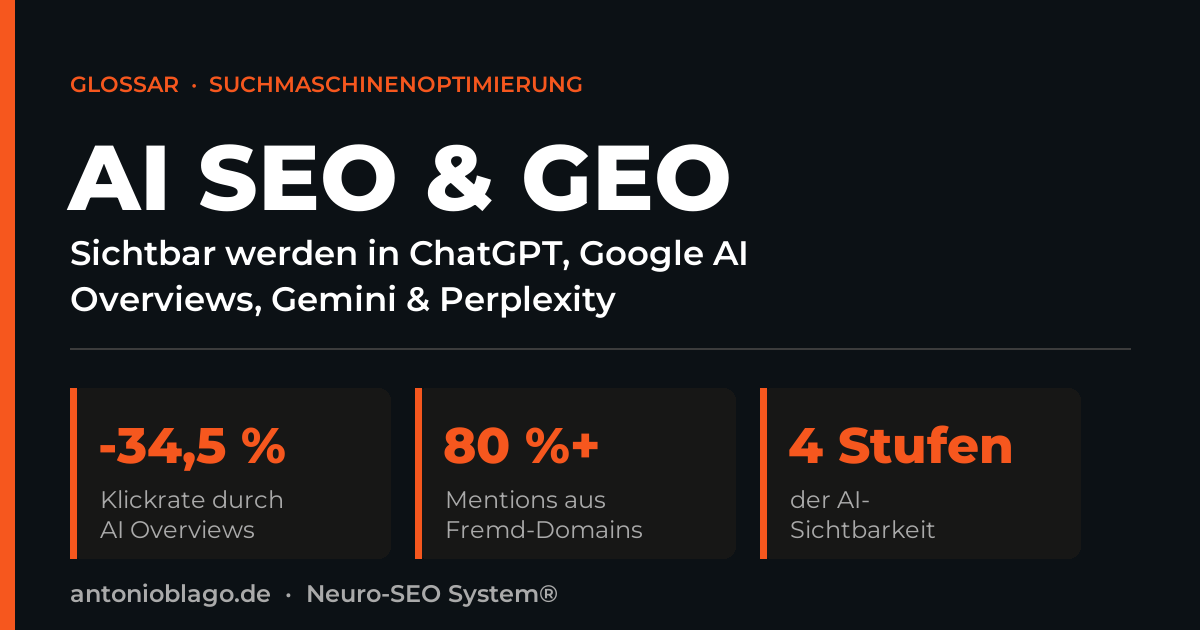
According to Sistrix data (SEO Campixx 2025), Google AI Overviews as of June 2025 appear for only around 25% of all keywords. The shift is therefore still ongoing.
Content strategy in the age of GEO SEO:
- Purely informational keywords are set to lose click traffic
- Transactional and commercial keywords remain with classic SEO for now
- Informational content still has value – as a foundation for the customer journey and as a knowledge base for AI models
- Priority should be placed on content that influences purchase decisions
"Someone searching for 'What is SEO?' is not a buyer. We will probably give up that informational traffic – and that's okay."
— Jörg Zimmer
Free initial consultation
30 minutes, your website, concrete next steps. No sales pressure.

About the Author: Antonio Blago
SEO Freelancer & AI Visibility Expert
I optimize SEO data-driven with Python, behavioral psychology, and my Neuro-SEO System®. On YouTube, LinkedIn, and Instagram I share hands-on tutorials, insights, and SEO strategies.