AI Statistics 2026: What Do Germans Use Today?

AI summary
- 37 percent of people aged 14 and over use AI tools at least weekly, up from 22 percent in 2025 (ARD/ZDF media study 2026).
- Only 13 percent of AI users pay for AI, up from 8 percent in 2025; 49 percent cannot imagine paying for an AI subscription (Bitkom 2026).
- 71 percent of AI users use ChatGPT, 50 percent Gemini and 43 percent Microsoft Copilot.
- AI Overviews appear for about 20 percent of Google searches in Germany, where the click-through rate for position 1 drops from 27 to 11 percent (SISTRIX).
Generated with AI, the details are in the article.
Table of contents
More than a third of Germans now use AI tools such as ChatGPT every week. A year ago it was just over a fifth[1]. Hardly anyone pays for it: only 13 percent of AI users have a subscription[2]. At the same time, Google shows an AI answer above the search results for roughly one in five searches in Germany[3]. Most people meet AI for free, in an app or right inside Google Search.
In these AI statistics I collect the numbers I keep needing in client calls and workshops: how many Germans use AI, which apps, who pays for it, what role Google plays, and where people spend their time on social media. Every number has a source and a definition. Where only estimates exist, I say so.
Use AI at least weekly
37%
2025: 22% (ARD/ZDF, ages 14+)
AI users with a paid plan
13%
2025: 8% (Bitkom, ages 16+)
Google searches with an AI Overview
about 20%
Germany (SISTRIX, October 2026)
AI statistics at a glance: current usage numbers
| Metric | Value | Source |
|---|---|---|
| Internet use (at least occasionally, ages 14+) | 97% | ARD/ZDF 2026[1] |
| AI tools at least weekly (ages 14+) | 37% | ARD/ZDF 2026[1] |
| Used AI at least occasionally (ages 16+) | 58% | Bitkom 2026[2] |
| ChatGPT among AI users | 71% | Bitkom 2026[2] |
| AI users who pay for AI | 13% | Bitkom 2026[2] |
| Google search engine market share | 88% | Statcounter, October 2026[17] |
| Searches with an AI Overview | about 20% | SISTRIX, October 2026[3] |
| Instagram at least weekly (ages 14+) | 40% | ARD/ZDF 2026[1] |
Adoption: how many Germans use artificial intelligence?
The answer depends on how you ask. The three major surveys for Germany measure different things but paint a similar picture:
- ARD/ZDF media study 2026: 37 percent of people aged 14 and over use AI tools such as ChatGPT at least once a week. In 2025 it was 22 percent. The study surveyed 2,462 people from late January to April 2026[1].
- Bitkom 2026: 58 percent of people aged 16 and over use AI at least occasionally, for work or privately. 34 percent use it at least weekly, 15 percent daily[2].
- Eurostat 2025: 32 percent of 16 to 74 year olds in Germany used generative AI in the last three months. That is right at the EU average of just under 33 percent[4].
In short: a good third of Germans use AI regularly, and more than half have tried it. Weekly use rose from 22 to 37 percent within one year, an increase of more than two thirds.
Germany compared with the EU
In a European comparison, Germany sits right in the middle at 32 percent. Denmark leads (48 percent), followed by Estonia and Malta (47 percent each) and Finland (46 percent); outside the EU, Norway even reaches 56 percent. Generative AI is least common in Romania (18 percent) and Italy (20 percent)[4]. The figures refer to 2025 and people aged 16 to 74.
AI use by age
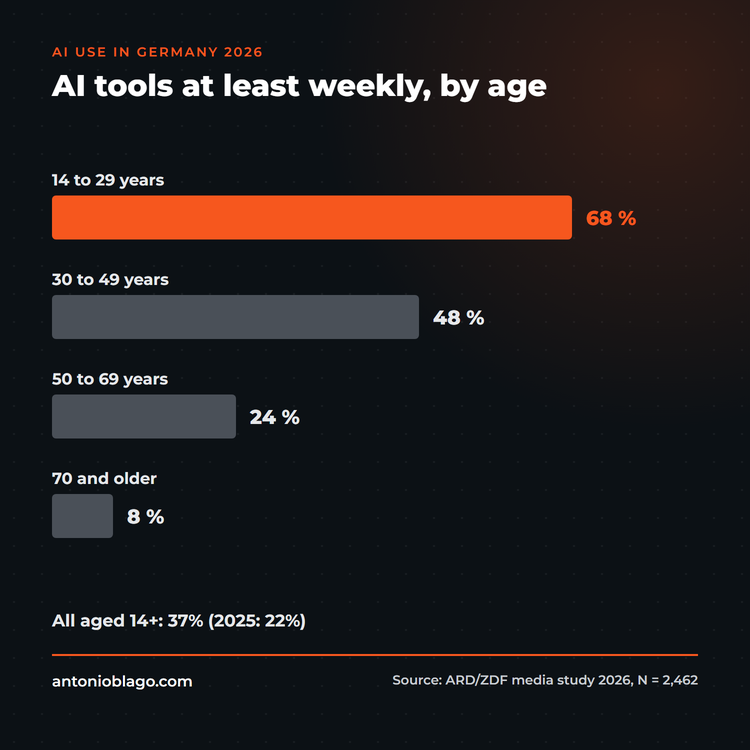
Few forms of media use depend this much on age. Among 14 to 29 year olds, 68 percent use AI tools every week; among people aged 70 and over it is 8 percent[1]. For companies with a young audience, AI is already an everyday channel. If you want to reach people over 50, you will still find most of them in classic search.
Risks and opportunities: how Germans rate AI
69 percent of respondents see artificial intelligence more as an opportunity, 27 percent more as a risk. In the previous survey, the positive view was 5 percentage points higher, so skepticism is growing slightly. Among 16 to 29 year olds, 81 percent see AI as an opportunity; among those aged 65 and over, 58 percent[2]. Acceptance grows with use, and both depend heavily on age.
AI at work
48 percent of employed people use AI at work at least occasionally. 12 percent of them do so without their employer knowing. Only 38 percent say their company provides its own AI for employees[2].
A practical example from my workshops matches this. At an AI workshop for an industrial client in spring 2026, I asked who doesn't use Copilot at all. Several hands went up. In a first call in October 2026, a consultant from a mid-sized company told me that employees there are not allowed to use Claude or Gemini, only Copilot[5]. Which AI someone uses at work is often decided by the IT department.
AI in companies: corporations ahead of SMEs
Adoption is growing fast in companies too. In 2025, 26 percent of German companies with at least 10 employees used AI, up from 12 percent in 2023. That puts Germany above the EU average of 20 percent. Size makes the difference: 23 percent of companies with 10 to 49 employees use AI, compared with 57 percent of companies with 250 or more[25]. 6 percent of companies use machine learning for data analysis, 9 percent use AI to generate text or speech.
Which AI apps do Germans use?
ChatGPT is clearly ahead. Among AI users, 71 percent use ChatGPT and half use Gemini[2]. Across everyone aged 16 and over, that means roughly 41 percent use ChatGPT (my own calculation: 58 percent AI users times 71 percent).
| AI application | Share among AI users |
|---|---|
| ChatGPT (OpenAI) | 71% |
| Gemini (Google) | 50% |
| Microsoft Copilot | 43% |
| Meta AI | 35% |
| DeepSeek | 8% |
| Perplexity | 7% |
| Grok | 6% |
| Claude (Anthropic) | 5% |
| Le Chat (Mistral) | 4% |
Two things stand out. Copilot and Meta AI rank high, probably also because they are built into Windows, Office, WhatsApp and Instagram; many people use them without opening a separate app. European offerings such as Mistral's Le Chat barely register despite the data protection debate.
Worldwide: user numbers of AI apps
| Provider | Users | Date and type of figure |
|---|---|---|
| ChatGPT | 900M weekly | February 2026, official[6] |
| ChatGPT | 1.2B weekly | September 2026, OpenAI at DevDay; unclear whether this covers all products[7] |
| Gemini app | over 1B monthly | October 2026, official[8] |
| Claude | about 245M monthly | May 2026, Sensor Tower estimate[9] |
| Microsoft 365 Copilot | over 20M paid users | April 2026, official[10] |
Paid or free: who pays for AI?
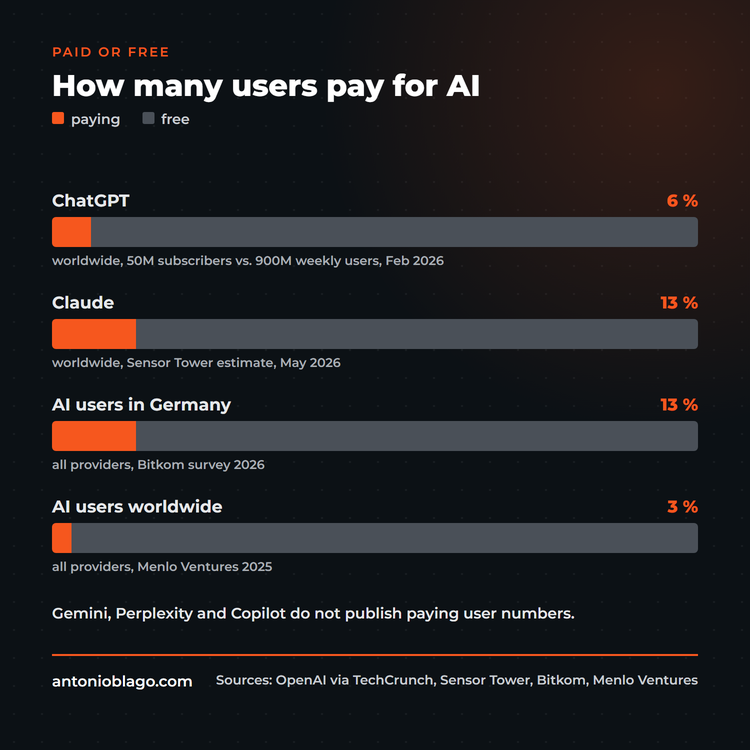
In Germany, 13 percent of AI users pay for generative AI, up from 8 percent a year earlier. Those who pay spend 20 euros a month on average. 29 percent don't pay yet but would be willing to. The share of people who cannot imagine paying for AI at all dropped from 62 to 49 percent[2]. Extrapolated to everyone aged 16 and over, about 7 to 8 percent pay for AI (my own calculation).
Worldwide the picture is similar, depending on the base you use:
- ChatGPT: 50 million paying subscribers against 900 million weekly users in February 2026[6]. That is about 6 percent. OpenAI has not published a newer subscriber number since.
- Claude: According to Sensor Tower, 13 percent of Claude users pay, the highest share among the major assistants[9]. Anthropic itself said in March 2026 that paid subscriptions had more than doubled since the start of the year[11].
- World population: At OMR 2026, analyst Philipp Klöckner estimated that five to seven percent of all AI users pay, which means "probably only one percent of the world population overall"[12]. Menlo Ventures arrived at about 3 percent paying users worldwide in 2025[13].
What free users get
Free plans often run on smaller models with tighter limits. Gemini uses a Flash-Lite model on the free plan; the Pro model starts with Google AI Pro at 21.99 euros a month[14]. Claude offers Sonnet and Haiku for free with limited usage; the largest model, Opus, comes with the Pro plan[15]. Since the end of August 2026, ChatGPT also shows ads in Germany in the free version and in the low-cost Go plan[16].
For visibility in AI search this is an underrated point. If you check your brand only with your own paid account, you often see different answers than most of your customers. In episode 5 of my podcast, my guest, an SEO expert, recommended exactly this test: enter the same prompt in ChatGPT, Perplexity, Gemini and Claude and compare which answers and which sources come back[5]. A practical example from my own analysis: in a GEO analysis for a beauty online shop in October 2026, ChatGPT often cited the rating from a review platform when asked about experiences with the shop, and Gemini referred to a test page of the shop that was never meant to be public[5]. You only find things like this if you measure regularly with the models your customers actually use.
Google remains the biggest AI channel
Many Germans meet AI without a separate app, directly in Google Search. Google has a search engine market share of about 88 percent in Germany, followed by Bing with just over 6 percent[17]. Since 26 March 2025, Google has shown AI Overviews in Germany, AI summaries above the search results[18]. AI Mode has been available in Germany since early October 2025[19].
According to SISTRIX, AI Overviews appear for about 20 percent of all searches in Germany, based on more than 100 million keywords. For these queries, the click-through rate of the first organic result drops from 27 to 11 percent on average[3]. Worldwide, Google reports over 2.5 billion monthly users of AI Overviews and over one billion for AI Mode[20]. A Pew Research Center analysis shows the behavior behind this: with an AI summary, users clicked a result in 8 percent of searches; without one, in 15 percent[21].
In short: the biggest AI reach in Germany costs users nothing and needs no app. If you rank well in Google, you have a good chance of being cited as a source in AI Overviews too. How rankings translate into clicks is shown in my Keyword Study 2026 with click-through rates from 94 domains.
Social media in Germany: where people are
Instagram is the most used social network in Germany in the narrower sense: 40 percent of people aged 14 and over use it at least weekly, 28 percent daily. Facebook keeps falling behind, TikTok stays in third place[1]. Almost all platforms lost slightly compared with 2025; only Instagram, Snapchat, LinkedIn and Mastodon held their numbers.
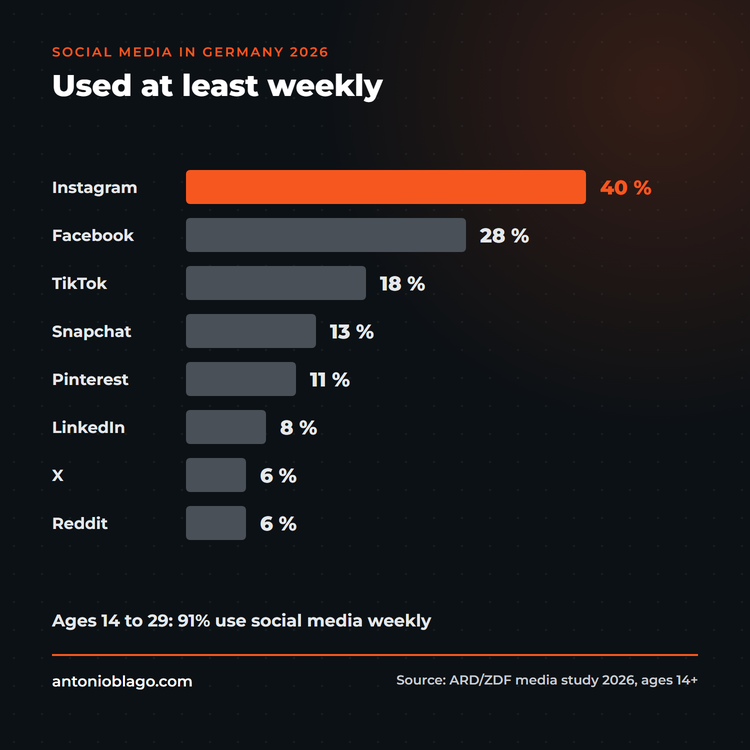
| Platform | Weekly (ages 14+) | Used at all (internet users 16+) |
|---|---|---|
| not surveyed | 85% | |
| YouTube | not surveyed | 85% |
| 40% | 59% | |
| 28% | 74% | |
| TikTok | 18% | 30% |
| 11% | 29% | |
| 8% | 29% | |
| 6% | 10% |
The two columns show how big the gap is between "has an account" and "is there regularly". Three quarters of internet users use Facebook at all, but only 28 percent of the population use it weekly. Among 14 to 29 year olds, 91 percent use social media at least once a week[1]. As an ad platform, YouTube reaches about 65 million people in Germany, Instagram 31 million and LinkedIn 24 million[23]. LinkedIn itself reports more than 31 million members in the DACH region[24].
For B2B this means: LinkedIn reaches only 8 percent of the population each week, but those are exactly the decision makers that matter. Reddit appears in the ARD/ZDF study for the first time in 2026, level with X at 6 percent weekly use[1].
What this means for marketing and businesses
- Google first. 88 percent of searches run through Google, and one in five shows an AI answer[3][17]. Good rankings are the basis for visibility in AI Overviews.
- Measure AI visibility with free models. Only 13 percent of AI users pay[2]. The answer your customers see usually comes from the free version. I describe how this works in my article on GEO and SEO.
- Plan by age group. Two thirds of under-30s use AI every week, hardly anyone over 70 does[1]. For older audiences, Google and classic channels remain more important.
- Choose social media by channel. Instagram for reach, LinkedIn for B2B, YouTube for explainer content. Review platforms deserve extra care because AI answers cite their ratings[5].
Frequently asked questions
How has AI use developed since 2025?
Weekly use of AI tools rose from 22 percent (2025) to 37 percent (2026)[1]. The share of paying users among AI users grew from 8 to 13 percent[2]. In companies, AI adoption doubled between 2023 and 2025, from 12 to 26 percent[25].
How many Germans use ChatGPT?
71 percent of AI users in Germany use ChatGPT. Since 58 percent of people aged 16 and over use AI, that is about 41 percent of the population aged 16+ (Bitkom 2026, my own extrapolation)[2].
How many people use ChatGPT worldwide?
OpenAI officially reported 900 million weekly users in February 2026[6]. At DevDay in late September 2026, OpenAI spoke of 1.2 billion weekly users[7].
How many users pay for ChatGPT?
Worldwide, ChatGPT had about 50 million paying subscribers in February 2026, roughly 6 percent of weekly users[6]. In Germany, 13 percent of AI users pay for some AI product[2].
Which social media platform do Germans use most?
WhatsApp and YouTube are each used by 85 percent of internet users[22]. Among classic social networks, Instagram leads with 40 percent weekly use[1].
Methodology and changelog
For Germany I prefer representative surveys (ARD/ZDF media study, Bitkom, Eurostat) and check the values in the original reports. Provider figures come from official announcements, earnings reports and keynotes. Estimates from market researchers are labelled as such. Extrapolations to the total population are my own analysis and marked as such. I leave out market forecasts to 2030 because they rest on assumptions nobody can check. I don't line up figures from different studies when their definitions don't match (weekly, occasionally, in the last three months).
I deliberately left out AI chatbot market shares by page views: the values for Germany jumped so much between September and October 2026 that I don't consider them reliable. I also could not find a source for the often quoted claim that 99.7 percent of people don't pay for AI.
- 2 November 2026: First publication with the ARD/ZDF media study 2026, Bitkom 2026, Eurostat 2025 (individuals and enterprises), Alphabet Q3 2026 and SISTRIX October 2026.
- February 2027 (planned): Update with quarterly results from Alphabet, Microsoft and Meta and DataReportal Digital 2027.
Conclusion
Artificial intelligence has arrived in everyday life in Germany: more than a third use it every week, two thirds among younger people. Few pay for it, and the biggest AI reach sits with Google, free and without an app. For businesses, that means continuing to take Google rankings seriously and measuring AI visibility the way customers use AI: with the free versions, regularly and across several providers. I keep these AI statistics up to date every quarter.
Sources
- ARD/ZDF research commission: Key results of the ARD/ZDF media study 2026, presented on 22.09.2026 (ages 14+, N = 2,462, fieldwork 27.01. to 19.04.2026). ard-zdf-medienstudie.de, accessed 02.11.2026
- Bitkom Research: Künstliche Intelligenz in Deutschland, study report June 2026 (ages 16+, n = 1,003). bitkom.org, accessed 02.11.2026
- SISTRIX: Google AI Overviews, updated 22.10.2026. sistrix.de, accessed 02.11.2026
- Eurostat: 32.7% of EU people used generative AI tools in 2025, 16.12.2025, dataset isoc_ai_iaiu. ec.europa.eu, accessed 02.11.2026
- Own conversations with clients and prospects, workshops and my own podcast, April to October 2026, transcripts stored locally, anonymized
- TechCrunch: ChatGPT reaches 900M weekly active users, 27.02.2026. techcrunch.com, accessed 02.11.2026
- OpenAI: DevDay 2026 Recap, 29.09.2026. openai.com, accessed 02.11.2026
- Google: Q3 2026 earnings call, Remarks from our CEO, 29.10.2026. blog.google, accessed 02.11.2026
- TechCrunch: ChatGPT's market share slips below 50% for first time (Sensor Tower data, State of AI 2026), 16.06.2026. techcrunch.com, accessed 02.11.2026
- TechCrunch: Microsoft says it has over 20M paid Copilot users, 29.04.2026. techcrunch.com, accessed 02.11.2026
- TechCrunch: Anthropic's Claude popularity with paying consumers is skyrocketing, 28.03.2026. techcrunch.com, accessed 02.11.2026
- OMR Podcast: Beyond the AI Hype 2026 with Pip Klöckner, May 2026. askomr.podigee.io, accessed 02.11.2026
- Menlo Ventures: 2026: The State of Consumer AI, September 2026, and 2025: The State of Consumer AI. menlovc.com, accessed 02.11.2026
- Google: Gemini subscriptions and pricing. gemini.google, accessed 02.11.2026
- Anthropic: Claude pricing. claude.com, accessed 02.11.2026
- HORIZONT: OpenAI: ChatGPT zeigt Werbung jetzt auch in Deutschland, 17.08.2026. horizont.net, accessed 02.11.2026
- Statcounter: Search Engine Market Share Germany, October 2026. gs.statcounter.com, accessed 02.11.2026
- Search Engine Roundtable: Google AI Overviews expand to more EU regions, March 2025. seroundtable.com, accessed 02.11.2026
- Search Engine Roundtable: Google AI Mode expands to more languages and countries, October 2025. seroundtable.com, accessed 02.11.2026
- Google: Sundar Pichai's opening keynote, Google I/O 2026, 19.05.2026. blog.google, accessed 02.11.2026
- Pew Research Center: Google users are less likely to click on links when an AI summary appears in the results, 22.07.2025. pewresearch.org, accessed 02.11.2026
- Bitkom Research: Social Media, Desinformation und Deepfakes, study report June 2026 (internet users aged 16+, n = 939). bitkom.org, accessed 02.11.2026
- DataReportal (Kepios): Digital 2026: Germany, 05.11.2025. datareportal.com, accessed 02.11.2026
- LinkedIn Germany: press releases, June 2026. mynewsdesk.com, accessed 02.11.2026
- Eurostat: Artificial intelligence by size class of enterprise, dataset isoc_eb_ai, 2025 (enterprises with 10+ employees, excluding the financial sector). ec.europa.eu, accessed 02.11.2026
Free initial consultation
30 minutes, your website, concrete next steps. No sales pressure.

About the Author: Antonio Blago
SEO Freelancer & AI Visibility Expert
I optimize SEO data-driven with Python, behavioral psychology, and my Neuro-SEO System®. On YouTube, LinkedIn, and Instagram I share hands-on tutorials, insights, and SEO strategies.