Agentic SEO Systems 2026: How I Use Claude Code as an SEO Control Center

AI summary
- I use Claude Code as an autonomous AI agent orchestrating multiple specialized agents for end-to-end SEO workflow automation since early 2026.
- My agentic SEO system completed keyword mapping for 5,000+ keywords in under 30 minutes and generated meta data for 650+ Shopify pages in one session.
- Claude Code connects to external data sources via Model Context Protocol servers including Visibly AI, Notion, Playwright, PDF-MCP, and Google Drive without manual export.
- By 2028, Gartner predicts over 90% of B2B purchasing decisions will be mediated by AI agents, making entity optimization and B2AI strategies essential for SEO professionals.
Generated with AI, the details are in the article.
Table of contents
What is Agentic SEO?
Agentic SEO describes the use of autonomous AI agents that don't merely support SEO tasks, but independently plan, execute, and optimize them. Instead of manually operating individual tools, an Agentic SEO system orchestrates multiple specialized agents that work together – from keyword research and technical audits to content creation.
The key difference from traditional SEO tools: an Agentic SEO system doesn't wait for instructions. It analyzes, recognizes patterns, and derives actions – autonomously and data-driven.
Core message: Agentic SEO is not a tool – it's a system of interconnected AI agents that automates SEO workflows end-to-end. The role of the SEO expert shifts from executor to strategist and quality controller.
Why Traditional SEO Tools Are Reaching Their Limits
Classic SEO workflows consist of a chain of isolated steps: open a keyword tool, export data, transfer it into spreadsheets, write texts, run technical checks, create reports. Every step requires manual intervention, tool switching, and loss of context.
The reality in 2026:
- Google is releasing algorithm updates in ever shorter cycles
- AI Overviews, SGE, and Agentic Search are fundamentally changing the SERPs
- Content requirements are rising – E-E-A-T, semantic depth, structured data
- Competitors are already using AI-powered workflows
A solo SEO freelancer or a small team can no longer keep up with manual processes. This is where SEO automation with AI comes in – not as a replacement for expertise, but as a multiplier.
My Agentic SEO System: Claude Code as the Control Center
Since early 2026, I've been using Claude Code as the central platform for my SEO work. Claude Code is an autonomous AI agent from Anthropic that runs directly in the terminal and is connected to external data sources via the Model Context Protocol (MCP).
My setup consists of three layers:
1. Claude Code as Orchestrator
Claude Code is not simply a chatbot – it's an agent that reads and writes files, executes scripts, calls APIs, and independently works through multi-step workflows. I provide a task, and Claude Code plans the steps, executes them, and delivers the result.
2. MCP Servers as Data Bridge
The Model Context Protocol (MCP) connects Claude Code to external services – without manual export/import. The following MCP servers are active in my system:
| MCP Server | Purpose | Example Action |
|---|---|---|
| Visibly AI | Workflows, skills, roles, SEO analysis & GSC data | Retrieve keywords, check rankings, on-page audit, competitive analysis |
| Notion | Project management | Create to-dos, save meeting notes |
| Playwright | Browser automation | Crawl live pages, take screenshots |
| PDF-MCP | PDF generation | Create CI-compliant audits and proposals |
| Google Drive | File management | Upload reports, manage client folders |
The special thing: Claude Code knows all connected MCP servers and automatically selects the right tool for each task. I say "Analyze the keywords for domain.de“ and Claude Code calls Visibly AI, whose MCP has access to the Google Search Console and verified SEO workflows.
3. Persistent Knowledge Through CLAUDE.md and Memory
What sets Claude Code apart from a simple AI chat: it learns on a project-by-project basis. Through the CLAUDE.md file and a memory system, I store client contexts, proven workflows, and feedback.
When I return to a client project the next day, Claude Code already knows:
- The client history and open to-dos
- My preferred working methods and standards
- Corporate identity requirements for documents
- Which mistakes should be avoided based on past experience
Via skill-mind.com, I can save individual preferences as a memory layer.
Practical Examples: Agentic SEO in Everyday Use
Theory is good – practice is better. Here are four real workflows I implement daily with my Agentic SEO System:
Example 1: Keyword Mapping for 5,000+ Keywords
For a client with over 5,000 target keywords, I create a complete content mapping. The traditional approach: days of work in Excel. With Agentic SEO:
- Claude Code reads in the keyword file
- Retrieves the current GSC data via Visibly AI
- Clusters keywords by thematic proximity using TF-IDF
- Assigns a page type to each cluster (category, guide, product)
- Generates a prioritized CSV with URL recommendations
Result: What used to take 2–3 days is completed in under 30 minutes – with greater consistency and complete data coverage.
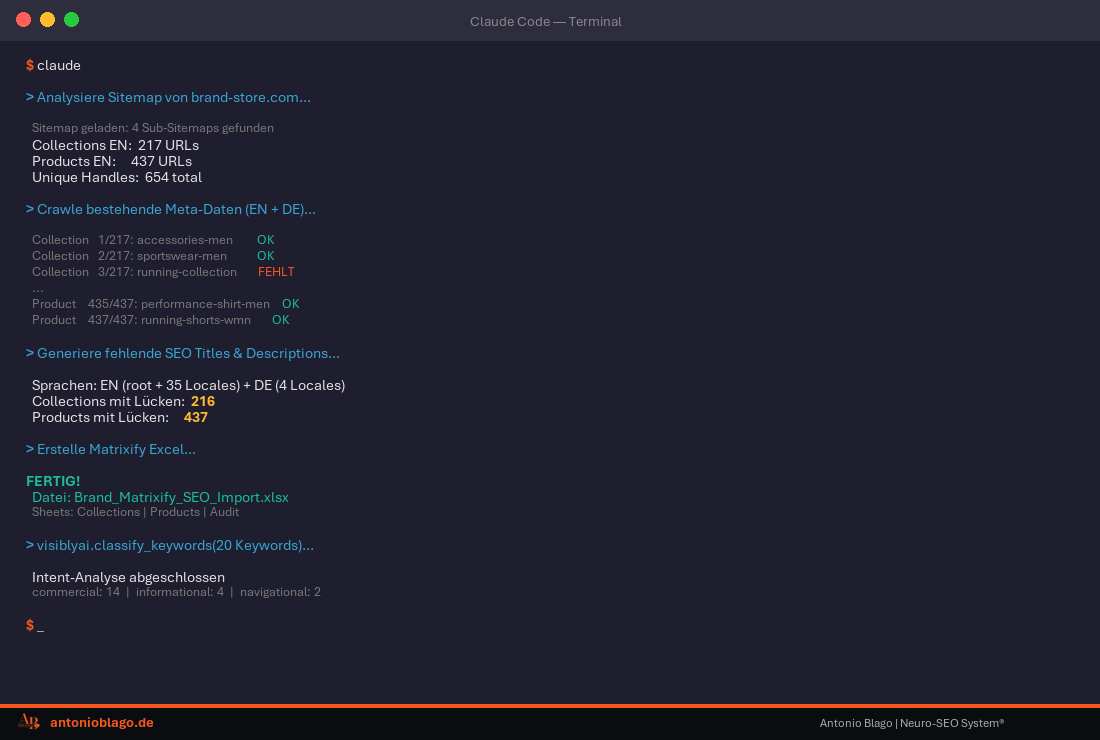
Example 2: Bulk Meta Data for an International Shopify Store (650+ Pages)
Just recently completed: for an international Shopify store belonging to a sportswear brand with over 650 pages (products + collections) across 39 language locales, meta titles and descriptions needed to be reviewed and supplemented.
The workflow in Claude Code:
- Crawl the sitemap and extract all URLs
- Check each page for existing meta tags (EN + DE)
- Automatically generate missing SEO data – based on product line, category, and target audience
- Create a Matrixify-compatible Excel file – with separate rows for all 39 locales
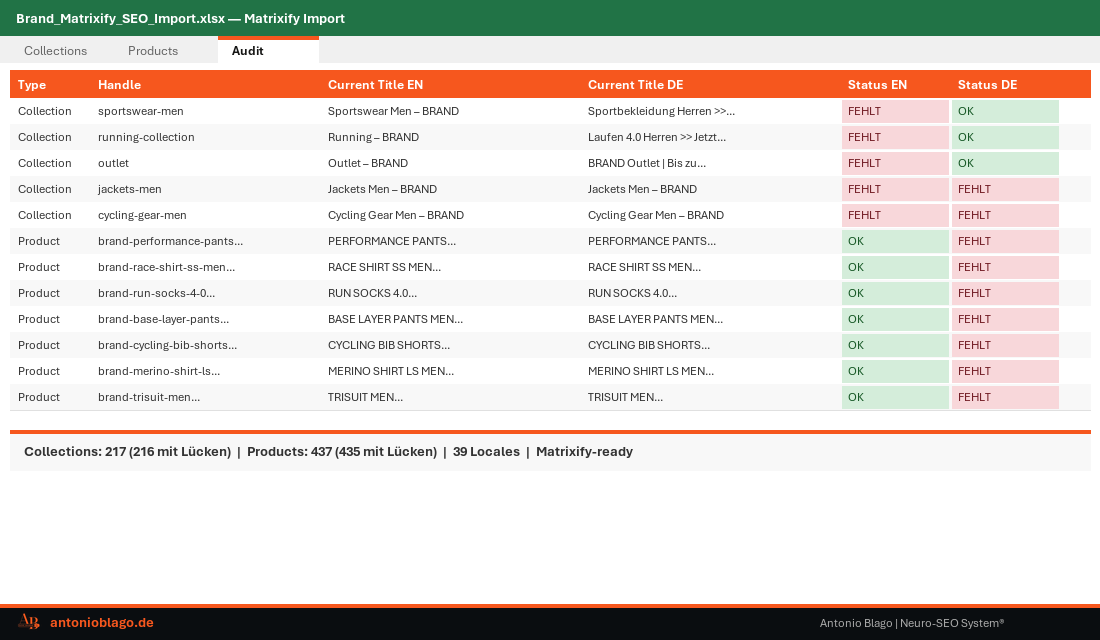
Result: Instead of weeks of manual work, the complete SEO audit with import file was finished in a single Claude Code session.
Example 3: Potential Analysis with ROI Calculation
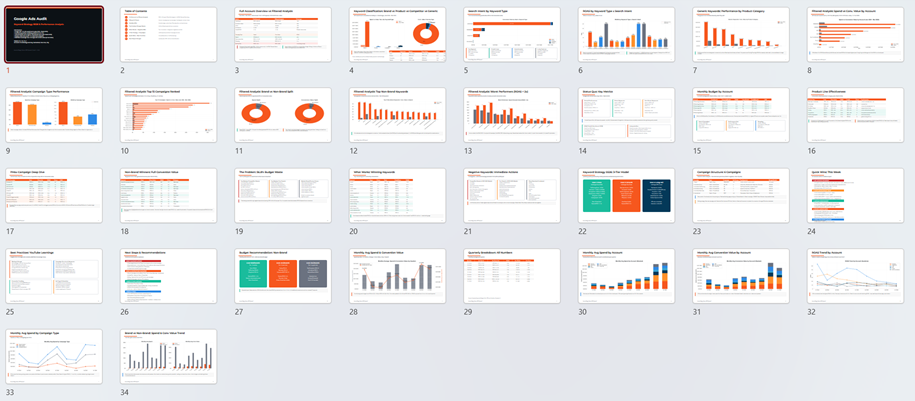
For initial meetings with enterprise clients, I create data-driven SEO potential analyses. The Agentic SEO system:
- Retrieves the top 5,000 keywords from Google Search Console
- Compares current positions with realistic target positions
- Calculates traffic deltas based on a position-dependent CTR model from the Keyword Study 2026
- Calculates the SEA equivalent value (What would this traffic cost as Google Ads?)
- Generates a CI-compliant PDF with executive summary, cluster tables, and ROI scenarios
Result: Within 20 minutes, a management-ready document is available that quantifies the value of SEO in EUR.
Example 4: Meeting Summary → Notion → Follow-up
After every client call:
- Claude Code creates a structured summary
- Enters open to-dos directly into the client's Notion database
- Drafts a follow-up email in first person (plain text, no Markdown)
- Updates the project status
The entire post-meeting workflow runs in under 5 minutes – automated, consistent, and without copy-pasting between tools.
Agentic SEO vs. Traditional SEO Tools: The Comparison
| Criterion | Traditional Tools | Agentic SEO System |
|---|---|---|
| Mode of operation | Reactive, manually controlled | Proactive, autonomous |
| Data sources | Isolated silos (one tool per task) | Connected via MCP (all sources in one system) |
| Context | Lost with every tool switch | Retained (memory, CLAUDE.md) |
| Output | Raw data for further processing | Finished deliverables (PDF, Excel, HTML) |
| Scalability | Linear (more work = more time) | Exponential (same effort, more output) |
| Expertise | Tool operator | Strategic controller |
How to Build Your Own Agentic SEO System
You don't need a huge budget or a development team. The basic setup:
Step 1: Set Up Claude Code
Claude Code is available as a CLI, desktop app, and IDE extension. For SEO work, I recommend connecting to visibly AI – here you can effectively reach your goal via an MCP with verified SEO workflows.
https://www.antonioblago.com/de/entwickler/mcp
Step 2: Create CLAUDE.md as a Knowledge Base
In the CLAUDE.md file, you define your standards, workflows, and client contexts. Claude Code reads this file on every start and acts accordingly. Example contents:
- Your SEO analysis workflow (steps, data sources, output format)
- Corporate identity requirements (colors, fonts, document structure)
- Client-specific rules ("For client X, always use GSC data from the DE property“)
Step 3: Connect MCP Servers
MCP servers are the bridge between Claude Code and your data sources. Particularly relevant for SEO work:
- SEO data: Visibly AI, DataForSEO, or Google Search Console
- Project management: Notion, Linear, or GitHub
- Content: WordPress, Shopify, or any CMS
- Browser: Playwright for live crawling and screenshots
Step 4: Iterate Workflows
Claude Code's memory system learns from your feedback. If you say "Next time, sort the CSV by topic instead of search volume„, the system remembers this preference for all future runs.
Agentic SEO 2026: The Most Important Trends
Based on current developments and my daily work, I see three central trends:
1. From Keywords to Entities
AI agents in Google Search don't understand keywords – they understand entities and relationships. Schema.org markup, clear data structures, and semantic consistency will be more important in 2026 than ever before.[1]
2. Business-to-AI (B2AI)
Gartner predicts that by 2028, over 90% of B2B purchasing decisions will be mediated by AI agents.[2] This means: your website needs to be optimized not only for humans, but also for the machines that search and make decisions on behalf of humans.
3. Continuous Optimization Instead of Periodic Audits
Agentic SEO systems work continuously. Instead of quarterly audits, AI agents monitor rankings, detect anomalies, and derive actions – in real time.[3]
My conclusion: Agentic SEO is not a vision of the future – it's already a reality today. Any SEO professional who wants to remain competitive can no longer afford to ignore AI agents. The key is not to hand over control, but to build the right systems and steer them strategically.
Want to know what an Agentic SEO system could look like for your business? Book a free initial consultation – or start your own analysis directly at http://visibly-ai.com in the dashboard above.
Sources
- Search Engine Land – Agentic AI and SEO: How autonomous systems redefine search. searchengineland.com
- Semrush – 26 AI SEO Statistics for 2026 + Insights They Reveal. semrush.com
- Siteimprove – Agentic SEO: From Keywords to Continuous Discoverability. siteimprove.com
- Friendventure – Agentic SEO explained: The future of search engine optimization. friendventure.de
- Search Engine Land – How to turn Claude Code into your SEO command center. searchengineland.com
Free SEO tools
Keyword ranking, SSR text check, sitemap audit and more, right in the browser and without signup.

About the Author: Antonio Blago
SEO Freelancer & AI Visibility Expert
I optimize SEO data-driven with Python, behavioral psychology, and my Neuro-SEO System®. On YouTube, LinkedIn, and Instagram I share hands-on tutorials, insights, and SEO strategies.