Link Building in the AI Age: What Really Works and Why External Signals Are Becoming More Important

AI summary
- AI-generated content floods the internet, making external signals like backlinks increasingly valuable for search algorithms to identify genuine expertise.
- High-quality backlinks require four criteria: real organic traffic, solid domain authority, clean history without artificial spikes, and healthy inbound-to-outbound link ratios.
- Link building only works when a website has solid fundamentals including good content and technical structure; weak sites cannot benefit from backlinks.
- Advertorials labeled as advertising are currently effective for AI search systems like ChatGPT and Perplexity because they provide product context better than traditional guest articles.
Generated with AI, the details are in the article.
Table of contents
Link Building in the Age of AI: What Really Works and Why External Signals Are Becoming More Important
I've been following Julian Kirfel on LinkedIn for a while. His posts on link building are unusually direct and free of the typical agency buzzword nonsense. At some point it was clear: I had to invite him on the podcast. In our conversation, we didn't waste a single minute. We got straight into the deep end, from the question of why AI is reshaping the entire SEO game, to concrete examples from ongoing client projects. I took quite a bit away from it.
Zum Video:
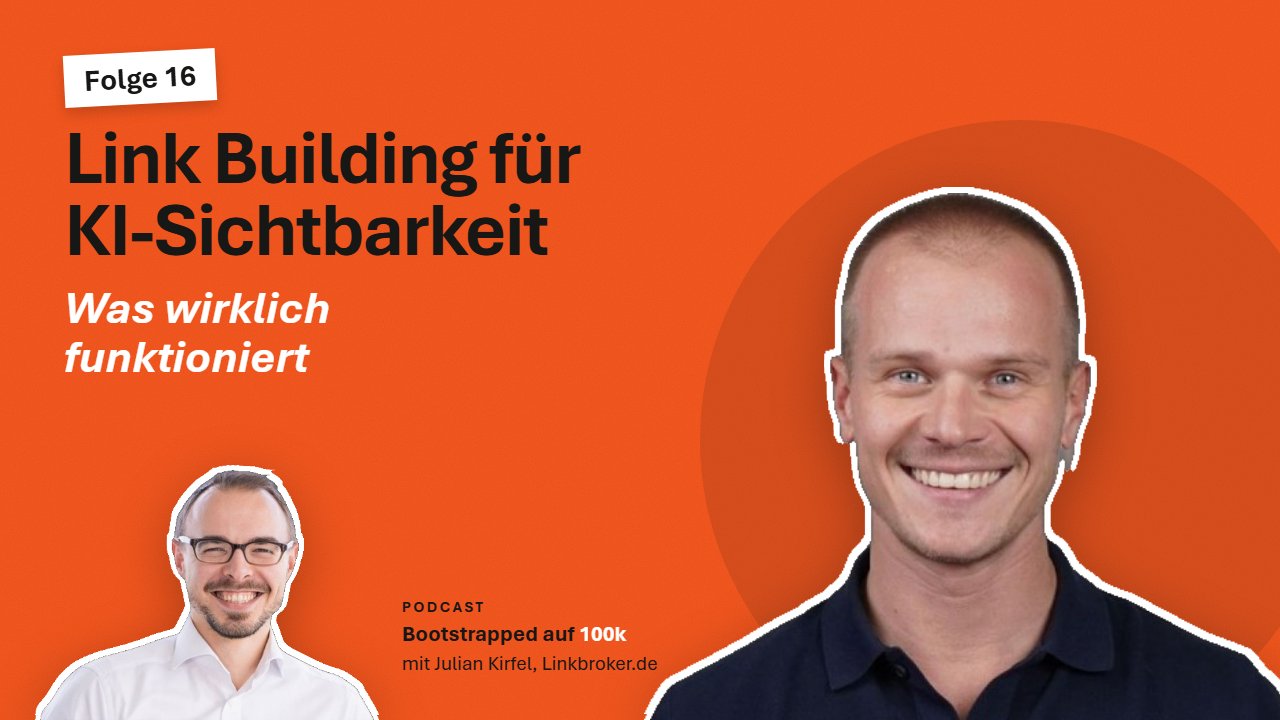
How Julian Got Into Link Building in the First Place
Julian's path is anything but straightforward. After finishing school, like many others he got into niche sites, back then working with pond pumps and classic affiliate marketing. Then came an economics degree, which he dropped in favor of a job as managing director at a family business. Nearly eight years of that. There, he didn't pursue SEO out of passion, but out of necessity: there was no budget for ads. So he rolled up his sleeves and did it himself.
That resonated with me immediately. Anyone who learns SEO under real pressure learns it properly. Julian optimized for keywords like „Transportkisten aus Holz“ or „Exportkisten“ and realized along the way just how much organic visibility can actually deliver.
He then took the leap into self-employment at the end of 2022, together with two partners. And the timing was no coincidence.
Why AI is bringing external signals back into focus
That was my entry point into the actual topic. When ChatGPT appeared at the end of 2022, Julian and his co-founders very quickly drew a conclusion that I hadn't seen formulated so clearly before.
As Julian put it:
„If the entire internet gets flooded with pseudo-expert content, how is the search algorithm supposed to understand who is truly relevant and who isn't?“
That's exactly the point. Technical SEO can increasingly be automated. Content too. But building reputation from the outside, getting real external signals – that can't simply be faked. And that's exactly where Julian and his team saw an opportunity.
I find this assessment pretty spot-on. Anyone who relies solely on on-page today is swimming in the same pool as everyone else producing AI content. What still counts then are the voices from outside.
Brand Radar: where does your brand stand?
Brand and generic traffic, competitors and potential at a glance, free of charge.
How the Link Broker Platform Works
Julian explained to me how their model is structured. I was already somewhat familiar with the platform, but the details were interesting.
The basic principle: You sign up for free, get access to a large directory of publisher domains, and can purchase links there in a targeted way. Each publisher sets their own price. You can see metrics like Domain Rating, traffic, link profile, and topical category, and decide for yourself whether a link makes sense for you.
What I like: There's a hybrid option. Anyone who doesn't want to figure it all out on their own can get free consultation. Julian did this himself for a long time, conducting a mini audit with clients before any link was purchased. The whole thing is refinanced through the purchasing agreements with publishers. So the model only works if it actually delivers results for the client.
What surprised me: A large number of SEO agencies use the platform as a white-label solution – including for clients who aren't actually managed by a pure SEO agency.
What really makes a good backlink
This is where things got particularly concrete for me. Julian mentioned four criteria that I immediately jotted down:
- Real organic traffic: The publisher must be visible, measurable through traffic.
- Solid domain authority: A good domain rating is a useful indicator, but not the only criterion.
- Clean history: No artificial spikes, no sudden traffic surges from black-hat methods.
- Healthy ratio between inbound and outbound links: Julian calls this the „R&L Ratio“ internally. Anyone who links to everything but hardly gets linked to themselves passes little value on.
That fourth point clicked with me straight away. I've seen it myself – how sites with a high domain rating still barely deliver any results, precisely because they're link farms.
And then came the example I hadn't had on my radar at all: disclaimer.de. A legal topics site that years ago published a WordPress plugin for disclaimers. This plugin was embedded by millions of websites, each of which automatically added a backlink. Domain rating today: 91. Julian recommends this link as an entry point for new domains, because it passes enormous authority without you having to spend thousands of euros on it.
When Links Don't Make Sense Yet
That was one of the most honest statements in the conversation. Julian put it plainly:
„If we analyze you and realize you first need a solid website and good content, we'll tell you that. Otherwise you're spending money on something that won't get you anywhere.“
I rarely hear that from someone who sells links. And I think it matters. In my own projects and with clients, I've often seen link building sold as a solution even when the fundamentals are missing. A thin website with barely any content won't suddenly become relevant through backlinks.
Julian's recommendation was also interesting: anyone who doesn't yet know whether their offer works should run Google Ads first. That gives you predictable leads and lets you test whether the offer has traction. Only then does link building make sense – as a way to gradually convert "rented" visibility into something you actually own.
Digital PR and Advertorials: The Underestimated Tool
We then got onto a topic that I personally find very relevant right now. In AI-powered search systems like ChatGPT, Perplexity or Gemini, traditional keyword SEO no longer works as directly. These systems need context, not just an anchor text in a guest article.
Julian explained it this way: A traditional guest article passes on authority, but hardly any context. It needs to be editorially prepared and must not sound promotional. Advertorials, on the other hand, are labeled as advertising, and that is precisely what allows you to pack in significantly more information about your own product or company.
As Julian put it:
„I can indirectly influence the narrative about my product. How long this will continue to work, nobody knows, but right now we're in a phase where it works very well.“
That was a small mindshift for me. I had long written off advertorials as dead. In the context of AI search, they suddenly make sense again.
The Competitive Example: 21run vs. Nike and Adidas
Julian shared a case study from his managed service that clearly shows what is and isn't possible with a limited budget.
A Dutch running shoe retailer wanted to rank better for keywords like „Laufschuhe Herren“. Budget: 2000 Euro. Competition: Nike, Adidas, Puma.
The results were good, but not consistently in the top 3 positions. And that's an honest assessment. Julian said it straight:
„The competitors don't sleep. When you're fighting against brands like these for commercial keywords, it's a never-ending race.“
What I appreciate about this: no false promises. But the project still paid off, because even brief periods in the top 3 positions for search volumes like these brought in multiples of the budget.
Outreach and the Gray Area of Transparency
We also talked about organic outreach, meaning the direct approach of website owners for links. Julian does this, but deliberately only in certain situations and only for suitable clients. No mass outreach, but targeted, when the platform's portfolio reaches its limits.
What occupied my thoughts at this point: the industry has a massive trust problem. Not just because of the Indian spam emails that everyone knows, but because there are no verifiable standards. Anyone can claim to be an expert. Julian's answer to this was clear:
„Ask to be shown case studies. Ask for an explanation of how things are approached. And if someone simply sells you a keyword list from Ahrefs for 1500 Euro, that's not a service.“
I can confirm this from my own experience. I've been through it myself, back when I was in a different role, where someone sold me a keyword analysis that had been exported from a paid tool, sorted by difficulty, and that was it.
My Personal Key Takeaways
When I break down the conversation to its most important points, these are they:
- External signals are becoming more valuable, because content is increasingly easy to produce. What's hard to fake is reputation from the outside.
- A good link needs four things: real traffic, clean authority, an honest history, and a healthy link balance at the publisher.
- Without a website and content, links are worthless. That's not an excuse – it's an honest diagnosis.
- Advertorials and digital PR are currently in a phase where they can provide particularly valuable context for AI search.
- Link building is not a one-time investment, but an ongoing task – especially in highly competitive markets.
- The three fundamentals of SEO were well summarized by Julian at the end: technical crawlability, on-page quality, external signals. In that order.
Conclusion
The conversation with Julian confirmed my own assessment: link building is not a dirty topic, it just often gets implemented in a dirty way. Anyone who works transparently, applies genuine quality standards, and doesn't simply sell links but truly thinks projects through can create real added value with it.
What I particularly appreciated: Julian didn't paint a rosy picture. He said when links bring no benefit, when the budget is better spent elsewhere, and why the race against big brands never really stops.
If you're serious about SEO, check out the full episode. And if you want to get started with link building, sign up with Link Broker or reach out to Julian directly on LinkedIn.
The podcast episode on YouTube:
F16: Link Building für SEO und AI Sichtbarkeit
Website Link Broker:
https://linkbroker.de
FAQ
Why are backlinks becoming even more important because of AI content?
Because more and more websites are publishing AI-generated content, it's becoming harder for search engines to distinguish genuine expertise from sheer volume. Julian and I talked about exactly this: what's hardest to fake are external signals. That means links from other sites that show someone from the outside is confirming relevance.
How do I recognize a high-quality backlink?
Julian mentions four factors: real organic traffic at the publisher's site, solid domain authority, a clean development history without artificial jumps, and a healthy ratio between inbound and outbound links. Anyone who links to everything while barely receiving links themselves passes very little value on.
When does link building not make sense yet?
When your own website doesn't have a solid foundation. That means when important pages are missing, the content is thin, or the technical structure has issues. Backlinks to a weak site fizzle out. Julian also recommends first testing with Google Ads whether your offering actually works before investing in organic visibility.
What are advertorials and why are they particularly interesting right now?
Advertorials are paid posts on external sites that are labeled as advertising. Unlike traditional guest articles, they're allowed to be promotional and can provide much more context about your own product. This makes them especially valuable for AI search systems, which need context to categorize a brand or an offering.
How much should you budget for link building each month?
It really depends. Julian and I talked about the fact that there's no flat rate. What matters is the goal, the competitive landscape, and how quickly you want to progress. What he made clear is: as little as necessary, but as much as is truly needed. For new domains, he recommends starting early with one or two strong links to speed up indexing and crawling.
Free initial consultation
30 minutes, your website, concrete next steps. No sales pressure.

About the Author: Antonio Blago
SEO Freelancer & AI Visibility Expert
I optimize SEO data-driven with Python, behavioral psychology, and my Neuro-SEO System®. On YouTube, LinkedIn, and Instagram I share hands-on tutorials, insights, and SEO strategies.