
Brand Positioning in E-Commerce: Branding Strategy

AI summary
- A missing brand positioning in e-commerce is the real cause when revenue drops despite good ads, appealing design, and solid products.
- A brand's true power lies where visuals meet meaning: buying a product means buying a piece of identity and sending a signal about values.
- Brands that reach 100 million euros revenue differ from 10 million euro brands through consistent brand building and internal team alignment, not higher budgets.
- Gustavo Gusto broke the saturated frozen pizza market by telling a disruptive story with a larger box and top-view design that competitors could not catch by copying.
Generated with AI, the details are in the article.
Table of contents
Good ads, an appealing web design, a solid product – and yet revenue suddenly drops. This pattern repeats itself in a frightening number of e-commerce companies. The reason is rarely poor campaigns. A missing brand positioning in e-commerce is almost always the real cause – one level deeper, harder to see, but decisive. Anyone who neglects branding in e-commerce is building their growth on sand.
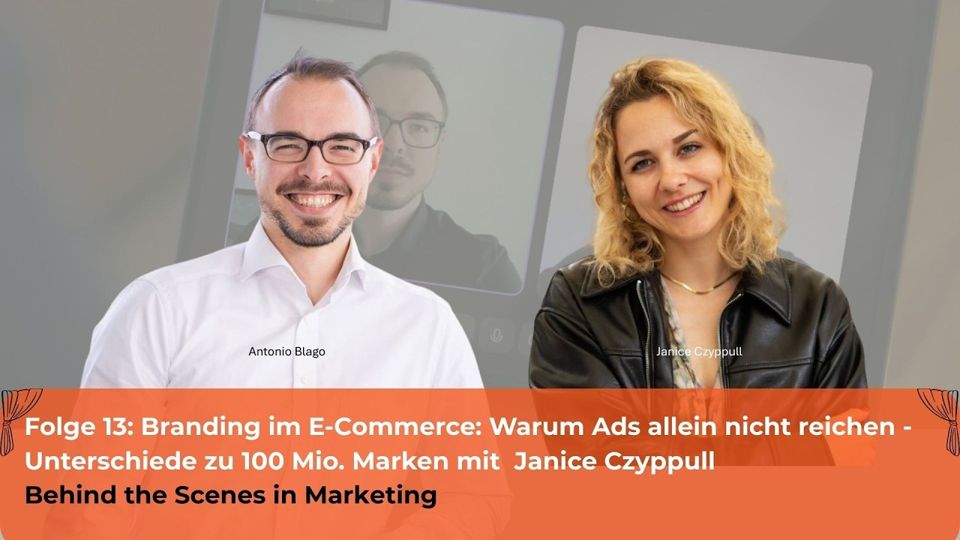
In the podcast episode Behind the Scenes in Marketing, host Antonio Blago speaks with Janice, a branding strategist, former team lead at a Berlin branding agency, and founder, about exactly this gap. The conversation is essential listening for anyone who takes e-commerce, D2C, packaging design, and sustainable brand growth seriously.
Watch the video:
What a brand really is – beyond logos and colors
Many companies confuse branding with aesthetics. A beautiful logo, a consistent color palette, professional product photos – all of this is necessary, but far from sufficient. Real brand building begins where visuals meet meaning.
Janice puts it succinctly:
"A brand is like an identity. When you buy a product, you buy a piece of identity."
This sounds abstract, but it's very concrete: someone who buys toilet paper without a cardboard roll that has twice as many sheets is sending a signal – about efficiency, sustainability, and awareness. This happens entirely unconsciously, in fractions of a second. This is precisely where the true power of a strong brand identity lies.
Especially on platforms like TikTok, this principle becomes visible: products are marketed not as objects, but as an expression of an attitude. Brands that understand this win communities. Brands that ignore it merely buy themselves temporary clicks.
The three pillars of a strong brand identity
According to Janice, a brand that truly endures needs three things:
- Clear positioning – What does the brand stand for? What does it say about its buyers?
- Consistency across all touchpoints – From the ad to the website to the packaging, the same story must be told.
- Desirability – A brand must be so attractive that people actively seek it out, rather than just stumbling upon it by chance.
A strong brand identity is not a nice-to-have, but the foundation of every sustainable growth strategy.
The biggest problem in e-commerce: performance without a foundation
Between 2018 and 2021, hundreds of new e-commerce brands emerged – many of them driven by cheap Facebook ads, dropshipping models, and a temporary surge in demand. The growth was real. The foundation often was not.
Janice describes the core problem directly:
"It's no longer enough these days to simply be good at e-commerce. It's extremely important that you truly build a brand around it."
The tricky part: performance marketing works – until it doesn't. Ad costs rise, audiences become saturated, competitors copy successful creatives. Anyone who then has no brand identity driving repeat purchases and organic referrals hits a growth ceiling that is nearly impossible to break through.
Why branding remains so difficult to measure
One key reason why many companies neglect branding: it cannot be as easily quantified as a ROAS value or a conversion rate.
"The big problem is that branding is very difficult to represent in measurable numbers. That's why many people find it hard to accept that it's truly an essential part of success."
This does not mean that branding in e-commerce doesn't work – it means that its impact shows itself with a time delay and through softer signals: brand awareness, referral rate, willingness to pay, customer loyalty. Anyone who only optimizes for short-term measurable KPIs is building their business on sand.
How visible is your brand in ChatGPT and friends?
The AI Check shows you within minutes whether and how AI assistants mention your brand.
Discount wars: short-term boost, long-term damage
Monthly Black Friday promotions, permanently running discount codes, "Sale" banners as the default – these are everyday tools in many e-commerce companies. Janice is nuanced but clear on this:
"Long-term, I'm convinced that it damages a brand, because you end up being perceived as a cheap discount brand."
As a counter-example, she mentions a well-known phone case manufacturer that a few years ago relied heavily on discount promotions – and today is positioned as a premium brand, with professional visuals and a significantly higher price point. The same product, a completely different perception. The difference: consistent branding over time.
The rule of thumb is: Discount promotions can make sense on specific occasions – product launches, seasonal events, new customer acquisition. As a permanent strategy, however, they destroy the perceived value of a brand and undermine any brand positioning you have worked hard to build.
Brand building: what separates 10M brands from 100M brands
The magic revenue threshold of 100 million euros is a goal for many e-commerce founders. But what separates the brands that get there from those that stagnate at 10 million? The answer lies in consistent brand building – not in the next channel or higher budgets.
Janice sees the difference less in budgets or number of channels than in internal consistency:
"There are often very many challenges that first need to be fixed internally within team structures. When a retail team is working toward a different vision than a social media team and there is no shared positioning, the brand simply falls apart."
This is an often overlooked point: beyond a certain company size, the greatest branding challenge is not an external one, but an internal one. Silos emerge, departments play out different claims, customers experience inconsistent brand worlds.
How to solve this
A shared positioning workshop for all relevant teams is often the first step. The goal: a common language, a common objective, a common story. Only then can individual channels and measures truly build on one another – and allow the brand positioning in e-commerce to unfold its full impact.
Branding strategy in practice: what Gustavo Gusto taught the frozen pizza market
No discourse on disruptive branding would be complete without a concrete example – and Janice chooses one that perfectly illustrates how a new story can break open a saturated market.
The frozen pizza market was a firmly divided game for decades. Dr. Oetker dominated with an almost endless variety of options. The category felt, to use Janice's word, "dusty." A bold branding strategy changed everything.
Then came Gustavo Gusto.
"They made the pizza slightly larger, at which point retailers said: 'Are you crazy? How is that supposed to fit on our shelves?' And then they put a completely different design on it."
Instead of the classic side view with melting cheese: the complete pizza in its original size, shown head-on, on a larger box. A completely different narrative – handmade, better, more honest. And the market responded.
Dr. Oetker's reaction? Copy them. "La Mia Grande" came to market, also larger, also with a top-view design. Perhaps successful in the short term – but not a strategy in the long term, because a copied story is not your own story.
"They simply need to make sure they revisit their positioning, rebrand, and tell a new disruptive story – not by copying it, but by telling their own, better story."
The lesson: In saturated markets, it's not the better product that wins, but the more compelling story. Whoever claims that story first has an advantage that cannot be caught up with through imitation.
Identity as a buying motive: what Pick'em tells us about brand psychology
Toothpicks. No product sounds less exciting. And yet the brand Pick'em managed to have people waiting in line outside a store for hours.
Janice explains the phenomenon:
"It's simply not just a toothpick – it's the values that stand behind it. That disruptive quality. We do things differently. We question existing structures."
Someone who buys Pick'em isn't buying a hygiene product. They're buying a statement. They're committing to an attitude, a community, a way of life. This is the result of a precisely developed brand identity – and it works just as well in the digital space as it does in brick-and-mortar retail.
The TikTok appearances, the activations in museums, the deliberately provocative communication – none of this is accidental hype, but consistent brand craftsmanship.
What brands can learn from this
- Products are carriers of meaning – Anyone who only communicates the product loses.
- Communities form around attitudes, not features – People identify with values, not with weight specifications.
- One clear channel, played consistently, is worth more than many half-hearted presences.
Visibly AI: your SEO copilot
Projects, rankings, Search Console data and a copilot that runs the analysis for you. Start for free.
Visibly AI: your SEO copilot
Projects, rankings, Search Console data and a copilot that runs the analysis for you. Start for free.

About the Author: Antonio Blago
SEO Freelancer & AI Visibility Expert
I optimize SEO data-driven with Python, behavioral psychology, and my Neuro-SEO System®. On YouTube, LinkedIn, and Instagram I share hands-on tutorials, insights, and SEO strategies.