Email Marketing Strategy: €55 Million in Revenue Through Retention

AI summary
- Invisible Brands generated 55 million euros in campaign revenue with 22 employees and achieved 75% growth in a single year through email marketing.
- Email marketing should represent 20 to 30% of total e-commerce revenue, with success determined by list size, automated flows, and campaign frequency of 8 to 64 emails monthly.
- Professional segmentation with at least 10 to 20 basic segments is essential, as sending unsegmented emails to 50,000 to 100,000 contacts is a costly common mistake.
- Invisible Brands operates through independent pods of 4 to 5 people managing 5 to 8 brands each, uses Klaviyo as primary tool, and integrates AI for copywriting and visual content production.
Generated with AI, the details are in the article.
Table of contents
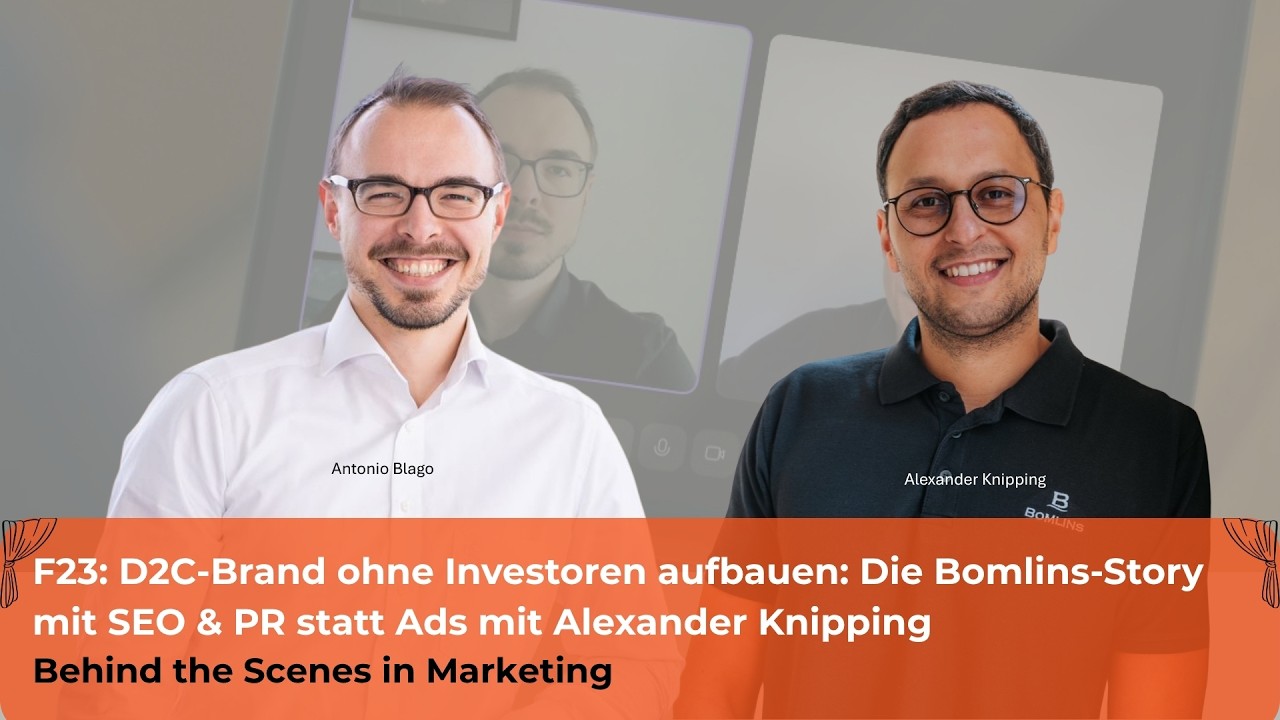
Email marketing is considered outdated by many — yet a well-thought-out email marketing strategy remains one of the most profitable channels in e-commerce. Maurice Prüßner, founder and CEO of Invisible Brands, proves this with impressive numbers: 55 million euros in campaign revenue, 22 employees, and 75% growth in a single year. In the podcast Behind the Scenes in Marketing by Antonio Blago, Maurice shares rare and candid insights into the day-to-day life of a specialized email marketing agency. This article summarizes the key insights, concrete tips, and strategic approaches from the conversation.
From Print-on-Demand Shop to Specialized Email Marketing Agency
Maurice's path into email marketing didn't begin with a grand vision — it started quite pragmatically: he ran his own e-commerce shop based on print-on-demand, which was scaled to up to half a million euros in revenue. When friends and acquaintances asked if he could handle their email marketing, he helped — and it worked.
To the podcast episode:
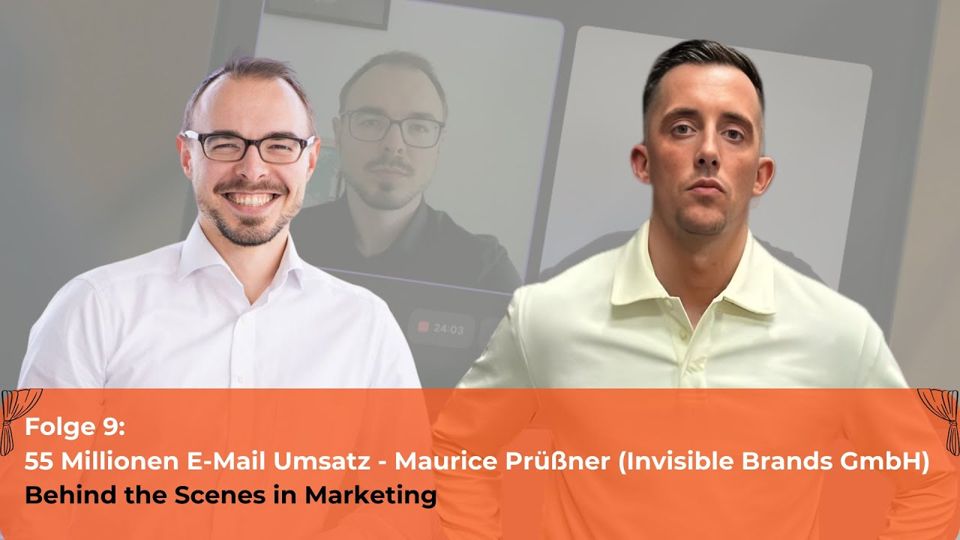
"Maybe you can turn this into a business model. Maybe you can help others with it too."
Together with his co-founder Simon, he then built the agency business from the ground up. What started as a side project is today one of the most well-known email marketing agencies in the German-speaking world: a 22-person agency based in Paderborn that manages the entire email and retention channel for e-commerce brands.
Tools, Team Structure, and Pods: How an Email Marketing Agency Operates
The Technical Stack
The agency once started with Omnisend, but today works primarily with Klaviyo — the widely used email marketing tool in the e-commerce world. In principle, the team is able to work with any provider, depending on what the client is already using.
The Pod Model: Small Teams, Big Impact
Invisible Brands doesn't work with traditional departments, but with so-called pods — small, interdisciplinary teams that operate independently. A pod typically consists of:
- an Account Manager (client communication & strategy)
- a Copywriter (copy for emails and campaigns)
- one or two Designers (visual design)
Each pod manages between 5 and 8 brands simultaneously — deliberately no more, to ensure quality and focus. In total, there are four to five such pods in the agency.
"They essentially operate independently within their own pods, working to achieve the best results for the client."
Brand Radar: where does your brand stand?
Brand and generic traffic, competitors and potential at a glance, free of charge.
The 3 Pillars of a Successful Email Marketing Strategy
According to Maurice, a strong email marketing strategy is based on three central levers that together determine the revenue generated from the email channel:
- List size: How many contacts can I actually reach?
- Flows: How well is the automated customer journey set up?
- Campaign frequency: How many campaigns are sent per month?
Frequency in particular is often underestimated. Many brands send two emails per month — yet it is a directly controllable lever for generating more revenue.
"Some might send two, but you can also send 4, 8, 16, 32, 64. That's a lever too."
The Realistic Revenue Share of Email Marketing
The often-cited benchmark is: 20 to 30% of total revenue for an e-commerce brand should come from the email channel. Maurice confirms this figure, but puts it in context with important factors:
- Product type: Supplements that are regularly repurchased achieve higher retention rates than a solid wood dining table.
- AOV (Average Order Value): With a low order value (under €50), it's easier to generate repeat purchases.
"20 to 30% — if you do it well — should be roughly the range."
If the email share falls below that, it's a clear signal: there's a large, still untapped lever here.
Email vs. WhatsApp: When Each Channel Belongs in the Strategy
A question that occupies many e-commerce entrepreneurs: when is WhatsApp worth it as an additional channel?
Maurice offers a clear recommendation that should be factored directly into any email marketing strategy:
- Under €100,000 monthly revenue: Focus exclusively on email. It is the cheapest and most beginner-friendly channel.
- From €300,000–400,000 monthly revenue: WhatsApp can be used as an additional channel for special events, launches, or promotions.
"WhatsApp costs money at the end of the day, and you can do much better through the email channel."
Segmentation: The Most Common and Costly Mistake Without an Email Marketing Strategy
Anyone sending the same email to all contacts is making an expensive mistake — and Maurice sees this regularly when taking over new accounts. Lists of 50,000 to 100,000 contacts being contacted without any segmentation are far from uncommon.
A Typical Consequence: The Discount Fail
A customer purchases a product yesterday — and today receives an email with 50% off that exact product. Customer service gets the complaint. This can be completely avoided with simple segmentation.
Useful Standard Segments to Start With
A professional email marketing strategy includes at least 10–20 basic segments, for example:
- Engaged (30 / 60 / 90 days)
- Purchased 10, 30, 60, 90 days ago
- Buyers with discount vs. without discount
- First-time buyers vs. repeat buyers
"You have a list of 50 to 100,000, and they just keep sending the same thing to everyone."
Someone who once bought at a discount responds differently to full-price offers than a loyal customer with no discount sensitivity. Knowing and leveraging these differences is at the core of professional retention marketing.
What a Newsletter Marketing Agency Discovers During an Audit
When a newsletter marketing agency like Invisible Brands takes over a new account, it regularly finds the same mistakes:
- Too few campaigns are being sent
- No or barely any segmentation in place
- Gaps in the customer journey (missing flows)
- Generic copy and generic design without brand personality
- Technical errors such as incorrect profile filters leading to duplicate messages
One frequently cited negative example: a winback flow that simply says: "We miss you!" — with no context, no incentive, no personality.
Quick-Win Improvements
- Set up a campaign calendar for the month with at least 8–12 emails
- Don't just fill pop-ups with 10% off — develop AOV-based offers (e.g., 20% off orders over €75)
- Set up a post-purchase flow that offers a complementary product 2 minutes after the purchase
- Keep the unsubscribe rate below 0.5–0.6% per email
AI in the Email Marketing Strategy: Productivity Booster with a Learning Curve
Invisible Brands has been using AI-powered tools for over a year — particularly for copywriting and visual content. Tools like Claude, Gemini, ChatGPT, and the image generation tool Nano Banana are a fixed part of the workflow.
What AI Specifically Contributes to the Email Marketing Strategy
- Faster content production: Email copy can be created significantly faster using AI as a foundation.
- More visual variety: With Nano Banana, new creatives can be produced without the brand constantly having to supply new visual assets.
- Less content dependency: Brands that rarely deliver new assets are no longer a blocker.
"At the end of the day, you don't need nearly as much content from the brand, because you can build a lot of assets with it yourself."
Resistance from Some Clients
Not all clients are immediately open to AI-generated content. Maurice addresses skepticism with a clear argument: the difference between AI and human is undetectable for 95% of recipients.
"Anyone who isn't engaging with this now will fall behind, because teams that have been working with it longer can work much faster."
Retention: The Underestimated Growth Lever of Every Email Marketing Agency
Why Existing Customers Are More Valuable Than Thought
Acquiring new customers costs money — through Meta, Google, or other paid channels. Existing customers, on the other hand, can be reactivated via email, WhatsApp, or postcards at a fraction of the cost. This is precisely where the strategic core advantage of a specialized email marketing agency lies.
"If I manage to sell to someone five times — and to someone else ten times — then the person who manages ten times can always invest more money in new customers."
Cross-Selling and Upselling as a Retention Strategy
A customer buys a hoodie. Two minutes after the purchase, they receive an automatic email with matching socks or pants — at a small discount. Maurice reports conversion rates of 10 to 30% with such post-purchase flows.
The question is always: What does someone who bought product A buy next?
"The best ecom brands launch new products every 9 to 12 weeks, because you already have the audience."
Invisible Data: When the Email Marketing Agency Builds Its Own Software
Invisible Brands has developed its own SaaS software: Invisible Data. The trigger was a classic agency pain point — reporting. Huge Excel or Google Sheets documents were laboriously filled in, but barely looked at by clients.
The solution: a lean piece of software that connects via the Klaviyo API in around 30 minutes and automatically syncs all relevant metrics. It now runs on over 100 accounts and is available to external users as a paid SaaS product — including a 14-day trial.
"The pain point was reporting. At some point, clients start asking
Visibly AI: your SEO copilot
Projects, rankings, Search Console data and a copilot that runs the analysis for you. Start for free.

About the Author: Antonio Blago
SEO Freelancer & AI Visibility Expert
I optimize SEO data-driven with Python, behavioral psychology, and my Neuro-SEO System®. On YouTube, LinkedIn, and Instagram I share hands-on tutorials, insights, and SEO strategies.