Coaching Executives: What You Learn from a Top Trainer

AI summary
- Eginhard Kieß built a successful coaching career starting from unemployment in 1997 through persistent cold calling three times weekly for five weeks to secure his first client.
- The personal training market has consolidated dramatically with supply ranging from €11 to €250 per session, forcing trainers in premium segments to rely on active acquisition rather than passive online traffic.
- The Reiss Motivation Profile measures 16 fundamental life motives without judgment, enabling executives to understand and resolve team conflicts by aligning different motivational profiles.
- At age 56, Kieß deliberately terminated six long-standing personal training clients to focus on executive coaching, demonstrating that strategic growth requires letting go of existing business.
Generated with AI, the details are in the article.
Table of contents
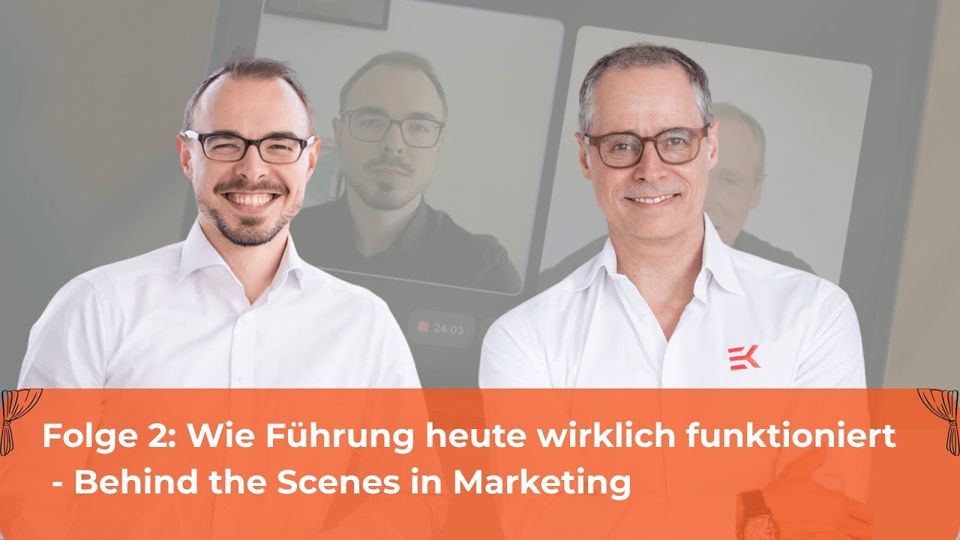
Coaching for executives is not a luxury — it is the decisive lever between mediocre and excellent leadership. Eginhard Kieß knows this from nearly three decades of experience as a personal trainer and leadership coach for successful entrepreneurs. In the second episode of Antonio Blago's podcast Behind the Scenes in Marketing, he speaks openly about his unusual journey, the transformation of the personal training market, and why the Reiss Motivation Profile is one of the most powerful tools for leadership and team dynamics.
This article summarizes the key insights — with concrete takeaways for entrepreneurs, executives, and anyone who wants to take their business or team to the next level.
To the podcast episode:
From unemployed PE teacher to sought-after leadership coach
Freelancing as a fitness trainer: An honest start without a business plan
Eginhard Kieß did not begin his career with a sophisticated business plan, but with a healthy dose of naivety — and the courage to try anyway. After studying sports in Cologne and working as a PE teacher at a rehabilitation clinic, he lost his job in the mid-1990s due to healthcare reform. An article in Stern magazine from 1996 titled "The Bodyguard Comes Home" gave him the idea to work freelance as a fitness trainer.
"I basically jumped out of bed on June 1st, 1997, said I was a personal trainer — and thought I was pretty hot stuff."
What followed was a year with no inquiries whatsoever. Not a single client. The sobering realization: a business card and a flyer are not enough to build a business.
The wake-up call that changed everything
The turning point came with his first real client — a young entrepreneur who gave him some plain words as early as the fifth training session:
"Eginhard, you have no idea what you're doing. You're far too cheap — and get off your high horse as a qualified sports teacher and learn to think like an entrepreneur."
That feedback hit home. And it was the beginning of a long entrepreneurial learning journey. Kieß used his training sessions with successful entrepreneurs not only to strengthen their bodies, but also to sharpen his own business thinking — coached for free by the very same people who were paying him for their training.
Practical tip: Anyone who is self-employed should actively seek out the company of experienced entrepreneurs — in networks, at events, or through shared activities. Honest feedback from someone who knows better is often worth more than any seminar.
Cold calling was necessary in 1998 — and it is again in 2025
Persistence as a success factor for freelance fitness trainers
Kieß did not win his first client through Instagram or Google, but through consistent cold calling by phone. For five weeks, three times a week, he called the same entrepreneur — until he finally received a callback.
"I actually called three times a week for five weeks, until I eventually got a callback."
What was born out of necessity back then is relevant again today. The market for freelance fitness trainers has changed dramatically: enormous supply, price competition from part-time trainers, stagnating purchasing power, and changed search habits among clients.
The market consolidation in personal training
Kieß describes the current state of the market without sugarcoating:
- The supply is huge — from €11 on eBay Classifieds to €250 per session
- Many trainers work part-time, thereby driving down the price level
- Economic strain in Germany is reducing the number of clients with strong purchasing power
- Many trainers respond by waiting rather than acting
"I notice many trainers are shutting themselves off. A behavior where I can only say: complete incomprehension — sitting in front of the mouse hole and hoping the storm will pass."
Takeaway for the self-employed: Anyone working in the premium segment and relying solely on passive online traffic will lose out during difficult market phases. Active, personalized acquisition is not a step backward, but a proven method that is regaining importance.
Visibly AI: your SEO copilot
Projects, rankings, Search Console data and a copilot that runs the analysis for you. Start for free.
How personal training became leadership coaching
Trust as a gateway in executive coaching
Kieß does not only train his clients physically — he is often the only person they confide their entrepreneurial concerns to. Twice a week, over many years, a foundation of trust develops that even fellow board members or spouses rarely achieve.
One telling example: a client to whom Kieß demonstrated a worrying cardiac finding via heart rate variability measurement spontaneously opened up about a massive entrepreneurial problem — the necessary dismissal of his board member.
"I can't talk to anyone about this. I can't tell people in the company that I have to let my board member go. The friend I could talk to, I see him less often than I see you. I see you twice a week."
From this trust, a second field of expertise developed over the years: leadership coaching. Not a planned pivot, but organic growth from genuine relationships.
The conscious step toward specialization
At the age of 56, Kieß made a deliberate decision: he parted ways with six long-standing personal training clients in order to create capacity for executive coaching. A difficult decision — but a strategically smart one.
Lesson for entrepreneurs: Growth sometimes means letting go of what exists. Those who do not actively manage their portfolio will be limited by their past.
Executive coaching methods: The Reiss Motivation Profile
What is the Reiss Motivation Profile?
The Reiss Motivation Profile (RMP) is one of the most effective executive coaching methods and is a scientifically developed personality instrument that measures 16 fundamental life motives. These motives describe what truly drives people — not on the surface, but at their core.
The 16 life motives include, among others:
- Power – the desire to exert influence
- Curiosity – the drive for knowledge and innovation
- Acceptance – the need for validation from others
- Independence – the desire for autonomy
- Social contact – the importance of social relationships
- Vengeance – the drive to assert oneself and compete
Crucially, there are no good or bad profiles. Every combination describes a unique individual — without judgment.
"The Reiss Profile is not about strengths and weaknesses, and it is never about evaluation. All people are good."
Why this coaching method brings lasting change to executives
Kieß describes how the Reiss Profile fundamentally changed his own communication. Not in the sense of manipulation, but through a deeper understanding of which messages resonate with which people.
"I went into conversations with potential clients in a completely different way. I developed a very different choice of words — so that my counterpart subconsciously recognized: Kieß is a match for me, or simply not."
The result: the clients who chose him after this changed communication style are still training with him today. No drop-outs, no dissatisfaction — because the motivational profiles simply align.
Increasing employee motivation: Two practical examples
Example 1: Resolving a conflict between two company owners
The initial situation
Kieß met a company owner on a motorcycle entrepreneur ride who had a simmering conflict with his co-owner. The cause: fundamentally different motivational profiles in areas such as power, vengeance, and communication.
The intervention
Kieß sat down with both owners, compared their respective Reiss Profiles, and worked out where the conflicts arose — and why.
A key tool in this process: the personal care label.
"How do you want me to wash you so your cotton sock doesn't shrink? I simply can't set the temperature to 60 degrees. How do I do that in interpersonal dealings?"
In concrete terms, this means: which forms of communication and ways of interacting enable collaboration, without any party having to permanently work against their own motives?
The outcome
Unfortunately, despite the intervention, the situation escalated years later — because one of the owners was not willing to embrace change. In the end, one owner was bought out. An expensive solution that could have been prevented earlier.
Key insight: Coaching and mediation can only resolve problems when all parties involved are willing to take responsibility.
Example 2: Increasing employee motivation in the accounting department
The problem
In a large company, three female employees in the accounting department worked together for different locations — or rather: against each other. The atmosphere was tense, and conflicts were a daily occurrence.
The analysis
Kieß created an individual Reiss Profile for each of the three women. In the joint session, it became clear: two motives were particularly revealing — curiosity and acceptance.
The youngest employee had a strongly pronounced curiosity motive. She quickly identified optimization potential and developed an innovative Excel tool. The two older colleagues — with a lower curiosity motive and years of established routine — felt bypassed and blocked the innovation.
The young employee, in turn, had a strong acceptance motive and received no recognition for her work. This led to tears, hurt feelings, and a poisoned team dynamic.
"The others had a low acceptance motive. They didn't even realize they were hurting her."
The solution
As soon as all three understood why they reacted the way they did, the dynamic shifted. The older colleague spontaneously said: "I never would have thought that you were upset because of that..." — and with that, the first real dialogue became possible.
Takeaway for team leadership: Anyone who wants to increase employee motivation must first understand what truly drives them. Conflicts often arise not from ill will, but from differing motivational profiles.
Homeoffice, Open Spa
Free initial consultation
30 minutes, your website, concrete next steps. No sales pressure.

About the Author: Antonio Blago
SEO Freelancer & AI Visibility Expert
I optimize SEO data-driven with Python, behavioral psychology, and my Neuro-SEO System®. On YouTube, LinkedIn, and Instagram I share hands-on tutorials, insights, and SEO strategies.