Pelvic Floor Training for Women: Expert Explains What Reall…

AI summary
- Carina Gerlach founded Pelveasy after experiencing pelvic floor problems postpartum, combining sports science degree with specialized Tupler Technique training.
- The Tupler Technique is an structured 18-week program using support splints, deep abdominal activation, movement adjustments, and targeted exercises with results visible in 3-6 weeks.
- From a €120 hourly rate, approximately €20 goes to VAT immediately, leaving self-employed trainers to cover taxes, operating costs, health insurance, and pension from remaining income.
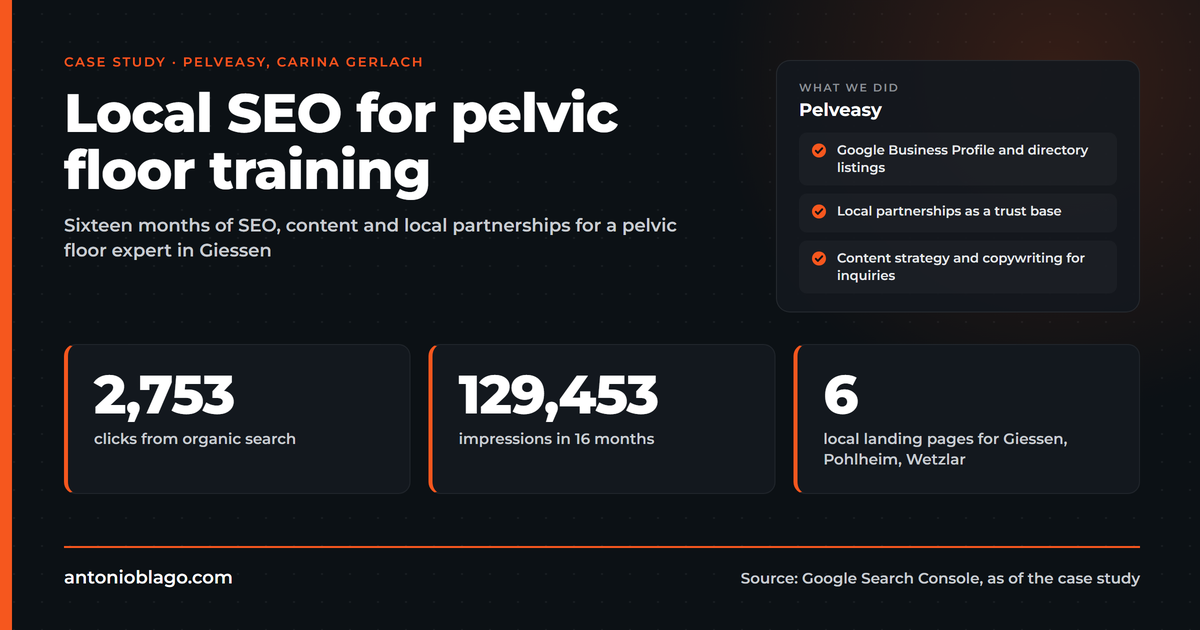
- A specialized blog post about levator avulsion injury attracted an inquiry from 1,000 kilometers away in Canary Islands, demonstrating SEO success for pelvic floor training.
Generated with AI, the details are in the article.
Table of contents
Introduction
Pelvic floor training for women is far more than a fitness trend – for many mothers, it is the key to regaining quality of life and body awareness. Carina Gerlach, founder of Pelveasy, has lived this journey herself: from her own pelvic floor problems after childbirth to becoming a specialized personal trainer for pelvic floor and diastasis recti. In the podcast "Behind the Scenes in Marketing," she speaks openly about what really works in pelvic floor training for women – and the role that SEO, targeted exercises, and smart positioning have played in that journey.
This article summarizes the key insights and shows what those affected, trainers, and self-employed professionals in the health sector can take away from it.
To the podcast episode:

The Origin: A Business Born from Personal Experience
Carina Gerlach studied sports science and worked for many years at a rehabilitation center. After the birth of her first child, she experienced firsthand how severely pelvic floor problems can affect quality of life.
"From the very beginning, this was a cause close to my heart, because I personally noticed how badly it affects you, how negatively your quality of life is impacted, when you simply have a problem with your pelvic floor."
From this personal experience came the idea to go self-employed as a pelvic floor trainer for women – not primarily for financial reasons, but out of a genuine desire to help other women. This "why" runs through her entire business and makes her brand authentic.
Takeaway for entrepreneurs: Businesses that grow from personal experience have a natural head start when it comes to trust. The personal story is not a marketing trick – it is the most powerful persuasion factor of all.
Brand Radar: where does your brand stand?
Brand and generic traffic, competitors and potential at a glance, free of charge.
Pelvic Floor Problems and Diastasis Recti: What Women Need to Know
To understand why targeted pelvic training for women is so important, it is worth looking at the most common complaints that arise after pregnancy.
Pelvic Floor Issues After Birth
During and after pregnancy, various problems can occur that pelvic floor training for women has been shown to help with:
- Stress incontinence: Urine leaks uncontrollably when coughing, sneezing, or exercising.
- Birth injuries: Perineal tears can lead to scar pain and tension.
- Muscle tension: An overly tight pelvic floor also causes pain and functional problems.
Diastasis Recti Exercises: Why the Abdominal Muscles Separate
Diastasis recti is a separation of the rectus abdominis muscles caused by the growth of the abdomen during pregnancy. The connective tissue strand between the muscle bands becomes softer and more elastic – this leads to an unstable abdominal wall, which manifests as back pain and general physical weakness.
"These rectus abdominis muscles are normally relatively close together. When the belly needs to grow during pregnancy, they move apart and the connective tissue strand becomes softer – the entire abdominal wall becomes less stable."
Targeted diastasis recti exercises help to gradually stabilize the abdominal wall and bring the muscles back together. With the right methodology, diastasis recti can generally be treated well – but it requires time, patience, and consistency.
The Tupler Technique: Structured Pelvic Floor Training for Women
Carina Gerlach has specialized, among other things, in the so-called Tupler Technique – a structured 18-week program developed specifically as pelvic floor training for women after childbirth. It is based on four pillars:
- Support splint: Holds the separated abdominal muscle bands together and supports healing.
- Activation of the deep abdominal muscle (transversus abdominis): Focus on body awareness and correct muscle activation.
- Everyday adjustments: Analysis and optimization of daily movement patterns that could hinder healing.
- Targeted diastasis recti exercises: Gradual build-up of overall core stability.
"There are no forbidden movements, but there are movements that I do 100 times a day that are not optimal for diastasis recti."
First results – less pain, greater stability – often become noticeable after three to six weeks. However, full regeneration of the connective tissue can take half a year or longer.
Parallel to SEO and marketing: Carina aptly compares this process to SEO work: those who stop after initial successes will lose their progress again. Sustainable growth – whether in the body or in online visibility – requires consistency.
Market Positioning: Why Specialized Pelvic Training for Women Wins
The market around pelvic training for women and postnatal recovery is fragmented: on one side are physiotherapists with specialized pelvic floor training, and on the other side are many course instructors without a deep professional foundation.
Carina deliberately positions herself as a specialized pelvic floor trainer for women in the gap between the two:
- Degree in sports science (5 years of study)
- Additional qualification in pelvic floor training and the Tupler Technique
- Personal experience as a credibility factor
- 1:1 personal training instead of group classes
"I would almost say I am the only one in Hesse currently offering this in this form – especially with this sports science background."
Takeaway: Broad positioning such as "I train everyone" may initially seem to offer more potential, but it leads to interchangeable offerings. Those who specialize in pelvic floor training for women are found more precisely and come across as more convincing.
Brand Building: The Story Behind Pelveasy
Carina did not develop the name of her brand alone. After intensive working sessions with a brand designer, the name Pelveasy was born:
- "Pelv" comes from pelvis (Latin for pelvis)
- "Easy" stands for lightness – the central promise to her clients
"I want my training to give women back their lightness and their joy of life."
In this way, the name conveys both the professional subject of pelvic floor training for women and the emotional message. It is memorable, clear, and target-group specific.
Takeaway for marketers: A good brand name is more than a pretty label. It pre-qualifies the target audience, creates recognition, and tells a story – without needing to explain a single word.
Pricing: What a Fair Hourly Rate Really Means
One of the most important – and often underestimated – points in the conversation is pricing. Many clients only see the gross hourly rate and wonder why pelvic floor training for women with a specialized personal trainer is "so expensive."
Carina calmly explains what actually remains from an hourly rate of, for example, €120:
- VAT (19%): approx. €20 goes directly to the tax office
- Income tax: on the remaining profit
- Operating costs: space, equipment, software, website, marketing
- Health insurance: fully self-funded as a self-employed person
- Private pension provision: no statutory pension, no employer contribution
"What many people forget: the fee doesn't stay with me 100%. If my session costs €120, 19% of that goes to the state straight away – and then I still have to cover my living expenses from what's left."
Practical pricing checklist for the self-employed:
- [ ] Record monthly fixed costs (personal + professional)
- [ ] Realistically plan for tax burden (including VAT, income tax, and trade tax if applicable)
- [ ] Factor in health insurance contributions
- [ ] Plan for pension provision reserves
- [ ] Include a marketing budget
- [ ] Calculate hourly rate based on actual working hours
The Health Insurance System: Prevention versus Surgery
A critical topic is the question of why qualified pelvic floor training for women is not reimbursed by health insurers – even though it would be less expensive in the long term than surgical interventions.
"If I reimburse a woman with diastasis recti for six months of personal training and as a result she never needs surgery – then that is economically more sensible for the system. But the insurers don't see it that way."
The system focuses on short-term acute treatments. Preventive measures that would reduce long-term healthcare costs are barely funded. For self-employed professionals in the health and fitness sector, this means: they must communicate the value of their work independently.
Organic Marketing: What Works in Pelvic Training for Women – and What Doesn't
Carina has tried various acquisition and marketing strategies. The results were mixed.
What Didn't Work: The Midwife Mailing Campaign
A targeted mailing campaign to around 60 midwives in the local area yielded only two responses. Possible reasons:
- Time pressure: Many midwives work 50–60 hours per week
- Latent competitive thinking: Fear of losing clients to personal trainers
- Lack of personal relationship: An email without prior contact carries little persuasive power
What Worked Well: Personal Networking
Direct collaboration conversations with gynecologists, pelvic floor physiotherapists, and other specialists proved to be significantly more effective. Referrals from these networks remain an important source of leads to this day.
The SEO Breakthrough: One Blog Post, One Inquiry from Spain
The most surprising success came through search engine optimization. A detailed blog post about the so-called levator avulsion – a specific pelvic floor injury – attracted an inquiry from a German woman living in the Canary Islands.
"That was the biggest aha moment. We had actually started out trying to make her more visible locally – and then someone called me from 1,000 km away
Visibly AI: your SEO copilot
Projects, rankings, Search Console data and a copilot that runs the analysis for you. Start for free.

About the Author: Antonio Blago
SEO Freelancer & AI Visibility Expert
I optimize SEO data-driven with Python, behavioral psychology, and my Neuro-SEO System®. On YouTube, LinkedIn, and Instagram I share hands-on tutorials, insights, and SEO strategies.